eBook - ePub
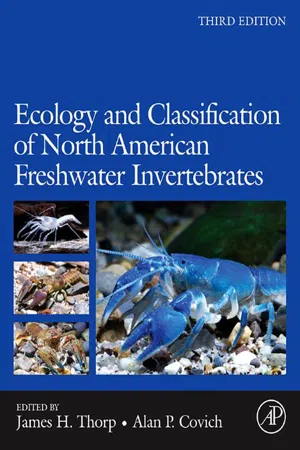
Ecology and Classification of North American Freshwater Invertebrates
- 1,021 pages
- English
- ePUB (mobile friendly)
- Available on iOS & Android
eBook - ePub
Ecology and Classification of North American Freshwater Invertebrates
About this book
The Third Edition of Ecology and Classification of North American Freshwater Invertebrates continues the tradition of in-depth coverage of the biology, ecology, phylogeny, and identification of freshwater invertebrates from the USA and Canada. This edition is in color for the first time and includes greatly expanded classification of many phyla.
- Contains extensive and detailed classification keys for identification of diverse freshwater invertebrates.
- Many drawings and color photographs of freshwater invertebrates.
- Single source for a broad coverage of the anatomy, physiology, ecology, and phylogeny of all major groups of invertebrates in inland waters of North America, north of Mexico.
Information
Chapter 1
Introduction to Invertebrates of Inland Waters
James H. Thorp, Kansas Biological Survey and Department of Ecology and Evolutionary Biology, University of Kansas, Lawrence, Kansas
Alan P. Covich, Institute of Ecology, Odum School of Ecology, University of Georgia, Athens, Georgia
Walter W. Dimmick, Kansas Biological Survey, and Department of Ecology and Evolutionary Biology, University of Kansas, Larence, Kansas
I. Introduction
At some point in almost every biologist’s life, an invertebrate stimulated their curiosity. It might have started when they peered through a microscope at pond water and saw a protozoan, hydra, rotifer, or some other creature. Or perhaps they watched a butterfly or bee pollinating a flower, a rolly-polly pill bug curled in a ball within their palm, ants marching rapidly past while carrying heavy loads, waving anemones within a tide pool, or a crayfish scurrying from under a stream rock. For many authors contributing to this book, this childhood fascination led progressively, if not inevitably, to a life-long career in science.
Aquatic scientists focusing on invertebrates conduct research in a wide diversity of fields. Some are fascinated by invertebrate variety and the relationships among species over evolutionary history, or they may be involved in conducting environmental assessments where knowledge of invertebrate identification is typically essential. Others seek to control human diseases by understanding and controlling invertebrate vectors of water-borne diseases, or perhaps they study the population biology or culturing of invertebrates involved in the food chains from which we derive many items, including freshwater crayfish and the zooplankton prey of trout and largemouth bass. Many more investigate the ecology of invertebrates to satisfy their scientific curiosity or to help abate environmental crises facing the natural and human world from future global climate change to more immediate and local environmental perturbations.
Next to their more colorful, and often larger, marine relatives, freshwater invertebrates may initially seem drab and uninspiring. Yet once the curious observer penetrates beyond superficial appearances and thoroughly examines the diverse structural, physiological, behavioral, and general ecological adaptations of freshwater invertebrates, few fail to be impressed by these fascinating animals. In this book, students and professionals alike will be exposed to new aspects of the biology, ecology, and classification of freshwater and other inland aquatic invertebrates. The authors of this book have reviewed the recent literature and drawn together some of the most important highlights associated with these diverse organisms. In this edition, we have also included new images and color plates to illustrate the diversity of forms and function.
This chapter, in particular, serves as a very brief introduction to freshwater invertebrates of Canada and the United States. Following a short discussion of procedures for naming and classifying organisms, we briefly describe the taxonomic groups covered in Chapters 3–22. We also include a taxonomic key to help the reader begin the process of classifying freshwater invertebrates. This dichotomous key will lead to the appropriate chapter for more detailed biological and taxonomic information. Additional information on freshwater invertebrates can be found in various texts on both invertebrate zoology[2,9,14,18] and aquatic ecology[1,22].
II. Species and Phylogenies
The identification of natural units is one of the major guiding principles for biologists that endeavor to study, discover, and document the world’s biodiversity. A natural unit of biodiversity is defined here as a unit that results from evolution. Examples of natural units of biodiversity are populations, species, and monophyletic groups of species. Natural units that are given a formal name (e.g., species) are called natural taxa. In contrast, subspecies is an example of a taxonomic unit that is often not a natural unit but rather a convenient partition of geographic variation. Because the number of animal species is enormous and the number of biologists studying them is minuscule in comparison, it is not surprising that our poor understanding of many genera, tribes, and families would frequently result in groups that are not natural taxa.
The principal intellectual tools needed to discover natural taxa have emerged from the disciplines of systematic biology and population genetics. Species concepts and methods for constructing and evaluating phylogenetic trees are central to systematic biology. The discipline of population genetics is important because it permits direct study of the degree of connectivity between populations. Studies of molecular variation enable us to discover the existence of species that are undetectable when we restrict our data to morphological characters. This has resulted in the recognition of multiple species that were formerly thought to be a single wide-ranging species.
Many biologists disagree about the best species concept and which methods of phylogenetic construction are most reliable. While this may seem to be an inconvenient situation for a new student or a researcher who is primarily interested in ecological or behavioral studies, an informed viewpoint about species concepts and phylogenetics is prerequisite for any serious student of freshwater invertebrates. Because of the extensive loss of habitat due to anthropogenic disturbances and the impending wide-scale ecological disruptions from global climate change, extinction is likely for an enormous number of species. Freshwater species could be at the leading edge of the forthcoming storm of extinction, and thus it is more important than ever to underpin ecological studies with a robust understanding of the natural units of biodiversity which we label, or sometimes mislabel, with taxonomic names. The following two sections present a brief introduction to some of the important implications of using different species concepts and the critical importance of phylogenetic trees.
A. Species and Concepts of Species
Students of invertebrate zoology are occasionally confronted with the daunting prospect of identifying specimens to the level of species. Unfortunately, the intellectual basis for taxonomic decisions at the species level is sometimes questionable. Freshwater invertebrates are an interesting and difficult group of organisms because of their great biological diversity and a dearth of genetic studies of wide-ranging species. Informed decisions about the validity of a species requires an understanding of which species concept was used to label the group of organisms collected at a particular place and time.
Species are the result of historical natural processes[6]. Anagenesis is the modification of lineages through mutation, gene flow, natural selection, and random genetic drift. Speciation is the creation of a new lineage by splitting a preexisting lineage or the result of hybridization between two preexisting lineages. Clearly, evolution is a phenomenon of lineages, and these lineages are called species by evolutionary biologists. Therefore, the first logical step to understanding current and past biodiversity is the identification of species and other natural units that result from evolution[12].
Because species are the products of evolution, their importance as units of biodiversity is paramount. Scientists often need to identify units of biodiversity below the species level, but ultimately definitions of these units must be cast in the light of an appropriate species concept because species serve as the ultimate frame of reference for studies of population variation. Species concepts play a critical role in the interpretation of intraspecific variation because species as natural taxa provide an upper boundary for comparisons among different populations. Whether a particular population or group of populations is distinctive enough to be recognized as a species has been a key issue in many taxonomic and conservation disputes. An understanding of what species are and how they can be identified is required to interpret studies of intraspecific variation and formulate biologically meaningful policies for identifying natural units of biodiversity.
The scientific literature about the nature of species and the best method of identifying species is enormous and contentious. Perhaps, the large quantity and legitimate controversies can even be considered a barrier to understanding for students, professional biologists, and policymakers. As an intellectual framework for understanding and organizing the many different concepts of species, it is useful to consider that they almost always fall into one of two different categories: operational species concepts or ontological species concepts. Operational species concepts provide a researcher with specific criteria, that is, an algorithm to implement in order to determine whether or not two different populations belong to the same species. The biological species concept of Mayr[13] is a classic example of an operational species concept. The operation used by Mayr’s biological species concept is the discovery of barri...
Table of contents
- Cover image
- Title page
- Table of Contents
- Front-matter
- Copyright
- Dedications from the Editors
- Contributors
- Preface
- Chapter 1. Introduction to Invertebrates of Inland Waters
- Chapter 2. An Overview of Inland Aquatic Habitats
- Chapter 3. Protozoa
- Chapter 4. Porifera
- Chapter 5. Cnidaria
- Chapter 6. Flatworms: Turbellarians and Nemertea
- Chapter 7. Gastrotricha
- Chapter 8. Rotifera
- Chapter 9. Nematoda and Nematomorpha
- Chapter 10. Mollusca: Gastropoda
- Chapter 11. Mollusca: Bivalvia
- Chapter 12. Annelida (Clitellata): Oligochaeta, Branchiobdellida, Hirudinida, and Acanthobdellida
- Chapter 13. Bryozoans
- Chapter 14. Tardigrada
- Chapter 15. Water Mites (Hydrachnidiae) and Other Arachnids
- Chapter 16. Diversity and Classification of Insects and Collembola
- Chapter 17. Aquatic Insect Ecology
- Chapter 18. Introduction to the Subphylum Crustacea
- Chapter 19. Ostracoda
- Chapter 20. Cladocera and Other Branchiopoda
- Chapter 21. Copepoda
- Chapter 22. Decapoda
- Glossary
- Subject Index
- Taxonomic Index
- Literature Citations
Trusted by 375,005 students
Access to over 1.5 million titles for a fair monthly price.
Study more efficiently using our study tools.
Frequently asked questions
Yes, you can cancel anytime from the Subscription tab in your account settings on the Perlego website. Your subscription will stay active until the end of your current billing period. Learn how to cancel your subscription
No, books cannot be downloaded as external files, such as PDFs, for use outside of Perlego. However, you can download books within the Perlego app for offline reading on mobile or tablet. Learn how to download books offline
Perlego offers two plans: Essential and Complete
- Essential is ideal for learners and professionals who enjoy exploring a wide range of subjects. Access the Essential Library with 800,000+ trusted titles and best-sellers across business, personal growth, and the humanities. Includes unlimited reading time and Standard Read Aloud voice.
- Complete: Perfect for advanced learners and researchers needing full, unrestricted access. Unlock 1.5M+ books across hundreds of subjects, including academic and specialized titles. The Complete Plan also includes advanced features like Premium Read Aloud and Research Assistant.
We are an online textbook subscription service, where you can get access to an entire online library for less than the price of a single book per month. With over 1.5 million books across 990+ topics, we’ve got you covered! Learn about our mission
Look out for the read-aloud symbol on your next book to see if you can listen to it. The read-aloud tool reads text aloud for you, highlighting the text as it is being read. You can pause it, speed it up and slow it down. Learn more about Read Aloud
Yes! You can use the Perlego app on both iOS and Android devices to read anytime, anywhere — even offline. Perfect for commutes or when you’re on the go.
Please note we cannot support devices running on iOS 13 and Android 7 or earlier. Learn more about using the app
Please note we cannot support devices running on iOS 13 and Android 7 or earlier. Learn more about using the app
Yes, you can access Ecology and Classification of North American Freshwater Invertebrates by James H. Thorp,Alan P. Covich in PDF and/or ePUB format, as well as other popular books in Biological Sciences & Marine Biology. We have over 1.5 million books available in our catalogue for you to explore.