eBook - ePub
Essentials of Coordination Chemistry
A Simplified Approach with 3D Visuals
- 282 pages
- English
- ePUB (mobile friendly)
- Available on iOS & Android
eBook - ePub
About this book
Essentials of Coordination Chemistry: A Simplified Approach with 3D Visuals provides an accessible overview of this key, foundational topic in inorganic chemistry. Thoroughly illustrated within the book and supplemented by online 3D images and videos in full color, this valuable resource covers basic fundamentals before exploring more advanced topics of interest.
The work begins with an introduction to the structure, properties, and syntheses of ligands with metal centers, before discussing the variety of isomerism exhibited by coordination compounds, such as structural, geometrical and optical isomerism. As thermodynamics and kinetics provide a gateway to synthesis and reactivity of coordination compounds, the book then describes the determination of stability constants and composition of complexes. Building upon those principles, the resource then explains a wide variety of nucleophilic substitution reactions exhibited by both octahedral and square planar complexes. Finally, the book discusses metal carbonyls and nitrosyls, special classes of compounds that can stabilize zero or even negative formal oxidation states of metal ions. Highlighting preparations, properties, and structures, the text explores the unique type of Metal-Ligand bonding which enable many interesting applications of these compounds.
Thoughtfully organized for academic use, Essentials of Coordination Chemistry: A Simplified Approach with 3D Visuals encourages interactive learning. Advanced undergraduate and graduate students, as well as researchers requiring a full overview and visual understanding of coordination chemistry, will find this book invaluable.
- Includes valuable visual content through 3D images and videos in full color, available online
- Provides a valuable introduction to the study of organic and inorganic ligands with metal centers
- Discusses advanced topics including metal carbonyls and nitrosyls
Information
Chapter 1
Basic Coordination Chemistry
Abstract
This chapter serves as a reviser for the advanced learner of coordination chemistry. Attempts have been made to review the evolution of the coordination chemistry along with a brief introduction of the established principles of coordination chemistry. The chapter includes systematic naming of the metal complexes, relationships between coordination numbers and geometry and various theories of bonding in complexes and magnetic behaviour. Catalytic applications of certain transition metal complexes are also briefly discussed.
Keywords
Chelate; Complex; Grubb's catalyst; Ligand; Ligand field theory; Magnetism; Spectrochemical series; Suzuki reaction1. Introduction
The coordination compounds found their applications long before the establishment of coordination chemistry. Bright red coloured alizarin dyes were under applications even before the fifteenth century. This bright red dye, now characterized as a chelated complex of hydroxyanthraquinone with calcium and aluminium metal ions, is shown in Figure 1.
Later, in the sixteenth century, the formation of a well-known member of today's coordination chemistry family, the tetraamminecupric ion [Cu(NH3)4]+2, was recorded upon contact between brass alloy and ammonium chloride. Addition of Prussian blue Fe4[Fe(CN)6]3·xH2O increased the use of coordination compounds in dyes and pigments. A platinum complex K2[PtCl6] offered an application for the refinement of platinum metal. Thus, before the coordination chemistry was structured, the coordination compounds, complexes and chelates found their applications.
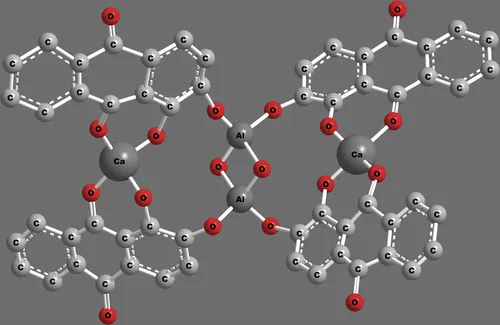
Figure 1 Structure of alizarin dye.
A systematic investigation of structure and bonding in coordination chemistry began with the inquisitiveness of Tassaert (1798), which was extended by distinguished chemists like Wilhelm Blomstrand, Jorgensen and Alfred Werner [1] until the end of the nineteenth century. In the events, Werner's coordination theory (1893) became the base of the modern coordination chemistry. It is worth noting that t...
Table of contents
- Cover image
- Title page
- Table of Contents
- Copyright
- Dedication
- Preface
- Acknowledgements
- Chapter 1. Basic Coordination Chemistry
- Chapter 2. Basic Concepts of Symmetry and Group Theory
- Chapter 3. Isomerism in Coordination Complexes
- Chapter 4. Thermodynamics and Kinetics of Complex Formation
- Chapter 5. Reactions in Octahedral Complexes
- Chapter 6. Reactions in Square Planar Complexes
- Chapter 7. Basic Organometallic Chemistry
- Chapter 8. Metal Carbonyls
- Chapter 9. Metal Nitrosyls
- Index
Trusted by 375,005 students
Access to over 1.5 million titles for a fair monthly price.
Study more efficiently using our study tools.
Frequently asked questions
Yes, you can cancel anytime from the Subscription tab in your account settings on the Perlego website. Your subscription will stay active until the end of your current billing period. Learn how to cancel your subscription
No, books cannot be downloaded as external files, such as PDFs, for use outside of Perlego. However, you can download books within the Perlego app for offline reading on mobile or tablet. Learn how to download books offline
Perlego offers two plans: Essential and Complete
- Essential is ideal for learners and professionals who enjoy exploring a wide range of subjects. Access the Essential Library with 800,000+ trusted titles and best-sellers across business, personal growth, and the humanities. Includes unlimited reading time and Standard Read Aloud voice.
- Complete: Perfect for advanced learners and researchers needing full, unrestricted access. Unlock 1.5M+ books across hundreds of subjects, including academic and specialized titles. The Complete Plan also includes advanced features like Premium Read Aloud and Research Assistant.
We are an online textbook subscription service, where you can get access to an entire online library for less than the price of a single book per month. With over 1.5 million books across 990+ topics, we’ve got you covered! Learn about our mission
Look out for the read-aloud symbol on your next book to see if you can listen to it. The read-aloud tool reads text aloud for you, highlighting the text as it is being read. You can pause it, speed it up and slow it down. Learn more about Read Aloud
Yes! You can use the Perlego app on both iOS and Android devices to read anytime, anywhere — even offline. Perfect for commutes or when you’re on the go.
Please note we cannot support devices running on iOS 13 and Android 7 or earlier. Learn more about using the app
Please note we cannot support devices running on iOS 13 and Android 7 or earlier. Learn more about using the app
Yes, you can access Essentials of Coordination Chemistry by Vasishta Bhatt in PDF and/or ePUB format, as well as other popular books in Technology & Engineering & Chemistry. We have over 1.5 million books available in our catalogue for you to explore.