- 360 pages
- English
- ePUB (mobile friendly)
- Available on iOS & Android
eBook - ePub
Shape Memory Polymers and Textiles
About this book
Shape memory polymers (SMPs) are smart materials that, as a result of an external stimulus such as temperature, can change from a temporary deformed shape back to an original shape. SMPs are finding an increasing use in such areas as clothing where they respond dynamically to changes in heat and moisture levels, ensuring greater comfort for the wearer. Shape memory polymers and textiles provides an authoritative and comprehensive review of these important new materials and their applications.After an introductory chapter on the concept and definition of shape memory materials, the book reviews methods for synthesising, characterising and modelling SMPs. It goes on to consider the properties of particular materials such as shape memory polyurethane and environmentally-sensitive polymer gels. The book concludes by assessing potential applications such as wrinkle-free fabrics and smart fabrics providing improved protection and comfort for the wearer.Shape memory polymers and textiles is a valuable guide to R&D staff in such areas as textile apparel in developing a new generation of smart textiles and other products.
- Reviews the structure, synthesis and preparation of shape memory polymers
- Assesses methods for analysing and modelling shape memory properties
- An authoritative overview of particular fibres such as shape memory polyurethane (SMPU)
Information
1
Introduction
Publisher Summary
This chapter presents a review of key concepts associated with shape memory material. Shape memory materials belong to a class of very smart materials that have the ability to remember their original shape. They are stimuli-responsive materials. Therefore, a temperature-sensitive shape memory material is one that undergoes a structural change at a certain temperature called the transition temperature. A change in shape caused by a change in temperature is called a thermally induced shape memory effect. The chapter reviews the kinds of materials that demonstrate a shape memory effect, with the focus on the structure and physical properties of thermally sensitive Shape Memory Polymers (SMPs). It also discusses their applications in textiles, medicine, and other areas and then examines their potentials based on current research progress. Shape memory materials are a promising class of materials useful for many industrial applications. The study of these materials has now been in progress for a long time. Much work has been done to exploit the potential of these materials, especially for biomedical applications. The use of Shape Memory Alloys (SMAs) is also promising in automotive, chemical-sensor, construction, electronics, and metal-forming applications, as well as in medical applications, such as prostheses, tissue connectors, and endovascular stents.
This chapter is intended to serve as a brief review of key concepts associated with shape memory material. We shall first review the kinds of materials that demonstrate a shape memory effect, with the focus being on the structure and physical properties of thermally sensitive shape memory polymers. We then discuss their applications in textiles, medicine, and other areas, following which their potentials based on current research progress is reviewed.
1.1 Concepts associated with shape memory materials
1.1.1 A concept of shape memory material as smart material
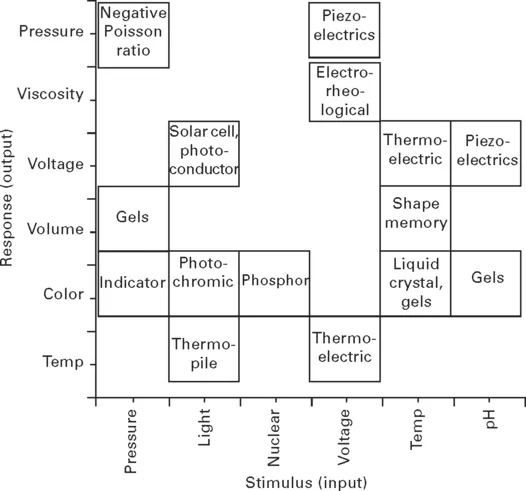
Materials scientists predict that intelligent materials will play a prominent role in the near future.1 Materials that respond dynamically to environmental stimuli can be called intelligent or smart materials.1–4 They have significant potential applications in various fields. As a result, research on such materials is actively growing both in academic and industrial sectors. Although the term ‘smart material’ has been conventionally used, all materials are in general responsive (and in this sense smart) but whether they are responsive in an adaptive way is questionable. A ‘very smart’ adaptive response is exhibited if materials/material systems are able to respond dynamically to a number of input stimuli and if this response is repeatable. For example, a simple pressure transducer that produces a voltage dependent upon the input pressure in a direct one-to-one fashion could be regarded as ‘smart’ in a basic or simple way. However, a pressure transmitter incorporating a thermocouple that measures both temperature and pressure and corrects the pressure in response to the sensor’s temperature coefficient could be regarded as ‘very smart’. Figure 1.1 summarizes the responses of different transducer materials to different stimuli (input/output characteristics).
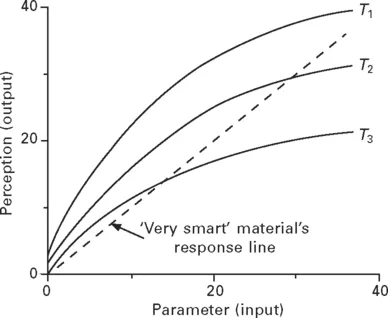
However, according to the general definition of a smart material, the material must also respond to more than one variable. This is shown conceptually in Fig. 1.2. If the material can be engineered to exhibit a particular response due to a sum of inputs, then it fulfills the definition of being ‘very smart’. The term ‘very smart’ also refers to materials that can (1) respond reversibly to the changes in the surrounding environment and (2) contribute an optimal or useful response by either changing its physical properties, geometry, mechanical properties, or electromagnetic properties. The physical change is usually a significant one which can easily be observed and detected. These very smart materials have been much studied in recent years because of their ability to change their physical properties usefully when they are triggered by environmental stimuli.5 The underlying concept of very smart materials is that they have their own way of sensing an external stimulus, which results in them changing their properties. In all cases, very smart materials are expected to provide a reversible and useful response to change in the adapted environment.6
Shape memory materials belong to a class of very smart materials, that have the ability to remember their original shape. The materials deform into a temporary shape and returns to its original shape by external environmental stimuli such as chemicals, temperature, or pH. Shape memory materials are stimuli-responsive materials. Therefore, a temperature-sensitive shape memory material is one that undergoes a structural change at a certain temperature called the transition temperature. A change in shape caused by a change in temperature is called a thermally induced shape memory effect.
Temperature-responsive shape memory materials can be easily and permanently deformed and upon heating return to their original structure. Once a sufficient stress is applied to the material, the material will undergo a large deformation that appears very similar to elastic deformation. However, on releasing the applied stress the material may return to its original shape with no permanent deformation. If the temperature of the surroundings does not reach the transition temperature of a shape memory material, the shape memory effect is not observed.
The shape memory effect was first observed in samples of gold–cadmium in 1932 and 1951, and in brass (copper–zinc) in 1938. It was not until 1962, however, that William J. Buehler and co-workers at the U.S. Naval Ordnance Laboratory (NOL) discovered that nickel–titanium showed this shape memory effect.7 Besides these shape memory alloys (SMAs), there are several classes of shape memory materials such as polymers,8 ceramics9 and gels10 that also show thermo–responsive shape memory properties. Among these, SMAs and shape memory polymers (SMPs) are most widely used, sometimes in combination, because of their properties.
1.1.2 Shape memory alloys
SMAs are metals that exhibit two unique properties. The first is the shape memory effect characterized by the capability of a material to be deformed at a low temperature and then to revert to its prior shape upon heating above a temperature associated with the particular alloy. The second is superplasticity, which is the ability of a material to exhibit large recoverable strains (up to approximately 15%), while deformed within a range of temperature characteristic of a specific alloy. Arne Olander first discovered these peculiar properties in 1938, but no significant research progress was made until the 1960s.11
This special class of metals is made from two or more elements exhibiting hardness and elasticity properties that change radically at particular temperatures. After alloying and mechanical processing, SMAs can be deformed into a given shape, and then be thermally set to that shape by heat treatment. When the SMAs are cooled, they can be bent, stretched, or deformed. They can recover some or all of the deformation following some moderate heating. For most SMAs, a temperature difference of only about 10 °C is required to trigger the shape change. The two phases present in shape memory alloys are called martensite and austenite. The former phase exists at lower temperatures and is the relatively soft and easily deformed phase of SMAs. The molecular structure of this phase is illustrated in Fig. 1.3. The deformed martensite phase is shown in Fig. 1.3 on the left. Austenite is a stronger phase of SMAs which occurs at higher temperatures. The shape of the austenite structure is cubic as shown on the top of Fig. 1.3. The undeformed martensite phase is represented by the same size and shape as the cubic austenite phase at a macroscopic level, so that no observable change in size or shape in shape memory alloys occurs until the martensite i...
Table of contents
- Cover image
- Title page
- Table of Contents
- The Textile Institute and Woodhead Publishing
- Copyright
- Preface
- Acknowledgements
- Chapter 1: Introduction
- Chapter 2: Preparation of shape memory polymers
- Chapter 3: Characterization techniques for shape memory polymers
- Chapter 4: Structure and properties of shape memory polyurethane ionomer
- Chapter 5: Water vapor permeability of shape memory polyurethane
- Chapter 6: Characterization of shape memory properties in polymers
- Chapter 7: Structure modeling of shape memory polymers
- Chapter 8: Environmentally sensitive polymer gel and its application in the textiles field
- Chapter 9: Evaluation of shape memory fabrics
- Chapter 10: Shape memory textiles
- Index
Trusted by 375,005 students
Access to over 1.5 million titles for a fair monthly price.
Study more efficiently using our study tools.
Frequently asked questions
Yes, you can cancel anytime from the Subscription tab in your account settings on the Perlego website. Your subscription will stay active until the end of your current billing period. Learn how to cancel your subscription
No, books cannot be downloaded as external files, such as PDFs, for use outside of Perlego. However, you can download books within the Perlego app for offline reading on mobile or tablet. Learn how to download books offline
Perlego offers two plans: Essential and Complete
- Essential is ideal for learners and professionals who enjoy exploring a wide range of subjects. Access the Essential Library with 800,000+ trusted titles and best-sellers across business, personal growth, and the humanities. Includes unlimited reading time and Standard Read Aloud voice.
- Complete: Perfect for advanced learners and researchers needing full, unrestricted access. Unlock 1.5M+ books across hundreds of subjects, including academic and specialized titles. The Complete Plan also includes advanced features like Premium Read Aloud and Research Assistant.
We are an online textbook subscription service, where you can get access to an entire online library for less than the price of a single book per month. With over 1.5 million books across 990+ topics, we’ve got you covered! Learn about our mission
Look out for the read-aloud symbol on your next book to see if you can listen to it. The read-aloud tool reads text aloud for you, highlighting the text as it is being read. You can pause it, speed it up and slow it down. Learn more about Read Aloud
Yes! You can use the Perlego app on both iOS and Android devices to read anytime, anywhere — even offline. Perfect for commutes or when you’re on the go.
Please note we cannot support devices running on iOS 13 and Android 7 or earlier. Learn more about using the app
Please note we cannot support devices running on iOS 13 and Android 7 or earlier. Learn more about using the app
Yes, you can access Shape Memory Polymers and Textiles by Jinlian Hu in PDF and/or ePUB format, as well as other popular books in Technology & Engineering & Materials Science. We have over 1.5 million books available in our catalogue for you to explore.