eBook - ePub
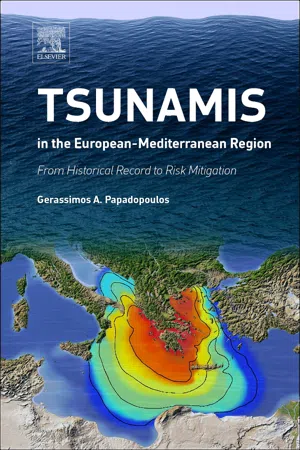
Tsunamis in the European-Mediterranean Region
From Historical Record to Risk Mitigation
- 290 pages
- English
- ePUB (mobile friendly)
- Available on iOS & Android
eBook - ePub
Tsunamis in the European-Mediterranean Region
From Historical Record to Risk Mitigation
About this book
Tsunamis in the European-Mediterranean Region: From Historical Record to Risk Mitigation provides readers with a much needed, reliable, and up-to-date history of the region, including descriptions and parameters of the main events from pre-history to the present that are supported by parametric catalogues, pictorial material, and examples of instrumental records, such as tide-gauge records.
The book presents a broader perspective of needed action for local and national governments, and international organizations, and is written by an internationally recognized expert in this field, providing an authoritative account of historical tsunamis in the eastern Mediterranean.
It addresses key points of tsunami mitigation, including the systems currently available for tsunami recording, monitoring, and early warning, along with a presentation of the preventative measures that can be applied in all tsunami-vulnerable regions.
- Details the systems currently available for tsunami recording, monitoring, and early warning, and the technologies that support them
- Contains numerical modeling techniques used for the generation, propagation, and inundation of tsunamis
- Presents clear examples of tsunamis in the region and their documentation, as well as comparisons with other regions globally
- Includes full-color illustrations that accompany the text
Information
Chapter 1
Tsunamis in the Global Ocean
Abstract
Tsunami waves are generated by several phenomena that cause sudden, large-scale disturbances of the sea level. The most frequent generation mechanisms of tsunamis are earthquake activity, volcanic eruptions, and landslide processes in submarine and coastal environments. Tsunamis hit not only the Pacific and Indian oceans but also all parts of the global ocean including the European and Mediterranean regions, as is documented in geological and historical documents and instrumental records. The physical properties of tsunamis are quite complex due not only to the complexity of their source mechanisms but also due to propagation features such as frequency dispersion and amplitude dispersion. No adequate tsunami magnitude scales exist at present, and therefore quantification of the tsunami size is a difficult issue, with tsunami intensity being a proxy of tsunami size for the time being. The lessons learned from the devastating large tsunamis of 2004 in the Indian Ocean and of 2011 in North East Japan have significantly affected the development of the tsunami studies and risk mitigation actions in global scale. The issue of early tsunami warning today is a rapidly developing, hot topic in which fields such as science, technology, emergency planning, awareness, education, and crisis management all contribute in synergy to protect coastal communities.
Keywords
tsunamis in global ocean
tsunami documentation
sources
generation mechanisms
physical properties
quantification
Indian Ocean 2004
Japan 2011
early warning
1.1. Tsunamis and Megatsunamis
According to the definition of Van Dorn (1968), tsunami is the Japanese name for the gravity wave system formed in the sea following any large-scale, short-duration disturbance of the free surface. The occurrence of tsunami events has been reported in all parts of the global ocean. The documentation of tsunami events that occurred in the preinstrumental period depends on the availability of a variety of records based on geological and archaeological observations and on historical documentary sources. For this reason the tsunami reporting period varies from one side of the global ocean to the other. For example, in Greece and other coastal sites of the east Mediterranean basin one may find the oldest historical tsunami documentation thanks to the availability of relevant historical sources and archaeological observations (Papadopoulos et al., 2014a).
Modern tsunamis are mainly instrumentally documented, which today includes records in tide gauges at the shorelines and in pressure tsunameters on the sea floor. In the last two decades or so efforts have been made toward detecting tsunamis propagating in the open ocean by satellite altimetry methods (see a review in Levin and Nosov, 2009). Of particular value are field data and eyewitnesses accounts collected during post-event field surveys as well as pictures and videos taken in coastal spots hit by tsunamis. In the last 20 years or so several large, disastrous tsunamis occurred in both the Pacific and Indian Oceans. Two of them, the 2004 Sumatra tsunami and the 2011 Japan tsunami, were among the largest ever reported globally, not only because of the physical dimension of their size but also due to their highly catastrophic consequences. In fact, they were ocean-wide tsunamis propagating across the Indian Ocean first and the Pacific Ocean second, while in both cases the measured maximum wave runup exceeded 30 m.
Such very large tsunamis are termed “megatsunamis”, although no standard definition has been given to define them (Goff et al., 2014). One may recognize that the historical record contains many examples of similar basin-wide tsunami waves associated with high run-up, such as the Chile seismic tsunami of May 22, 1960 in the Pacific Ocean and the Krakatoa volcanic tsunami of August 27, 1883 in the Indian Ocean. Table 1.1 lists some of the most significant tsunamis in the Pacific and Indian oceans during the last 150 years or so. However, analogous historical cases can be found in the European and Mediterranean region as well. For example, it is widely accepted that the concept of megatsunami could apply to the seismic tsunamis of AD July 21, 365 and August 8, 1303 in Crete Island (Hellenic Arc) and of November 1, 1755 in South West Iberia, Atlantic Ocean. One may not exclude the large tsunami, which is documented by geological and archaeological evidence to have occurred around the end of the seventeenth century BC after the colossal Plinian-type eruption of the volcano of Thera (Santorini) in the South Aegean Sea. Figure 1.1 shows a global map of known tsunami sources from the antiquity until the present day.
Table 1.1
List of some significant tsunamis reported worldwide in the last 150 years or so
| Date | Source area | Generation mechanism | Hmax (m) | Distant areas affected |
| August 13, 1868 | Arica (Chile) | EQ | 21.0 | Peru, Japan, Hawaii, New Zealand, Australia, Fiji, USA |
| May 10, 1877 | Arica (Chile) | EQ | 24.0 | Peru, California, Hawaii, New Zealand, Australia |
| August 27, 1883 | Krakatau Volcano (Indonesia) | VE | 35.0 | All around Indian Ocean |
| August 15, 1918 | Celebes Sea | EQ | 12.0 | Indonesia, Philippines |
| September 7, 1918 | S. Kuril Islands | EQ | 12.0 | Japan, Hawaii |
| November 11, 1922 | Atacama (Chile) | EQ | 12.0 | Colombia, Hawaii, Japan, Samoa, New Zealand |
| March 2, 1933 | Sanriku (NE Japan) | EQ | 29.0 | Hawaii |
| April 1, 1946 | Unimak Island (Alaska) | 35.0 | Hawaii, Peru, California, Samoa, Chile | |
| November 4, 1952 | Kamchatka Peninsula | EQ | 20.0 | Hawaii, Sanriku (Japan) |
| March 9, 1957 | Aleutian Islands | EQ | 16.2 | Hokkaido (Japan), Hawaii, California, El Salvador |
| May 22, 1960 | S. Chile | EQ | 25.0 | South-Central-North America, Hawaii, Japan, Marquesas Islands, Samoa, Kuril Islands, Taiwan, Fiji, New Zealand, Australia |
| March 28, 1964 | Al... |
Table of contents
- Cover
- Title page
- Table of Contents
- Copyright
- Dedication
- Preface
- Acknowledgments
- Introduction
- Chapter 1: Tsunamis in the Global Ocean
- Chapter 2: Historical and Geological Evidence of Tsunamis in Europe and the Mediterranean
- Chapter 3: Impact of Tsunamis
- Chapter 4: Tsunamigenic Sources and Generation Mechanisms
- Chapter 5: What Do We Learn for the Source Characterization from Numerical Modeling?
- Chapter 6: Hazard, Vulnerability, and Risk Assessment
- Chapter 7: Tsunami Early Warning Systems and Risk Mitigation
- Appendix: Strong Tsunamis Historically Known in the Mediterranean and Connected Seas
- References
- Subject Index
Trusted by 375,005 students
Access to over 1.5 million titles for a fair monthly price.
Study more efficiently using our study tools.
Frequently asked questions
Yes, you can cancel anytime from the Subscription tab in your account settings on the Perlego website. Your subscription will stay active until the end of your current billing period. Learn how to cancel your subscription
No, books cannot be downloaded as external files, such as PDFs, for use outside of Perlego. However, you can download books within the Perlego app for offline reading on mobile or tablet. Learn how to download books offline
Perlego offers two plans: Essential and Complete
- Essential is ideal for learners and professionals who enjoy exploring a wide range of subjects. Access the Essential Library with 800,000+ trusted titles and best-sellers across business, personal growth, and the humanities. Includes unlimited reading time and Standard Read Aloud voice.
- Complete: Perfect for advanced learners and researchers needing full, unrestricted access. Unlock 1.5M+ books across hundreds of subjects, including academic and specialized titles. The Complete Plan also includes advanced features like Premium Read Aloud and Research Assistant.
We are an online textbook subscription service, where you can get access to an entire online library for less than the price of a single book per month. With over 1.5 million books across 990+ topics, we’ve got you covered! Learn about our mission
Look out for the read-aloud symbol on your next book to see if you can listen to it. The read-aloud tool reads text aloud for you, highlighting the text as it is being read. You can pause it, speed it up and slow it down. Learn more about Read Aloud
Yes! You can use the Perlego app on both iOS and Android devices to read anytime, anywhere — even offline. Perfect for commutes or when you’re on the go.
Please note we cannot support devices running on iOS 13 and Android 7 or earlier. Learn more about using the app
Please note we cannot support devices running on iOS 13 and Android 7 or earlier. Learn more about using the app
Yes, you can access Tsunamis in the European-Mediterranean Region by Gerassimos Papadopoulos in PDF and/or ePUB format, as well as other popular books in Biological Sciences & Environmental Science. We have over 1.5 million books available in our catalogue for you to explore.