- 802 pages
- English
- ePUB (mobile friendly)
- Available on iOS & Android
eBook - ePub
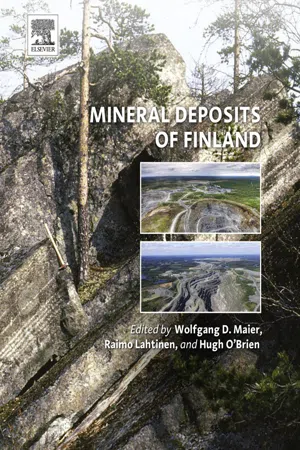
Mineral Deposits of Finland
About this book
Mineral Deposits of Finland is the only up-to-date and inclusive reference available that fully captures the scope of Finland's mineral deposits and their economic potential. Finland hosts Europe's most mature rocks and large cratonic blocks, analogous to western Australia and Southern Africa, which are the most mineralized terrains on Earth.Authored by the world's premier experts on Finnish mineral exploration and mining, Mineral Deposits of Finland offers a thorough summary of the mineral deposits and their petrogenesis, helping readers to map, explore, and identify Finland's renewed potential for mineral exploration and extraction.
- Presents a thoroughly inclusive catalogue of Finland's mineral deposits and their economic potential
- Features full-color figures, illustrations, working examples and photographs to aid the reader in retaining key concepts to underscore major advances in the exploration of Finland's mineral resources
- Offers concise chapter summaries authored by leaders in geological research, which provide accessible overviews of deposit classes
Information
Topic
Physical SciencesSubtopic
MineralogyPart 1
Chapter 1
A History of Exploration for and Discovery of Finland’s Ore Deposits
I. Haapala, and H. Papunen
Abstract
Historically documented mining in Finland started in the 1530s when the area formed part of Sweden. The post of commissioner of mines was founded in 1638. The Swedish government activated mineral exploration in Finland in the seventeenth century and, during the Age of Utility, in the eighteenth century. Numerous small iron, copper, and lead occurrences were found, as well as the larger Orijärvi copper deposit. During 1809-1917 when Finland was a Grand Duchy within the Russian Empire, exploration was reorganized and strengthened. New, generally small iron deposits were discovered to supply iron works. Deposits found in the Pitkäranta area were mined for copper, tin, zinc, and iron. The Geological Survey of Finland was established in 1885. The large and rich Outokumpu copper deposit was discovered in 1910 as a result of scientific exploration by Otto Trüstedt of the Geological Survey. Since then, boulder tracing (later also till geochemistry), geophysical measurements, and diamond drilling have been the standard exploration methods. After Finland declared independence in 1917, mineral exploration was considered important for the development of domestic industry. In 1921 the Geological Survey discovered the nickel–copper ore field of Petsamo, and by the end of the 1930s, several other deposits, including the Otanmäki iron–titanium–vanadium deposit, were discovered. After the Second World War, the Geological Survey was reorganized and strengthened, and in the following decades it discovered numerous important ore deposits, including the Vihanti zinc–copper deposit (1951) and the Kemi chromium deposit (1960). The state-owned mining companies Outokumpu Oy and Rautaruukki Oy established their own exploration departments in the 1950s. Outokumpu Oy discovered the Kotalahti (1956), Vammala, and Kylmäkoski nickel–copper deposits, the Pyhäsalmi copper-zinc deposit (1958), the Vuonos (1965) and Kylylahti (1984) Outokumpu-type deposits, and several gold deposits. Otanmäki Oy/Rautaruukki Oy discovered several iron deposits in Lapland, as well as the large apatite-rich Sokli carbonatite complex. Rautaruukki Oy terminated their exploration activities in 1985 and Outokumpu Oy in 2003. Finnish private companies also carried out successful mineral exploration. After becoming a member of the European Union in 1995, the role of international mining and exploration companies has strongly increased in Finland, the main interest being in precious metal deposits.
Keywords
exploration; Finland; history; ore deposits; Geological Survey of Finland; Outokumpu Oy; Rautaruukki OyIntroduction
The activity and success of exploration for mineral deposits in Finland has, over the centuries, varied markedly depending on the political, cultural, and economic situation, as well as on the more or less fortuitous availability of persons capable to plan, lead, and carry out prospecting and exploitation of deposits. A major historical background is provided by the changes in the form of government. The eastern part of Norden (or geographic Fennoscandia) now known as Finland was gradually incorporated into the kingdom of Sweden during the twelfth and thirteenth centuries. Over the subsequent five centuries, the eastern border of Sweden shifted several times as a result of wars between Sweden and Novgorod/Russia, until 1809 when Finland was ceded to Russia. Since December 1917 Finland has been an independent state.
Several extensive volumes have been published on the history of the mining industry and exploration in Finland. The first that should be mentioned is the work of Tekla Hultin, which deals with the evolution of the mining industry and exploration during the time of Swedish rule (Hultin, 1896, 1897). The exploration and mining industry during the period of the Russian rule has been documented in detail by Dr. Eevert Laine (e.g., Laine, 1950, 1952). A comprehensive account of the mining industry in Finland from 1530–2001 was recently published by Kauko Puustinen (1997, 2003). Hyvärinen and Eskola (1986) published a chapter on mineral exploration in Finland, including selected case histories of discoveries. A shorter article, “One hundred years of ore exploration in Finland,” by one of the current authors (Papunen, 1986), has been an important source, for the present review.
Time of Swedish Rule
The skill to collect limonitic bog and lake iron ore nodules and produce iron from it in simple furnaces was known in Finnish villages in ancient times, and such iron occurrences were still harvested in small quantities at the end of the nineteenth century. Some lake ore deposits south of Iisalmi in eastern Finland were still studied as possible manganese ores in 1940s and 1950s.
During the reign of King Gustaf I Vasa (1496–1560), the crown supported exploration and mining in the eastern part of Sweden as well. The first clearly documented mine in Finland was the Ojamo skarn-type iron deposit in Karjaa, southern Finland. The deposit was mined in the 1530s by Erik Fleming, the councilor of southern Finland, although it was not until 1542 that King Gustaf I awarded him the formal privilege to exploit the deposits (Puustinen, 1997, 2010). The ore was first worked up in Siuntio, and later in the nearby Mustio ironworks. After Fleming’s time mining slowed down. Under the reign of Gustaf I some other minor deposits (e.g., copper ore of Remojärvi in Juva in eastern Finland and iron ore in Siuntio) were exploited. How the deposits were discovered is not known.
In the seventeenth century, under the reign of Gustaf II Adolf Vasa (1594–1632) the mining industry rose to a new level, driven by mercantilism and wars in central Europe, especially the Thirty Years’ War in 1618–1648. One reason for the success of the Swedish army in this war was the large and rich Dannemora iron and the Falun copper mines. Gustaf II Adolf had a keen interest in ores and mining. As the crown prince, he had stayed in Finland in 1611 and collected ore specimens that he brought to Stockholm for closer studies (Salokorpi, 1999). As king he traveled in Finland during 1614–1616 and gave personal orders to open or reopen mines and to establish new ironworks (Hultin, 1896, 1897). He had an optimistic view of Finland’s ore potential. After his death in the battle of Lützen in 1632 mining policies were continued by his successors. The Board of Mines was established in Stockholm in 1637, and Finland received a permanent post of commissioner of mines in 1638. Finland’s first university, Academia Aboensis (Academy of Turku), was founded in 1640 in Turku.
The mining and manufacturing of the large ore deposits in central Sweden seriously depleted Swedish forests. As Finland contained huge tracts of virgin forest that could be exploited for the production of charcoal, as well as rivers for transport and rapids to run furnaces and hammers, experts were sent to Finland to explore for ore deposits and set up metal works in suitable places. Clergymen and other officials were urged to assist in these efforts. The Ojamo mine was reopened and several new ironworks were established: Mustio or Svartå in Karjaa (1550–1901); Antskog (1630–1880), Billnäs (1641–1905), and Fiskars (1649–1904) in Pohja; Fagervik in Inkoo (1646–1904); Orisberg in Isokyrö (1676–1900); Skogby in Tammisaari (1682–1908); and Tykö in Perniö (1686–1908). As raw material, these ironworks mainly used ore or raw iron from the Utö deposits in the Stockholm archipelago. If possible, hard-rock iron deposits from Finland were used, including Ojamo (exploited periodically in 1533–1863), Vittinki in Ylistaro (1563–1920), Sådö (1610–1863) and Långvik (1662–1863) in Inkoo, Juvakaisenmaa in Kolari (1662–1917), Morbacka in Lohja (1668–1873), Malmberg in Kisko (1670–1866), Vihiniemi in Perniö (1690–1865), and Kelkkala in Tammisaari (1690–1900), as well as many other relatively small deposits. In some cases, Finnish lake and bog iron ores were used. The copper and lead occurrences found in the seventeenth century were generally relatively small (Puustinen, 2003).
The beginning of the eighteenth century was overshadowed by the Great Nordic War (1702–1721) as a result of which Sweden lost parts of eastern Finland to Russia. In order to strengthen the Swedish and Finnish mining industry after the war, a royal statute of 1723 promised significant rewards for discovery of ore deposits and benefits for their exploitation.
The Board of Mines sent geological experts to work in Finland, including Daniel Tilas (1712–1772) and Magnus Linder (1709–1799). In the report of his travel to Finland in 1737–1738, Tilas described the bedrock and mineral occurrences of southern Finland. His visits to larger villages were announced in churches, and people were urged to report their findings. Tilas himself carried out exploration for ore deposits at several sites, including the newly discovered Ansomäki iron deposit near Haveri in Viljakkala (Puustinen, 2006). In Tammela he visited a site where in 1733 a farmer had found a large boulder containing high-grade copper ore. Tilas had recognized that erratic boulders are generally situated southeast of their sources, which enabled him to find chalcopyrite-bearing veins in outcrops at Hopiavuori (later known as Tilasinvuori). The deposit was mined in 1740–1749 (Puustinen, 2014). This is the first time that “boulder tracing” was successfully applied to the exploration of ore deposits, long before the theory of the great Nordic continental glaciation (Ice Age) was presented.
Tilas’ colleague Magnus Linder was appointed to the post of deputy commissioner of mines in Finland in 1741, but because of renewed war with Russia he could not travel to Finland until 1744. He held the permanent post of commissioner of mines in 1747–1787. When Linder started his work, the few existing mines and ironworks were stagnant and the mining administration was thoroughly decayed. Linder set about reorganizing the mining industry. In 1744 he discovered the skarn-type Sillböle iron deposit in Helsinki, which was in production in 1744–1770 and 1823–1866. In the same limestone-skarn horizon, a few kilometers west of Sillböle, other skarn iron deposits were found in Hämeenkylä and Jupperi, and they were mined periodically from 1786 to 1860 (Saltikoff et al., 1994). In 1757 the owner of the Orijärvi estate found metallic ore minerals in a rock outcrop in his back forest, and the rock turned out to be good copper ore. The deposit was mined with some interruptions from 1758 to 1954, and during the last 30 years zinc and lead were also produced (Nikander, 1929; Turunen, 1957; Poutanen, 1996). Orijärvi was the first significant copper deposit found in Finland (Figs. 1.1 and 1.2).
Period of Russian Rule
Organization of Geological Research and Main Results of Mineral Exploration
During the Napoleonic wars the Russian army occupied Finland in 1808–1809. Russia annexed Finland and conveyed it the status of a Grand Duchy. Because of the war, mining and exploration had largely ceased. The only significant discovery was that of the Kulonsuonmäki titaniferous iron deposit near Karkkila. It was mined in 1817–1888, and the Högfors ironworks was built to process the ore. The office of the commissioner of mines was weak, but the situation improved when General Count Fabian Steinheil was appointed Governor General in 1810. Steinheil, who himself was a skillful mineralogist, wanted to promote geological research, exploration, and the mining industry in Finland. On his recommendation, the young lawyer and mineralogist Nils Gustaf Nordenskiöld (1792–1866) was appointed at commissioner of mines in 1818. Nordenskiöld had studied law and chemistry under Johan Gadolin in the Academy of Turku as well as science of mining and metallurgy in Uppsala, and he was familiar with the ore deposits of central Sweden. Steinheil arranged financing for a three-year expedition to central and western Europe, during which time Nordenskiold got acquainted with mineral exploration and its organization as well as other branches of the mining industry. The office of commissioner of mines was rearranged in 1821. The leader of the office became superintendent, and the staff was increased. Nils Gustaf Nordenskiöld was appointed the first superintendent in 1823, a post he retained until 1855. In 1858 the office was reorganized and became the Board of Mines.
Nordenskiöld reorganized the mineral exploration and the training of his staff. He gave prospectors detailed directions on how to compile geological maps and collect samples. All known ore fields were restudied and some of them were mined. Numerous new ore deposits, mainly iron deposits, were found, and the mining compass came into use. The remarkable Jussarö iron ore field in the archipelago near Tammisaari was discovered in 1834, and the deposit was mined in 1834–1861. Most of the other occurrences were quite small and were mined only briefly. A few deposits, such as Haukia (exploited 1839–1864) and Pahalahti (1826–1854) in Kisko, and Väsby in Korppoo (1839–1864) produced thousands of tons of iron ore. The old deposits of Ojamo, Sillböle, Hämevaara, Malmberg, and Vihiniemi were again mined, and special attention was paid to the deposits of Haveri and Juvakaisenmaa. The aim was to make Finland self-sufficient with respect to iron, but this goal was not attained. Iron ore and raw iron were imported from the Utö mines in Sweden to the ironworks of southern and western Finland. When large limonitic lakes and bog ores were found in central and eastern Finland, a number of ironworks were established in those areas to work the lake ores. The Juantehdas (Strömsdal) ironworks in Juankoski, founded in 1746, was in operation until 1911. Of the ironworks established in eastern Finland during the nineteenth century, those of particular importance included Möhkö in Ilomantsi (in operation 1837–1907), Värtsilä in Tohmajärvi (1851–1920), Varkaus (1815–1908), and Annantehdas in Suojärvi (1809–1905). In the nineteenth century, exploitation of the lake ores was less expensive than mining of hard rock ores of similar iron contents, but their utilization was ham...
Table of contents
- Cover image
- Title page
- Table of Contents
- Copyright
- Contributors
- Preface
- Part 1
- Part 2
- Part 3. Magmatic Ni-Cu-PGE-Cr-V Deposits
- Part 4. Deposits Related to Carbonatities and Kimberlites
- Part 5. Gold Deposits
- Part 6
- Part 7
- Part 8
- Part 9. Other Types of Mineral Deposits
- Part 10. Exploration Methods
- Part 11
- Index
Trusted by 375,005 students
Access to over 1.5 million titles for a fair monthly price.
Study more efficiently using our study tools.
Frequently asked questions
Yes, you can cancel anytime from the Subscription tab in your account settings on the Perlego website. Your subscription will stay active until the end of your current billing period. Learn how to cancel your subscription
No, books cannot be downloaded as external files, such as PDFs, for use outside of Perlego. However, you can download books within the Perlego app for offline reading on mobile or tablet. Learn how to download books offline
Perlego offers two plans: Essential and Complete
- Essential is ideal for learners and professionals who enjoy exploring a wide range of subjects. Access the Essential Library with 800,000+ trusted titles and best-sellers across business, personal growth, and the humanities. Includes unlimited reading time and Standard Read Aloud voice.
- Complete: Perfect for advanced learners and researchers needing full, unrestricted access. Unlock 1.5M+ books across hundreds of subjects, including academic and specialized titles. The Complete Plan also includes advanced features like Premium Read Aloud and Research Assistant.
We are an online textbook subscription service, where you can get access to an entire online library for less than the price of a single book per month. With over 1.5 million books across 990+ topics, we’ve got you covered! Learn about our mission
Look out for the read-aloud symbol on your next book to see if you can listen to it. The read-aloud tool reads text aloud for you, highlighting the text as it is being read. You can pause it, speed it up and slow it down. Learn more about Read Aloud
Yes! You can use the Perlego app on both iOS and Android devices to read anytime, anywhere — even offline. Perfect for commutes or when you’re on the go.
Please note we cannot support devices running on iOS 13 and Android 7 or earlier. Learn more about using the app
Please note we cannot support devices running on iOS 13 and Android 7 or earlier. Learn more about using the app
Yes, you can access Mineral Deposits of Finland by Wolfgang Derek Maier,Raimo Lahtinen,Hugh O'Brien in PDF and/or ePUB format, as well as other popular books in Physical Sciences & Mineralogy. We have over 1.5 million books available in our catalogue for you to explore.