- 636 pages
- English
- ePUB (mobile friendly)
- Available on iOS & Android
eBook - ePub
Colorants for Non-Textile Applications
About this book
This volume examines the chemistry of natural and synthetic dyes produced for non-textile markets, where much new basic research in color chemistry is now taking place.The first group of chapters covers the design, synthesis, properties and application technology pertaining to dyes for digital printing and photography. The reader will be pleased with the breadth and depth of information presented in each case. Of particular interest is the discussion of strategies for the design of dyes in these categories, with emphasis on enhancing technical properties. In view of certain new developments, the ink-jet chapter includes results from studies pertaining to dyes for textiles.The three chapters comprising Section II of this volume cover the broad subject of dyes for food, drug and cosmetic applications and then provide an in-depth look at dyes for biomedical applications and molecular recognition. The chapter on dyes for molecular recognition places emphasis on applications in the biological sciences, including sensory materials and artificial receptors. While the former two topics have been covered elsewhere in the past, the present chapters are unequalled in scope.Section III provides an in-depth review of the design of laser dyes and dye-based functional materials. In the first of the two chapters, the major principles of laser operation are summarized. This is followed by a discussion of spectroscopic properties, such as activation and deactivation of absorbed light by laser dyes. Approaches to the development of new laser dyes are presented. The second chapter pertains to the synthesis of dicyanopyrazine-based multifunctional dyes. The visible and fluorescence spectra of these dyes in solution and the solid state are correlated with their three-dimensional molecular structures. Molecular stacking behavior and solid state properties of these "multifunctional" dye materials are presented.The final group of chapters pertains to natural dyes and dyes for natural substrates. In recent years, the impression among certain consumers that "natural" is better/safer has generated much interest in the use of natural dyes rather than synthetics. This has led to a few short discussion papers in which the environmental advantages to using natural dyes have been questioned. The initial chapter in this group provides both a historical look at natural dyes and a comprehensive compilation of natural dye structures and their sources. Though natural dyes are of interest as colorants for textiles, selected ones are used primarily in food and cosmetics.Chapter ten provides an update on the author's previous reviews of structure-color-relationships among precursors employed in the coloration of hair. Chemical constitutions characterizing hair dye structures are presented, along with a summary of available precursors and their environmental properties. Similarly, the chapter on leather dyes covers constitutions and nomenclature, in addition to providing interesting perspectives on the origin and use of leather, the dyeing of leather, and key environmental issues.This volume is concluded with another look at colors in nature. In this case, rather than revisiting colors in plant life, an interesting chapter dealing with color in the absence of colorants is presented. Chapter twelve covers basic concepts of color science and illustrates how 3-D assemblies leading to a plethora of colors are handled in nature. It is our hope that this atypical "color chemistry" chapter will invoke ideas that lead to the design of useful colorants.The chapters presented in this volume demonstrate that color chemistry still has much to offer individuals with inquiring minds who are searching for a career path. This work highlights the creativity of today's color chemists and the wide variety of interesting non-textile areas from which a career can be launched.
Information
IV
NATURAL COLOR/SUBSTRATES
9
Natural Dyes
ALOIS G. PÜNTENER1 and ULRICH SCHLESINGER2
1TFL Ledertechnik AG, 4002 Basel, Switzerland
2Ciba Spezialitätenchemie GmbH, 79630 Grenzach, Germany
1 INTRODUCTION AND HISTORICAL OVERVIEW
In the Stone Age powders of coloured minerals (mostly heavy-metal ores) mixed with binders were applied to hair and body to confer magic powers while hunting or to impress others. People started wearing tanned skins, and later also textiles, as protection against the weather. In ancient Egyptian cuneiform texts we find the first descriptions of dyeing clothing and other materials that contain mainly natural organic dyes. These dyes were extremely labour-intensive to produce and apply, and therefore very valuable. In ancient Rome dyes were as valuable as gold. Not surprisingly, given the cultural importance of colours, the techniques of producing and applying dyes were steadily refined. The dyeing recipes themselves were kept secret by the priests and craftsmen and used as monopolistic sources of income. Most of the dyes were fixed with metal salts such as potassium alum, cuprous sulphate, and ferric sulphate to obtain different coloured complex compounds in the form of lakes. Organic mordanting agents such as tannin were also used for fixation. Gallic acid, a tanning agent combines with ferrous sulphate to yield ink black.
The Phoenicians were familiar with murex shells for dyeing purple. With the decline of Byzantium the secret of purple dyeing was lost and kermes became the new red until, following the discovery of America, the better and more productive cochineal red of the Mayas replaced kermes. For yellow, the pollen of saffron was widely used in the Arab countries, and in China it was the privilege of the emperors to wear saffron coloured robes.
With the advent of world-wide merchant shipping an increasing number of dyes were produced and exchanged. Indigo blue from India, called the ‘king of dyes’, was more brilliant and productive than European dyer’s woad, which subsequently was replaced. Tropical dyewoods like logwood and fustic also became very popular.
Until the mid 19th century, textile and leather were dyed with animal and vegetable dyes, plus a few mineral dyes (see recommended literature, H. Schwepe).
In 1771 Woulfe made the first synthetic dye - picric acid for colouring silk - by oxidation of natural indigo. Perkin synthesized cationic mauve in 1856 and successfully started the first industrial scale dye manufacturing operation. In 1859 Virguin discovered the bluish red coal-tar dye fuchsine. Today, most organic synthetic dyes are basically azo dyes, a family discovered in 1858 by Griess (see recommended literature, H. Zollinger). Azo compounds rarely occur in nature.
New substances obviously also entail new, unknown risks. Although most synthetic dyes are classified as safe, consumers are increasingly asking as a matter of principle whether products of natural origin could replace synthetic dyes [1].
Back to nature - a road to the future?
The amount of dyes obtainable from animals and plants varies widely [2], ranging from <0.01% (w/w) in the case of murex shells, to as much as 27% rutin in persian berries which, in turn, make up only part of the plant’s total weight. In the case of dyewoods such as fustic, roots such as madder and shrubs such as indigo plant, the yields are 0.5 to 5%. It has been estimated that 100 million tons/year of dyer’s plants would be needed to dye only the world’s annual consumption of fibres. A more realistic long-term source of natural dyes for the future could well involve the use of genetically engineered micro-organisms. Even now indigo [3] yields of a few grams per litre fermentation broth per day are feasible.
So far only a very small number of natural colorants has proved commercially viable. Natural colorants are usually a mixture of dyes whose chemistry is often not precisely defined [4]. Since no exact recipe can be formulated for a given shade, it is difficult to reproduce the same shade. Colourants in plants are not designed by nature with transfer to a technical substrate in mind. Therefore, today natural dyes are mainly used for colouring foodstuffs and cosmetics. The very stringent safety and toxicological requirements to be met in dyeing food and cosmetics mean that only selected natural dyes are permitted. To their credit natural dyes display good biodegradability.
1.1 Isotins
1.1.1 Purple
CAS 19201-53-7
C.I. Natural Violet 1
C.I. Constitution 75800
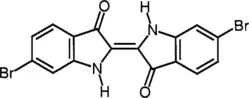
Purple, also known as purple of the ancients, ‘royal purple’ and ‘Tyrian purple’, occurs as the vat form of 6,6′-dibromo-indigo in a yellowish-green mucus contained in a small sac in the body of marine molluscs of the genus Murex and Purpura. The dye itself forms under the action of air and light via intermediate stages. The word purple is derived from the Latin word “purpura” the Greek word “porphyra”.
Many writers of antiquity regarded the Phoenicians as the pioneers of purple dyeing. Tradition attributes the beginning of this art to the maritime trading city of Tyre in the year 1439 BC, although used murex shells were found on Crete that dated to 1600 BC. Probably the Phoenicians became familiar with purple dyeing in Ugarit on the coast of Syria.
Asiatic rulers were the first to wear purple, a luxury subsequently adopted by Alexander the Great. In the early days of Rome chiefly members of the priesthood wore purple cloaks (“pallium”). In the time of the republics these cloaks were reserved for high officials of the state (“purpurati”). Under Caesar and Augustus the wearing of purple was confined to persons distinguished by office and rank.
The most famous factories for the manufacture of purple were in Syracuse and Tarentum. The Byzantine emperors and the Church of Rome have clung longest to costl...
Table of contents
- Cover image
- Title page
- Table of Contents
- Copyright
- Preface
- Contributors
- I: PRINTING AND IMAGING TECHNOLOGIES
- II: FD&C AND MEDICAL DYES
- III: FUNCTIONAL MATERIALS
- IV: NATURAL COLOR/SUBSTRATES
- Index
Trusted by 375,005 students
Access to over 1.5 million titles for a fair monthly price.
Study more efficiently using our study tools.
Frequently asked questions
Yes, you can cancel anytime from the Subscription tab in your account settings on the Perlego website. Your subscription will stay active until the end of your current billing period. Learn how to cancel your subscription
No, books cannot be downloaded as external files, such as PDFs, for use outside of Perlego. However, you can download books within the Perlego app for offline reading on mobile or tablet. Learn how to download books offline
Perlego offers two plans: Essential and Complete
- Essential is ideal for learners and professionals who enjoy exploring a wide range of subjects. Access the Essential Library with 800,000+ trusted titles and best-sellers across business, personal growth, and the humanities. Includes unlimited reading time and Standard Read Aloud voice.
- Complete: Perfect for advanced learners and researchers needing full, unrestricted access. Unlock 1.5M+ books across hundreds of subjects, including academic and specialized titles. The Complete Plan also includes advanced features like Premium Read Aloud and Research Assistant.
We are an online textbook subscription service, where you can get access to an entire online library for less than the price of a single book per month. With over 1.5 million books across 990+ topics, we’ve got you covered! Learn about our mission
Look out for the read-aloud symbol on your next book to see if you can listen to it. The read-aloud tool reads text aloud for you, highlighting the text as it is being read. You can pause it, speed it up and slow it down. Learn more about Read Aloud
Yes! You can use the Perlego app on both iOS and Android devices to read anytime, anywhere — even offline. Perfect for commutes or when you’re on the go.
Please note we cannot support devices running on iOS 13 and Android 7 or earlier. Learn more about using the app
Please note we cannot support devices running on iOS 13 and Android 7 or earlier. Learn more about using the app
Yes, you can access Colorants for Non-Textile Applications by H.S. Freeman,A.T. Peters in PDF and/or ePUB format, as well as other popular books in Technology & Engineering & Chemical & Biochemical Engineering. We have over 1.5 million books available in our catalogue for you to explore.