- 896 pages
- English
- ePUB (mobile friendly)
- Available on iOS & Android
eBook - ePub
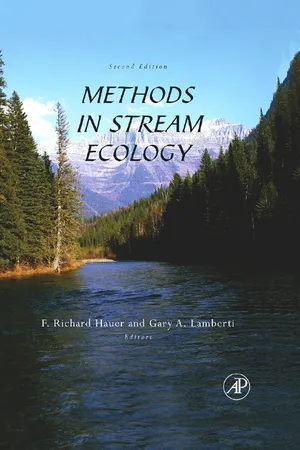
Methods in Stream Ecology
About this book
Methods in Stream Ecology, Second Edition, provides a complete series of field and laboratory protocols in stream ecology that are ideal for teaching or conducting research.
This updated edition reflects recent advances in the technology associated with ecological assessment of streams, including remote sensing. In addition, the relationship between stream flow and alluviation has been added, and a new chapter on riparian zones is also included.
The book features exercises in each chapter; detailed instructions, illustrations, formulae, and data sheets for in-field research for students; and taxanomic keys to common stream invertebrates and algae.
With a student-friendly price, this book is key for all students and researchers in stream and freshwater ecology, freshwater biology, marine ecology, and river ecology. This text is also supportive as a supplementary text for courses in watershed ecology/science, hydrology, fluvial geomorphology, and landscape ecology.
- Exercises in each chapter
- Detailed instructions, illustrations, formulae, and data sheets for in-field research for students
- Taxanomic keys to common stream invertebrates and algae
- Link from Chapter 22: FISH COMMUNITY COMPOSITION to an interactive program for assessing and modeling fish numbers
Information
SECTION C
STREAM BIOTA
CHAPTER 14 Heterotrophic Bacteria
I. INTRODUCTION
Heterotrophic microorganisms in streams, which include bacteria, protists, and fungi, are important components of the microbial communities associated with the water column; submerged surfaces such as rocks, leaves, and wood; and interstitial water of benthic sediments (e.g., Aumen et al. 1983, Bott et al. 1984, Stock and Ward 1989, Findlay et al. 1993, Lock 1993, Stanley et al. 2003). The focus of this chapter is on heterotrophic bacteria, which decompose dissolved (DOM) and particulate organic matter (POM) and are consumed by organisms at higher trophic levels (Meyer 1990).
The field of microbial ecology has undergone extraordinary growth over the last two decades that has resulted in an expanded understanding of the ecological importance of bacteria in stream and other aquatic environments. This growth has been coupled to and driven largely by the development of an array of new techniques that have accelerated our ability to estimate bacterial abundances, growth rates, and productivity in natural and laboratory settings (Zimmerman and Meyer-Reil 1974, Hobbie et al. 1977, Porter and Feig 1980, Fuhrman and Azam 1982, Findlay et al. 1984, Kirchman et al. 1985, Simon and Azam 1989). More recently, the development of highly sensitive biochemical and molecular techniques has enabled progress in understanding bacterial diversity and linkages among microbial composition, spatial arrangement, and function in natural environments (Chrost 1990, Hoppe 1991, Fuhrman et al. 1994, Amann et al. 1995). With new technology and methods in microbial ecology, we can more thoroughly answer old questions, as well as pose new and exciting ones (Christian and Capone 1997).
One of the continuing challenges in freshwater ecology is to understand the fate of DOM and the roles of microbial communities in determining that fate. In streams, one important role of benthic bacterial communities that has long been recognized is the assimilation of dissolved materials from the overlying water. Both biotic and abiotic retention of DOM (e.g., leachate from leaves) on benthic surfaces is well documented in small stream ecosystems (Cummins et al. 1972, Lock and Hynes 1976, Dahm 1981, McDowell 1985). These processes result in the transfer of organic carbon associated with DOM from the overlying stream water to surfaces, where it can then be partially or wholly metabolized by benthic, heterotrophic microbial communities. Therefore, these communities function to retain and transform DOM, which is an important source of energy. The removal of DOM to benthic habitats by stream microorganisms has primarily been documented by measuring the disappearance of DOM—that is, the decrease in concentration in the overlying water. These studies have revealed that some sources of DOM are removed more rapidly than others, suggesting differences in quality of DOM (Lock and Hynes 1975, Lush and Hynes 1978). Quality of organic matter is an imprecise term, but it relates to the ability of organisms to use it as a food source. High-quality DOM should be rapidly assimilated and quickly metabolized by heterotrophic organisms, whereas low-quality DOM should be more slowly utilized (e.g., Hedin 1990).
With the development of methods for estimating bacterial productivity together with an array of other techniques, new approaches to understanding the relationship between microbes and DOM in streams and other environments have evolved. We now know that DOM concentrations are positively correlated with increases in heterotrophic bacterial abundances and productivity in a variety of environments (Findlay et al. 1986, Cole et al. 1988, Moriarty et al. 1990, McKnight et al. 1993, Johnson and Ward 1997, Farnell-Jackson and Ward 2003). However, direct measurement of metabolic responses of heterotrophic microorganisms in stream ecosystems to sources of DOM of different quality has been much less studied. We also know little about the role of different sources of DOM in determining the activity and composition of bacterial communities.
Despite the enormous progress that has been made in microbial ecology in recent years, some fundamental characteristics of natural microbial communities in aquatic ecosystems are still not well understood or measured. Over the past decade, several epifluorescent microscopic methods have been developed or fine-tuned for determining bacterial cell activity. Enumeration of acridine orange or DAPI-stained bacterial cells from natural microbial communities yields estimates of total bacterial abundances (Amann et al. 1995) but does not distinguish among living, dormant but viable, or dead cells. Active bacterial cells invariably make up a very small percentage (<30%) of total direct counts, which has led to the conclusion that most bacterial particles in aquatic environments are inactive or dead (Beloin et al. 1988, Marxsen 1988, Ward and Johnson 1996). The ability to distinguish and quantify active cells will help explain essential ecological attributes such as patterns of microbial growth and productivity and the environmental factors that control these patterns, including responses to DOM (del Giorgio et al. 1996, 1997).
In this chapter, two methods are described that are fundamental to understanding key features of heterotrophic bacterial communities: (1) a CTC (5-cyano-2,3-ditolyl tetrazolium chloride) method for identifying and quantifying actively respiring bacteria, and (2) a [3H]leucine method for estimating bacterial productivity. The first method requires a compound microscope equipped with a high magnification (100X), oil imme...
Table of contents
- Cover image
- Title page
- Table of Contents
- Copyright
- Contributors
- Preface
- SECTION A: PHYSICAL PROCESSES
- SECTION B: MATERIAL TRANSPORT, UPTAKE, AND STORAGE
- SECTION C: STREAM BIOTA
- SECTION D: COMMUNITY INTERACTIONS
- SECTION E: ECOSYSTEM PROCESSES
- SECTION F: ECOSYSTEM QUALITY
- Index
Trusted by 375,005 students
Access to over 1.5 million titles for a fair monthly price.
Study more efficiently using our study tools.
Frequently asked questions
Yes, you can cancel anytime from the Subscription tab in your account settings on the Perlego website. Your subscription will stay active until the end of your current billing period. Learn how to cancel your subscription
No, books cannot be downloaded as external files, such as PDFs, for use outside of Perlego. However, you can download books within the Perlego app for offline reading on mobile or tablet. Learn how to download books offline
Perlego offers two plans: Essential and Complete
- Essential is ideal for learners and professionals who enjoy exploring a wide range of subjects. Access the Essential Library with 800,000+ trusted titles and best-sellers across business, personal growth, and the humanities. Includes unlimited reading time and Standard Read Aloud voice.
- Complete: Perfect for advanced learners and researchers needing full, unrestricted access. Unlock 1.5M+ books across hundreds of subjects, including academic and specialized titles. The Complete Plan also includes advanced features like Premium Read Aloud and Research Assistant.
We are an online textbook subscription service, where you can get access to an entire online library for less than the price of a single book per month. With over 1.5 million books across 990+ topics, we’ve got you covered! Learn about our mission
Look out for the read-aloud symbol on your next book to see if you can listen to it. The read-aloud tool reads text aloud for you, highlighting the text as it is being read. You can pause it, speed it up and slow it down. Learn more about Read Aloud
Yes! You can use the Perlego app on both iOS and Android devices to read anytime, anywhere — even offline. Perfect for commutes or when you’re on the go.
Please note we cannot support devices running on iOS 13 and Android 7 or earlier. Learn more about using the app
Please note we cannot support devices running on iOS 13 and Android 7 or earlier. Learn more about using the app
Yes, you can access Methods in Stream Ecology by F. Richard Hauer,Gary Lamberti,Gary A. Lamberti in PDF and/or ePUB format, as well as other popular books in Biological Sciences & Ecology. We have over 1.5 million books available in our catalogue for you to explore.