
- 312 pages
- English
- ePUB (mobile friendly)
- Available on iOS & Android
eBook - ePub
Fatigue and Tribological Properties of Plastics and Elastomers
About this book
Part of a series of core databooks within the William Andrew Plastics Design Library, Fatigue and Tribological Properties of Plastics and Elastomers provides a comprehensive collection of graphical multipoint data and tabular data covering fatigue and tribology.The concept of fatigue is very straightforward: if an object is subjected to a stress or deformation, and it is repeated, the object becomes weaker. This weakening of plastic material is called fatigue. Tribology is the science and technology of surfaces in contact with each other and therefore covers friction, lubrication and wear. The reduction of wear and fatigue and the improvement of lubrication are key bottom-line issues for engineers and scientists involved in the plastics industry and product design with plastics.Fatigue and Tribological Properties of Plastics and Elastomers, Second Edition is an update of all that has changed in the world of plastics since the 1st edition appeared nearly 15 years ago, and has been reorganized from a polymer chemistry point of view.
- A hard-working reference tool: part of the daily workflow of engineers and scientists involved in the plastics industry and product design with plastics
- The reduction of wear and fatigue and the improvement of lubrication are key bottom-line issues
- The data in this book provide engineers with the tools they need to design for low failure rates
Information
Chapter 1. Introduction to Fatigue and Tribology of Plastics and Elastomers
1.1. Introduction to Fatigue
There are two recently published books on the properties of engineering plastics in this series. The Effect of Temperature and Other Factors on Plastics1 discusses the general mechanical properties of plastics. The mechanical properties as a function of temperature, humidity, and other factors are presented in graphs or tables. That work includes hundreds of graphs of stress versus strain, modulus versus temperature, impact strength versus temperature, etc. Time was not a factor in that book. The Effect of Creep and Other Time Related Factors on Plastics2 discusses the long-term behavior of plastics when exposed to constant stresses or strains for long periods of time. This book adds another two layers of plastics performance criteria, fatigue, and tribology.
This book provides graphical multipoint data and tabular data on fatigue and tribological properties of plastics and elastomers. This first chapter deals with the types of stress and an introduction to fatigue. Tribology is discussed in Chapter 2. The chemistry of plastics follows in Chapter 3. The remaining chapters contain the data.
The idea of fatigue is very simple. If an object is subjected to a stress or deformation, and it is repeated, the object becomes weaker. This weakening of plastic material is called fatigue and occurs when the material is subject to alternating stresses over a long period of time.
1.2. Types of Stress
As noted in Section 1.1, fatigue occurs as a result of rapidly changing stress or strain. Stress and strain can be applied in a number of ways. Normal stress (σ) is the ratio of the applied force (F) over the cross-sectional area (A) as shown in Equation 1.1 and Figure 1.1.
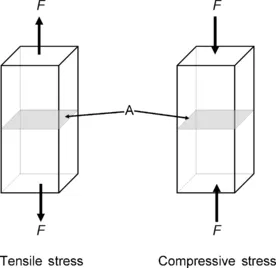 |
| Figure 1.1 Illustration of tensile stress and compressive stress. |
(1.1)

1.2.1. Tensile and Compressive Stress
When the applied force is directed away from the part, as shown in Figure 1.1, it is a tensile force inducing a tensile stress. This is also called a normal stress as it is applied perpendicularly. When the force is applied toward the part, it is a compressive force inducing a compressive stress.
1.2.2. Shear Stress
A shear stress (τ) is defined as a stress which is applied parallel or tangential to a face of a material as shown in Figure 1.2. The shear force is applied parallel to the cross-sectional area “A”.
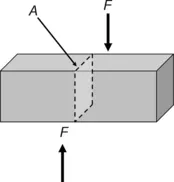 |
| Figure 1.2 Illustration of shear stress. |
Shear stress is also expressed as force per unit area as in Equation 1.2.
(1.2)

1.2.3. Torsional Stress
Torsional stress (τ) occurs when a part such as a rod for a shaft is twisted as in Figure 1.3. This is also a shear stress, but the stress is variable and depends how far the point of interest is from the center of the shaft. The equation describing torsional stress is shown in Equation 1.3.
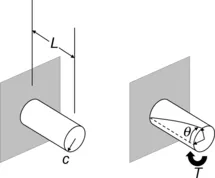 |
| Figure 1.3 Illustration of torsional stress. |
(1.3)

In this equation, T is the torque and c is the distance from the center of the shaft or rod. K is a torsional constant that is dependent on the geometry of the shaft, rod, or beam. The torque (T) is further defined by Equation 1.4, in which θ is the angle of twist, G is the m...
Table of contents
- Cover image
- Table of Contents
- Copyright
- Preface
- Chapter 1. Introduction to Fatigue and Tribology of Plastics and Elastomers
- Chapter 2. Introduction to the Tribology of Plastics and Elastomers
- Chapter 3. Introduction to Plastics and Polymers
- Chapter 4. Styrenic Plastics
- Chapter 5. Polyether Plastics
- Chapter 6. Polyesters
- Chapter 7. Polyimides
- Chapter 8. Polyamides (Nylons)
- Chapter 9. Polyolefins and Acrylics
- Chapter 10. Thermoplastic Elastomers
- Chapter 11. Fluoropolymers
- Chapter 12. High-Temperature Polymers
- Index
Trusted by 375,005 students
Access to over 1.5 million titles for a fair monthly price.
Study more efficiently using our study tools.
Frequently asked questions
Yes, you can cancel anytime from the Subscription tab in your account settings on the Perlego website. Your subscription will stay active until the end of your current billing period. Learn how to cancel your subscription
No, books cannot be downloaded as external files, such as PDFs, for use outside of Perlego. However, you can download books within the Perlego app for offline reading on mobile or tablet. Learn how to download books offline
Perlego offers two plans: Essential and Complete
- Essential is ideal for learners and professionals who enjoy exploring a wide range of subjects. Access the Essential Library with 800,000+ trusted titles and best-sellers across business, personal growth, and the humanities. Includes unlimited reading time and Standard Read Aloud voice.
- Complete: Perfect for advanced learners and researchers needing full, unrestricted access. Unlock 1.5M+ books across hundreds of subjects, including academic and specialized titles. The Complete Plan also includes advanced features like Premium Read Aloud and Research Assistant.
We are an online textbook subscription service, where you can get access to an entire online library for less than the price of a single book per month. With over 1.5 million books across 990+ topics, we’ve got you covered! Learn about our mission
Look out for the read-aloud symbol on your next book to see if you can listen to it. The read-aloud tool reads text aloud for you, highlighting the text as it is being read. You can pause it, speed it up and slow it down. Learn more about Read Aloud
Yes! You can use the Perlego app on both iOS and Android devices to read anytime, anywhere — even offline. Perfect for commutes or when you’re on the go.
Please note we cannot support devices running on iOS 13 and Android 7 or earlier. Learn more about using the app
Please note we cannot support devices running on iOS 13 and Android 7 or earlier. Learn more about using the app
Yes, you can access Fatigue and Tribological Properties of Plastics and Elastomers by Laurence W. McKeen in PDF and/or ePUB format, as well as other popular books in Technology & Engineering & Materials Science. We have over 1.5 million books available in our catalogue for you to explore.