- 754 pages
- English
- ePUB (mobile friendly)
- Available on iOS & Android
eBook - ePub
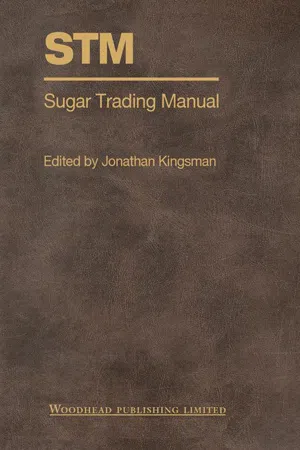
Sugar Trading Manual
About this book
Since its launch, Sugar Trading Manual (STM) has established itself as the definitive information source for the sugar market worldwide. It is compiled from contributions by some of the most senior and widely respected figures in the international sugar trade. This edition takes into account changes in all aspects of the business including production, markets, pricing, contracts, administration and management, and the influence of the major trading blocs. STM is an invaluable training resource for all new entrants to the industry as well as providing everyone already involved in the global sugar business with vital information on its day-to-day workings.
- The only comprehensive, updateable reference source to the structure and conduct of the global sugar business
- Written by well-respected industry insiders
- Covers the entire spectrum of trading instruments and markets
Information
Part 1
The history of sugar
1
Early history
Tony Hannah International Sugar Organization
The sugar cane variety from which most modern sugar-producing varieties are derived – Saccharum officinarum – is thought to have originated in New Guinea. It has been domesticated and cultivated there, for its sweet taste, for an estimated 9000 years. Botanists believe that there were three diffusions from New Guinea through migrations: the first, after two thousand years, was to the Philippines and India; later, cane spread east to China and subsequently throughout the Polynesian tropical settlements.
The first datable reference to sugar cane comes from Nearchus, a general of Alexander the Great, who wrote in 327 BC of ‘a reed in India that brings forth honey without the help of bees, from which an intoxicating drink is made though the plant bears no fruit’.
Evidence of sugar-making comes much later, around the beginning of the Christian era. There are some disputed references by Greek and Roman writers of that period. For example, Dioscorides wrote: ‘there is a kind of concreted honey, called Saccharon, found in reeds in India and Arabia Felix, like in consistence to salt, and brittle to be broken between the teeth, as salt is. It is good for the belly and the stomach being dissolved in water and so drank, helping the pained bladder and the reins.’ The food historian R.J. Forbes writes: ‘Sugar was therefore produced, at least in small quantities, in India and was just becoming known to the Roman world in Pliny’s day’ (the first century AD). The first references to sugar in Indian writings date from approximately the same period. Sugar is mentioned in medical works, the Chanaka, thought to have been written around AD 78 and the Susruta-Samtitas of about a century later. The first writings describing sugar in China date from the Liang dynasty (AD 502–560).
Between the first century AD and the arrival of the first Western European explorers, the sugar industries of India and China developed considerably. Sugar progressed from being a medicine to become a desired food condiment. Marco Polo (1254–1325) noted the extent of the industry in south-east China. Referring to the region about the mouth of the Yangtse River, Marco Polo wrote: ‘You must know that the production of sugar is immense in this province… twice greater than the rest of the world, and this also implies an immense revenue.’ Of the region opposite Taiwan he wrote: ‘They have enormous quantities of sugar. From this City the Great Kaan gets all the sugar that is used at Court, enough to represent a considerable sum in value. You must know that in these parts before the great Kaan subjected it to his overlordship, the people did not know how to prepare and refine sugar, as is done in Egypt. They did not let it congeal and solidify in moulds, but merely boiled and skimmed it, so that it hardened to a kind of paste, and was black in colour. But after the country had been conquered by the Great Kaan, there came into the region men of Egypt, who had been at the Court of the Great Kaan, and who taught them to refine it with the ashes of certain trees.’
In 1498, when Vasco da Gama landed at Calicut in India, he noted large quantities of sugar. Ludivico di Varthema, who travelled to India in 1503–8, records south of Goa ‘a great abundance of sugar, especially sugar candied according to our way’. Duane Barbosa, visiting India in 1513, wrote: ‘In Bengal white and good sugar is manufactured, but they do not understand how to make it into the form of white sugar, but only as meal. It is packed in cotton sacks, enclosed in rawhide outer covers, carefully sown and shipped to many foreign lands’ (Sri Lanka and Arabia are mentioned).
During this period of development of sugar production in India and China, the method of production remained essentially the same, similar to the production of gur in present-day India. The juice was extracted by pestle and mortar or vertical or horizontal rollers, powered by humans or oxen. The juice was then boiled in open pans until it solidified.
The spread of sugar westwards
The introduction of sugar cane into Persia from India is dated at the 6th century AD. The first mention of sugar as a product is in AD 627 when the Roman Emperor Heraclius conquered a palace near Baghdad and sugar wa...
Table of contents
- Cover image
- Title page
- Table of Contents
- Copyright page
- Contributors
- Foreword
- Introduction
- Index
- Part 1: The history of sugar
- Part 2: The global picture
- Part 3: Physicals
- Part 4: Futures
- Part 5: Administration and management
- Part 6: Regional markets
- 1: Sugar No. 11 Rules
- 2: Sugar No. 5 Rules
- 3: Standard physical contract
- 4: Sugar Charter-Party 1999
- 5: Sugar No. 14 Rules
- 6: Glossary
Trusted by 375,005 students
Access to over 1.5 million titles for a fair monthly price.
Study more efficiently using our study tools.
Frequently asked questions
Yes, you can cancel anytime from the Subscription tab in your account settings on the Perlego website. Your subscription will stay active until the end of your current billing period. Learn how to cancel your subscription
No, books cannot be downloaded as external files, such as PDFs, for use outside of Perlego. However, you can download books within the Perlego app for offline reading on mobile or tablet. Learn how to download books offline
Perlego offers two plans: Essential and Complete
- Essential is ideal for learners and professionals who enjoy exploring a wide range of subjects. Access the Essential Library with 800,000+ trusted titles and best-sellers across business, personal growth, and the humanities. Includes unlimited reading time and Standard Read Aloud voice.
- Complete: Perfect for advanced learners and researchers needing full, unrestricted access. Unlock 1.5M+ books across hundreds of subjects, including academic and specialized titles. The Complete Plan also includes advanced features like Premium Read Aloud and Research Assistant.
We are an online textbook subscription service, where you can get access to an entire online library for less than the price of a single book per month. With over 1.5 million books across 990+ topics, we’ve got you covered! Learn about our mission
Look out for the read-aloud symbol on your next book to see if you can listen to it. The read-aloud tool reads text aloud for you, highlighting the text as it is being read. You can pause it, speed it up and slow it down. Learn more about Read Aloud
Yes! You can use the Perlego app on both iOS and Android devices to read anytime, anywhere — even offline. Perfect for commutes or when you’re on the go.
Please note we cannot support devices running on iOS 13 and Android 7 or earlier. Learn more about using the app
Please note we cannot support devices running on iOS 13 and Android 7 or earlier. Learn more about using the app
Yes, you can access Sugar Trading Manual by Jonathan Kingsman,Corina Gafner in PDF and/or ePUB format, as well as other popular books in Economics & Business Strategy. We have over 1.5 million books available in our catalogue for you to explore.