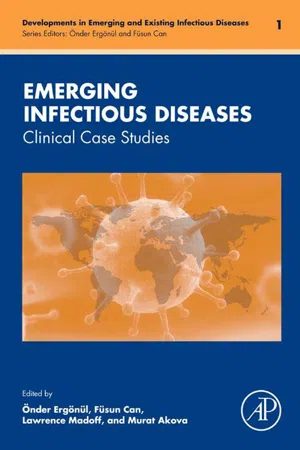
More than 30 newly emerged microorganisms and related diseases have been discovered in the past 20 years. Since these infections are so new, even infectious diseases experts and clinical microbiologists need more information. This book covers recently emerged infectious diseases based on real cases and provides comprehensive information including different aspects of the infections. Written in a 'teaching' style, this book is of interest to every medical specialist and student.
- Includes more than 35 emerging infection cases based on the following criteria:newly emerged or re-emergedrecently acquired significance in clinical practicerecently radically changed in case management
- Offers a balanced synthesis of basic and clinical sciences for each individual case, presenting clinical courses of the cases in parallel with the pathogenesis and detailed microbiological information for each infection
- Describes the prevalence and incidence of the global issues and current therapeutic approaches
- Presents the measures for infection control
Severe Fever with Thrombocytopenia Syndrome Associated with a Novel Bunyavirus
Keita Matsuno, Heinz Feldmann and Hideki Ebihara, Laboratory of Virology, Division of Intramural Research, National Institute of Allergy and Infectious Diseases, National Institutes of Health, Rocky Mountain Laboratories, Hamilton, MT, USA
Severe fever with thrombocytopenia syndrome virus (SFTSV) is a newly recognized pathogen and the first highly pathogenic tick-borne virus reported in the genus Phlebovirus, family Bunyaviridae. Except for some basic knowledge on viral biology and epidemiology as well as the establishment of diagnostics and the description of the clinical disease syndrome, little is known about this emerging pathogen. Currently, there are neither therapeutic approaches nor vaccines available for the treatment and prophylaxis of SFTSV infections. In the absence of more thorough ecology and epidemiology, prevention is based on education targeting towards avoiding exposure through ticks and blood and secretions/excretions of patients. Urgently needed are further studies on the pathogenesis and host responses to infection in order to define targets for therapeutic intervention and strategies for vaccination.
Keywords
severe fever with thrombocytopenia syndrome virus; SFTSV; phlebovirus; tick-borne disease; epidemiology; pathogenesis; diagnosis; disease control
Case Presentation
A 40-year-old female farmer, who lived in a rural, hilly area outside Chizhou city, in Anhui Province, China, was admitted to a hospital in Shanghai (400 km/78 miles from Chizhou) in the middle of May 2012. She had no other known underlying medical conditions but a history of schistosomiasis in 2008. There was no history of previous drug or food allergies or blood transfusions.
On May 16, 2012, the patient had sudden onset of fever with a peak temperature of 40°C accompanied by muscle pain. She was examined and subsequently admitted to a local hospital, where treatment with intravenous antibiotics was started. Following no improvement, the patient was transferred on May 19 to a hospital in Chizhou, where treatment was changed to aztreonam and ribavirin. With no changes in her clinical status and fever remaining high, the patient was transferred to a hospital in Shanghai on May 21, where she presented with continuing fever, chills, body aches, and diarrhea (five to six times a day). The suspected diagnosis of SFTS was made and the patient was admitted to the intensive care unit (ICU). Her treatment was continued with cefotiam, levodropropizine, and intensive care support. The condition of the patient deteriorated and she became apathetic on May 22. Subsequent treatment included vancomycin and platelet substitution therapy, but her condition further deteriorated. The following day she presented with a stiff neck, accompanied by enlarged lymph nodes in the neck, axillar and mediastinum, and abnormal brain waves on electroencephalogram. On May 25, the patient was in critical condition with shortness of breath, hypotension (88/50 mmHg), oliguria, severe acidosis, an abnormal flow index, but no skin bleeding or blood stasis. Thereafter, she was treated with prednisone, platelet and plasma transfusions, and hemodialysis before she died on the same day (May 25th) with multi-organ failure including kidney and lung, disseminated intravascular coagulation, and shock.
Laboratory findings showed decreased white blood cell counts throughout the disease progression, which increased on the day of her death. The platelet count (PLT) decreased over time along with concomitant prolonged thrombin time (TT) and activated partial thromboplastin time (APTT). Multi-organ dysfunction (including liver and kidney failure) was evident by elevated blood urea nitrogen (BUN) and hepatic transaminases (alanine aminotransferase, ALT; aspartate aminotransferase, AST), lactate dehydrogenase (LDH), and creatine kinase (CK). The presence of microscopic hematuria and proteinuria was also documented. On May 25 the results of an arterial blood gas were consistent with severe metabolic acidosis and respiratory compensation (pH: 7.17; PCO2: 14.0 mmHg; PO2: 110 mmHg;
SFTSV infection was confirmed by quantitative real-time reverse transcriptase polymerase chain reaction (RT-PCR) following death. The patient had no known exposure to tick bites, but contact history with birds, rodents, and other wild animals was reported. Her activities during the past 2 weeks prior to disease onset involved fieldwork collecting cotton, rice, and tea. She had no known exposure to an SFTSV case or a person with similar illness and no similar cases were found in and around her residence. No secondary SFTSV cases were found among her contacts (adapted from reference1).
1 Why this Case was Significantly Important as an Emerging Infection
Severe fever with thrombocytopenia syndrome (SFTS) was discovered in 2009 in Central China as a newly emerged clinical syndrome with clinical and epidemiological similarity to human anaplasmosis.2 The causative agent of SFTS was identified as a novel phlebovirus, SFTS virus (SFTSV). Currently, SFTS cases have been reported from China, Japan, and South Korea with case fatality rates ranging from 10 to 30%. A milder but similar disease has been reported from the United States caused by Heartland virus, which is a recently related discovered phlebovirus.3
2 What is the Causative Agent?
SFTSV is tentatively classified as a novel member of the genus Phlebovirus, family Bunyaviridae. As other bunyaviruses, SFTSV is an enveloped spherical-shaped particle, about 80–100 nm in diameter, carrying a genome of three segmented negative-stranded RNA molecules. The large RNA (L) segment is 6368 nucleosides in length and encodes for the RNA-dependent RNA polymerase (RdRp), which is responsible for viral RNA transcription and replication. The medium RNA (M) segment is 3378 nucleosides in length and encodes a membrane glycoprotein precursor, which is cleaved into the two mature membrane glycoproteins (Gn and Gc). Finally, the small RNA (S) segment is 1744 nucleosides in length encoding the nucleocapsid protein (N) and a non-structural protein (NSs) in an ambisense orientation (Figure 1.1).2 Based on phylogenetic analysis of SFTSV isolates/sequences, the Chinese isolates currently form five distinct genetic lineages.4 The Japanese isolates mostly belong to lineage D, whereas the Korean isolate clusters belong to l...
Table of contents
Cover image
Title page
Table of Contents
Copyright
Dedication
List of Contributors
Preface
Chapter 1. Severe Fever with Thrombocytopenia Syndrome Associated with a Novel Bunyavirus
Chapter 2. Bas-Congo Virus: A Novel Rhabdovirus Associated with Acute Hemorrhagic Fever
Chapter 3. Hantavirus Infections
Chapter 4. Lassa Fever
Chapter 5. Alkhurma Hemorrhagic Fever
Chapter 6. Rift Valley Fever
Chapter 7. Lujo Virus Hemorrhagic Fever
Chapter 8. Toscana Virus Infection
Chapter 9. Ebola Virus Disease
Chapter 10. Crimean-Congo Hemorrhagic Fever
Chapter 11. Phlebotomus Fever—Sandfly Fever
Chapter 12. Chikungunya Fever
Chapter 13. Nipah Virus Disease
Chapter 14. Middle East Respiratory Syndrome-Coronavirus (MERS-CoV) Infection
Chapter 22. The Exserohilum rostratum Incident: The Compounding Pharmacy as a Source of Emerging Infections
Chapter 23. Mucormycosis
Chapter 24. Lyme Borreliosis
Chapter 25. Plasmodium knowlesi
Chapter 26. Measles
Chapter 27. Pertussis
Chapter 28. Buruli Ulcer (Atypical Mycobacteria)
Index
Trusted by 375,005 students
Access to over 1.5 million titles for a fair monthly price.
Study more efficiently using our study tools.
Frequently asked questions
Yes, you can cancel anytime from the Subscription tab in your account settings on the Perlego website. Your subscription will stay active until the end of your current billing period. Learn how to cancel your subscription
No, books cannot be downloaded as external files, such as PDFs, for use outside of Perlego. However, you can download books within the Perlego app for offline reading on mobile or tablet. Learn how to download books offline
Perlego offers two plans: Essential and Complete
Essential is ideal for learners and professionals who enjoy exploring a wide range of subjects. Access the Essential Library with 800,000+ trusted titles and best-sellers across business, personal growth, and the humanities. Includes unlimited reading time and Standard Read Aloud voice.
Complete: Perfect for advanced learners and researchers needing full, unrestricted access. Unlock 1.5M+ books across hundreds of subjects, including academic and specialized titles. The Complete Plan also includes advanced features like Premium Read Aloud and Research Assistant.
Both plans are available with monthly, semester, or annual billing cycles.
We are an online textbook subscription service, where you can get access to an entire online library for less than the price of a single book per month. With over 1.5 million books across 990+ topics, we’ve got you covered! Learn about our mission
Look out for the read-aloud symbol on your next book to see if you can listen to it. The read-aloud tool reads text aloud for you, highlighting the text as it is being read. You can pause it, speed it up and slow it down. Learn more about Read Aloud
Yes! You can use the Perlego app on both iOS and Android devices to read anytime, anywhere — even offline. Perfect for commutes or when you’re on the go. Please note we cannot support devices running on iOS 13 and Android 7 or earlier. Learn more about using the app
Yes, you can access Emerging Infectious Diseases by Onder Ergonul,Fusun Can,Murat Akova,Lawrence Madoff in PDF and/or ePUB format, as well as other popular books in Sciences biologiques & Immunologie. We have over 1.5 million books available in our catalogue for you to explore.