The continuing evolving capability of guided weapons demands ever more knowledge of their development. This modern and comprehensive book covers the control aspect of guidance of missiles, torpedoes, robots, and even animal predators, from the viewpoint of the pursuer. The text studies trajectories, zones of interception, the required manoeuvre effort, time of flight, launch envelopes, and stability of the guidance process. Mathematics at first-year university level is the only prerequisite. Acquaintance with feedback control theory would be helpful to the reader.
- Covers the control aspect of guidance of missiles, torpedoes, robots, and even animal predators, from the viewpoint of the pursuer
- Studies trajectories, zones of interception, the required manoeuvre effort, time of flight, launch envelopes, and stability of the guidance process
This chapter is dedicated to definitions of several concepts and terms used in the study of guidance. Some of these definitions are not universal, there being differences between British and American usage as well as between individual authors. We shall use the terminology that seems most accepted, giving alternatives where relevant.
1.1 The Three Levels of the Guidance Process
‘Guidance’ is the process for guiding the path of an object towards a given point, which in general may be moving. If the given point is fixed and the guided object is ‘manned’ (or is, for example, a migrating bird), then the process is simply navigation.1 Thus, although navigation can be said to be a subclass of guidance, in this book we give the term ‘guidance’ a narrower meaning, which excludes navigation. This specific meaning will now be explained.
1.1.1 Definitions
Guidance is a hierarchical process which may be said to consist of three levels.
(a) In the highest one, a geometrical rule is stated in terms of a line-of-sight that passes through the objective of the guidance. We shall henceforth refer to this objective as the target T, and to the guided object as M. This definition serves to distinguish between guidance in the meaning given to it in this book and marine navigation, for example, or inertial guidance.
The kinematics of the engagement is dealt with in this level, and problems of shape of trajectories, curvature, and required lateral accelerations are examined. Time t, of course, is usually a parameter; very often, the total time of the guidance process, from t = 0 when it started till intercept at t = tf, is of importance. We call it the time-of-flight although M may not necessarily be an aircraft or a spacecraft.
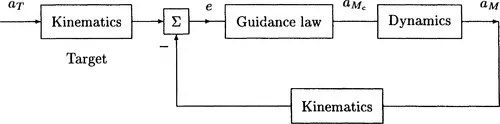
(b) In the second level of the process, a guidance law appears. A guidance law is the algorithm by which the desired geometrical rule is implemented; this is done by closing a guidance loop (Fig. 1.1). The ‘error’ e in this feedback loop is a direct function of the measured deviation of M’s state in space from the state required by the geometrical rule. It is used to produce a steering command given to M according to the guidance law.
Figure 1.1 The guidance loop
In most cases, the command is for lateral acceleration, which will be denoted here by
, ‘c’ signifying ‘command’. The lateral acceleration (sometimes called latax) actually performed by M is aM · Similarly, aT denotes the lateral acceleration of T. The resulting motion of M is such that e is reduced by the feedback, eventually driven to zero.
(c) We now come to the third level of the process, that of control. Here M is no more just a point. Rather, it is a body, say rigid, with mass and moments of inertia, whose attitude in space is defined by three angles. Clearly, it is in this level that we study the stability and performance of the body control loop, which is an inner loop whithin...
Table of contents
Cover image
Title page
Table of Contents
About the Author
Copyright page
Preface
Introduction
Chapter 1: Terminology and Definitions
Chapter 2: Line-of-Sight Guidance
Chapter 3: Pure Pursuit
Chapter 4: Parallel Navigation
Chapter 5: Proportional Navigation
Chapter 6: Mechanization of Proportional Navigation
Chapter 7: Guidance Laws Related to Prop. Navigation
Chapter 8: Modern Guidance Laws
Appendix A: Equations of Motion
Appendix B: Angular Transformations
Appendix C: A Few Concepts from Aerodynamics
Appendix D: Derivations of Several Equations
List of Symbols and Abbreviations
Index
Trusted by 375,005 students
Access to over 1.5 million titles for a fair monthly price.
Study more efficiently using our study tools.
Frequently asked questions
Yes, you can cancel anytime from the Subscription tab in your account settings on the Perlego website. Your subscription will stay active until the end of your current billing period. Learn how to cancel your subscription
No, books cannot be downloaded as external files, such as PDFs, for use outside of Perlego. However, you can download books within the Perlego app for offline reading on mobile or tablet. Learn how to download books offline
Perlego offers two plans: Essential and Complete
Essential is ideal for learners and professionals who enjoy exploring a wide range of subjects. Access the Essential Library with 800,000+ trusted titles and best-sellers across business, personal growth, and the humanities. Includes unlimited reading time and Standard Read Aloud voice.
Complete: Perfect for advanced learners and researchers needing full, unrestricted access. Unlock 1.5M+ books across hundreds of subjects, including academic and specialized titles. The Complete Plan also includes advanced features like Premium Read Aloud and Research Assistant.
Both plans are available with monthly, semester, or annual billing cycles.
We are an online textbook subscription service, where you can get access to an entire online library for less than the price of a single book per month. With over 1.5 million books across 990+ topics, we’ve got you covered! Learn about our mission
Look out for the read-aloud symbol on your next book to see if you can listen to it. The read-aloud tool reads text aloud for you, highlighting the text as it is being read. You can pause it, speed it up and slow it down. Learn more about Read Aloud
Yes! You can use the Perlego app on both iOS and Android devices to read anytime, anywhere — even offline. Perfect for commutes or when you’re on the go. Please note we cannot support devices running on iOS 13 and Android 7 or earlier. Learn more about using the app
Yes, you can access Missile Guidance and Pursuit by N A Shneydor in PDF and/or ePUB format, as well as other popular books in Technology & Engineering & Aerodynamics. We have over 1.5 million books available in our catalogue for you to explore.