- 830 pages
- English
- ePUB (mobile friendly)
- Available on iOS & Android
eBook - ePub
Handbook of Chemical Technology and Pollution Control
About this book
The Handbook of Chemical Technology and Pollution Control, Third Edition provides a detailed review of the chemistry and operating conditions of many of the present large-scale chemical processes important to our economy and high standards of living. The processes that could lead to emissions affecting our air, soil, and water are considered, together with ways in which it may be possible to reduce or eliminate these pollutants. Focusing on cleaner production concepts without neglecting 'end of pipe' measures. With an increase in the awareness of corporate and social responsibility among business and industry leaders, the pressure to reduce harmful emissions and the desire to increase efficiencies and energy utilization, this book provides an essential resource. Suitable for researchers, practitioners and postgraduate students in the fields of chemical and biochemical engineering and environmental science, as well as government monitoring and regulatory agencies and industry leaders who want to stay one step ahead, this book will be a valuable addition to any library.
- Integrated treatment of chemical technology with emission control chemistry
- Introductory outline of the causes and effects of air and water pollution chemistry
- Outline of the operating features and efficiency of basic emission control devices
- Historical background of developments in industrial chemistry to 2004 in a single volume
- Organized for easy access to chemical technology, new developments, or emission control details
- Referenced to current additional sources of information in each area covered
- Review questions provide working experience with the material provided
Information
1
Background and Technical Aspects
Take calculated risks. That is quite different from being rash.
—George S. Patton
1.1 IMPORTANT GENERAL CHARACTERISTICS
The business niche occupied by the chemical industry is of primary importance to the developed world in its ability to provide components of food, clothing, transportation, accommodation, and employment enjoyed by modern humanity. Most material goods are either chemical in origin or have involved one or more chemicals during the course of their manufacture. In some cases, the chemical interactions involved in the generation of final products are relatively simple ones. In others, such as the fabrication of some of the more complex petrochemicals and drugs, more complicated and lengthy procedures are involved. Also, most chemical processes use raw materials naturally occurring on or near the earth’s crust to produce the commodities of interest.
Consider the sources of some of the common chemical raw materials and relate these to products that are accessible via one or two chemical transformations in a typical chemical complex. Starting with just a few simple components—air, water, salt (NaCl), and ethane—together with an external source of energy, quite a range of finished products is possible (Fig. 1.1). While it is unlikely that all of these will be produced at any one location, many will be, and all are based on commercially feasible processes [1]. Thus, a company which focuses on the electrolytic production of chlorine and sodium hydroxide from salt will often be sited on or near natural salt beds in order to provide a secure source of this raw material. A large source of freshwater, such as a river or a lake will generally be used for feedstock and cooling water requirements. Quite often an oil refinery is one of a cluster of companies, which find it mutually advantageous to locate together. This can provide a supply of ethane, benzene, or other hydrocarbon feedstocks. In this manner all the simple raw material requirements of the complex can flow smoothly into the production of more than a dozen products for sale (Fig. 1.1).
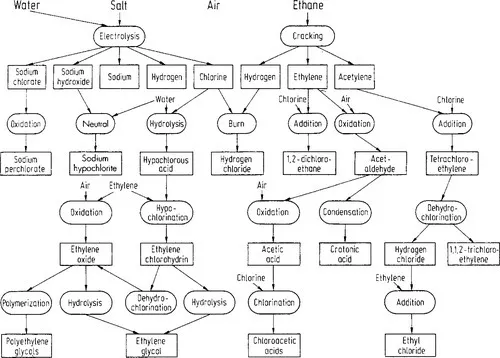
FIGURE 1.1 Flow sheet of a hypothetical though credible chemical complex based on only air, water, salt, and ethane raw materials. Ellipses represent processes, rectangles indicate products.
A rapid rise in the numbers of chemicals produced commercially, and a steady growth in the uses and consumption of these chemicals historically (since the 1930–1940 period), has given the chemical industry a high growth rate relative to other industrial activities. In current dollars, the average annual growth rate in the U.S.A. was about 11% per year in the 1940s and just over 14% per year through the 1970s, seldom dropping below 6% in the intervening period. Plastics and basic organic chemicals have generally been the stronger performing sectors of the chemical industry. Basic inorganic chemicals production, a “mature” area of the industry, has shown slower growth. World chemical export growth has been strong too, having averaged just over a 17% annual growth rate during the 1968–1978 interval. However, growth rates based on current dollar values, such as these are, fail to recognize the salutary influence of inflation. Using a constant value dollar, and smoothing the values over a 10-year running average basis gives the maximum for the real growth rate of about 9% per year occurring in 1959, tapering down to about 1–3% per year by 1990. The slowing of the real growth rate in recent years may be because the chemical industry is gaining maturity. More recently, there may also have been a contribution from the global business recessions.
Most of the machinery and containment vessels required for chemical processing are expensive, in part because of the high degree of automation used by this industry. This means that the labor requirement is relatively low, based on the value of products. Put in another way, in the U.S., the investment in chemical plant per employee has amounted to about $30,000 per worker at the time when the average for all manufacturing stood at $14,000 per worker. In the U.K., this ratio of capital investment per employee in the chemical industry versus the investment by all manufacturing is very similar to the experience in the U.S.A. In 1963, these figures stood at 7,000 and 3,000 pounds, and in 1972, 17,000 and 7,000 pounds, respectively [2].
Yet another way of considering the relationship of investment to the number of employees is in terms of the “value added per employee,” The value added is defined as the market price of a good minus the cost of raw materials required to produce that good [3]. It can be used as a measure of the worth of processing a chemical in terms of its new (usually greater) value after processing than before. When the gross increase in value of the products of a chemical complex is divided by the numbers of employees operating the complex, one arriv...
Table of contents
- Cover image
- Title page
- Table of Contents
- Copyright page
- Foreword to the Third Edition
- Preface to the Third Edition
- Preface to the Second Edition
- Preface to the First Edition
- Acknowledgments
- 1: Background and Technical Aspects
- 2: Air Quality Measurement and Effects of Pollution
- 3: Air Pollution Control Priorities and Methods
- 4: Water Quality Measurement
- 5: Raw Water Processing and Wastewater Treatment
- 6: Natural and Derived Sodium and Potassium Salts
- 7: Industrial Bases by Chemical Routes
- 8: Electrolytic Sodium Hydroxide, Chlorine, and Related Commodities
- 9: Sulfur and Sulfuric Acid
- 10: Phosphorus and Phosphoric Acid
- 11: Ammonia, Nitric Acid and Their Derivatives
- 12: Aluminum and Compounds
- 13: Ore Enrichment and Smelting of Copper
- 14: Production of Iron and Steel
- 15: Production of Pulp and Paper
- 16: Fermentation and other Microbiological Processes
- 17: Petroleum Production and Transport
- 18: Petroleum Refining
- 19: Petrochemicals
- 20: Condensation (Step-Growth) Polymer Theory
- 21: Commercial Polycondensation (Step-Growth) Polymers
- 22: Addition (Chain Reaction) Polymer Theory
- 23: Commercial Addition (Vinyl-Type) Polymers
- 1: Information Related to Soil Pollution Topics
- 2: Relevant Technical Websites by Topic
- 3: Constants, SI Units, and Multiples and Formulas
- 4: Conversion Factors, Viscosity Data
- Index
Trusted by 375,005 students
Access to over 1.5 million titles for a fair monthly price.
Study more efficiently using our study tools.
Frequently asked questions
Yes, you can cancel anytime from the Subscription tab in your account settings on the Perlego website. Your subscription will stay active until the end of your current billing period. Learn how to cancel your subscription
No, books cannot be downloaded as external files, such as PDFs, for use outside of Perlego. However, you can download books within the Perlego app for offline reading on mobile or tablet. Learn how to download books offline
Perlego offers two plans: Essential and Complete
- Essential is ideal for learners and professionals who enjoy exploring a wide range of subjects. Access the Essential Library with 800,000+ trusted titles and best-sellers across business, personal growth, and the humanities. Includes unlimited reading time and Standard Read Aloud voice.
- Complete: Perfect for advanced learners and researchers needing full, unrestricted access. Unlock 1.5M+ books across hundreds of subjects, including academic and specialized titles. The Complete Plan also includes advanced features like Premium Read Aloud and Research Assistant.
We are an online textbook subscription service, where you can get access to an entire online library for less than the price of a single book per month. With over 1.5 million books across 990+ topics, we’ve got you covered! Learn about our mission
Look out for the read-aloud symbol on your next book to see if you can listen to it. The read-aloud tool reads text aloud for you, highlighting the text as it is being read. You can pause it, speed it up and slow it down. Learn more about Read Aloud
Yes! You can use the Perlego app on both iOS and Android devices to read anytime, anywhere — even offline. Perfect for commutes or when you’re on the go.
Please note we cannot support devices running on iOS 13 and Android 7 or earlier. Learn more about using the app
Please note we cannot support devices running on iOS 13 and Android 7 or earlier. Learn more about using the app
Yes, you can access Handbook of Chemical Technology and Pollution Control by Martin B. B. Hocking in PDF and/or ePUB format, as well as other popular books in Technology & Engineering & Chemical & Biochemical Engineering. We have over 1.5 million books available in our catalogue for you to explore.