- 440 pages
- English
- ePUB (mobile friendly)
- Available on iOS & Android
eBook - ePub
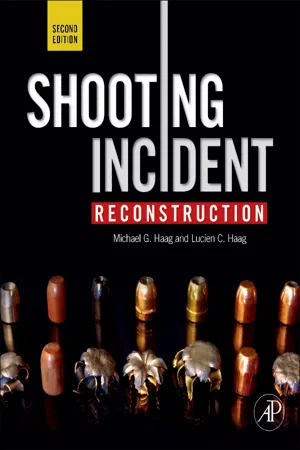
Shooting Incident Reconstruction
About this book
Shooting Incident Reconstruction, Second Edition, offers a thorough explanation of matters from simple to complex to help the reader understand the factors surrounding ballistics, trajectory, and shooting scenes.
Forensic scientists, law enforcement, and crime scene investigators are often tasked with reconstruction of events based on crime scene evidence, along with the subsequent analysis of that evidence. The use and misuse of firearms to perpetrate crimes from theft to murder necessitates numerous invitations to reconstruct shooting incidents. The discharge of firearms and the behavior of projectiles create many forms of physical evidence that, through proper testing and interpretation by a skilled forensic scientist, can establish what did and what did not occur.
Written by the world's most well-respected shooting scene and ballistics experts, the book addresses the terminology, science, and factors involved in reconstructing shooting incident events to solve forensic cases. It covers the full range of related topics including: the range from which a firearm was discharged; the sequence of shots in a multiple discharge shooting incident; the position of a firearm at the moment of discharge; and the position of a victim at the moment of impact. The probable flight path of a projectile and the manner in which a firearm was discharged are also discussed. Case studies illustrate real-world application of technical concepts, supported by over 200 full-color diagrams and photographs.
This book will be of value to practicing forensic scientists (firearm and toolmark examiners), ballistics experts, crime scene personnel, police departments, forensic consultants (generalists), attorneys and judges, medical examiners (coroners), and forensic pathologists.
- Written by the most well-respected shooting scene and ballistics experts in the world
- Contains over 200 full-color diagrams and photographs that support and illustrate key concepts
- Case studies illustrate real-world application of technical concepts
Information
Chapter 1. Case Approach, Philosophy, and Objectives
A good starting place in most endeavors is an overview of end goals, or an establishment of some basic expectations. Chapter 1 of this book defines what “Shooting Incident Reconstruction” is, and provides the reader with an idea of some of the many avenues an investigation of this type may take. From this chapter, the reader should immediately grasp a fundamental truth that is slipping away from common knowledge in many crime lab systems: science does not mean the scientist follows a cookbook procedure; the true scientist operates using thought and experience, and experimentation. The chapter also outlines suggested basic skills a practitioner should have in doing shooting reconstruction, and highlights the need for communication between other individuals involved in a case. The basic case approach of understanding what is not in dispute, and what is in dispute requires that reconstructionists (1) take it upon themselves to learn as much as possible and relevant about an incident, and (2) be allowed by management and authorities to obtain such information. The chapter ends with a set of common examples of questions that may or may not be answered by an examination of physical evidence. The methodology for answering these questions is in large part the body of the text.
Keywords: methodology, procedure, scientific method, technician, scientist, Locard
Why this Book?
Many years ago I was rigorously cross-examined by an excellent attorney who had put considerable thought and preparation into his questions. My work on the case was totally reconstructive in nature, and my cross-examiner attempted to exclude my testimony on the basis that there was no such thing as “shooting reconstruction.” He went on to claim that the term was something that I had made up. At the time I could not name a single textbook entitled Shooting Reconstruction that dealt specifically with shooting scene reconstruction or that had “Shooting Reconstruction” in its title. Neither could I name a forensic science textbook that even had a chapter devoted to this subject. 1 To those who have familiarity with case law and tests of admissibility in the American legal system, the attorney’s argument was basically a Frye challenge (Frye v. U.S., 1923).
1There was in fact a book that dealt almost exclusively with shooting incident reconstruction when I was rigorously cross-examined some 20 years ago. Written by G.G. Kelly and first published in 1963, The Gun in the Case (Whitcombe & Tombs, Christschurch, NZ) is long out of print but a good read if you can find a copy. Kelly was the arms and ballistics officer for the New Zealand Police from 1929 to 1955. While I survived my cross-examiner’s attack and my testimony was allowed in the trial, I nonetheless wished that I had known of this fascinating book at the time.
With what has resulted because of the Daubert and Kumho decisions (Daubert v. Merrell Dow Pharmaceuticals, 1993; Kumho Tire Co. v. Carmichael, 1999), future challenges are likely to be raised where reconstructive efforts have been undertaken in a shooting case and the results are offered at trial. The idea for this book was the direct result of my cross-examination and is the product of nearly 40 years of applied research, casework, and trial experience in this specialized area of criminalistics.
Reconstruction: The Ultimate Goal of Criminalistics
It may be useful to pause a moment and consider the very concept of reconstruction and whether it is a legitimate function of forensic science. Probably the best quotes on this subject come from a contemporary textbook on criminalistics by De Forest et al. 2 and are as follows:
2Forensic Science: An Introduction to Criminalistics by Peter De Forest, Robert Gaensslen, and Henry Lee (McGraw-Hill, 1983).
p. 29: “Physical evidence analysis is concerned with identification of traces of evidence, reconstruction of events from the physical evidence record, and establishing a common origin of samples of evidence.”
p. 45: “Reconstruction can assist in deciding what actually took place in a case and in limiting the different possibilities. Eyewitnesses to events are notoriously unreliable. People have trouble accurately remembering what they saw, particularly if a complex series of events takes place suddenly and unexpectedly. Reconstruction may provide the only ‘independent witness’ to the events and thus allow different eyewitness accounts to be evaluated for accuracy.”
p. 294: “Crime-scene reconstruction techniques are employed to learn what actually took place in a crime. Knowledge of what took place and how or when it happened can be more important than proving that an individual was at a scene. A skilled reconstruction can be successful in sorting out the different versions of the events and helping to support or refute them.”
Events that arise out of the use or misuse of firearms offer some very special and unique opportunities from a reconstruction standpoint. The wide variety of firearms and ammunition types, the relatively predictable behavior of projectiles and firearms discharge products, the chemistry of many of these ammunition-related products, and certain laws of physics may be employed to evaluate the various accounts and theories of how an event took place. To some degree this is little different from the well-known principles of traffic accident reconstruction, where the “ballistic” properties of motor vehicles give rise to momentum transfer, crush damage, and trace evidence exchanges. These phenomena are routinely used to reconstruct such things as the sequence of events, the location of one or more impacts, approximate speeds of vehicles, and so forth.
In summary and in fact, there are many criminalists and forensic firearm examiners who perform various types of shooting scene reconstruction. A distance determination based on a powder pattern around a bullet hole is probably the simplest example of a reconstruction. A shotgun range-of-fire determination based on pellet pattern diameter represents another common example. This book is an effort to describe the various principles of scene reconstruction as they relate to shooting incidents.
Basic Skills and Approach to Casework
From the very onset, the true forensic scientist must be proactive by finding out what the case is about. From this, he or she must then make certain scientific assessments, define the important issues and questions in the case, ascertain what is in dispute, and then ultimately design a testing protocol based on the information derived from these previous efforts. He or she must focus on the issues in the case itself and not just the items of physical evidence.
The first step should not be placing an evidence bullet on a scale to get its weight or test-firing a submitted gun to verify its operability. Rather it should, and must, be a reasoning process after making inquiry into the facts and issues in the particular case. This has always been and remains within the forensic scientist’s control even in a laboratory that has been reduced to a clinical model. It simply requires that the analyst pick up the telephone and call the submitting investigator or attorney handling the case to ask a few key questions such as:
• Tell me about this case.
• What are the issues?
• What do any witnesses to the incident say happened?
• Did the shooter provide an explanation?
• What is and what is not in dispute in this case?
• What are the competing ...
Table of contents
- Cover image
- Table of Contents
- Front-matter
- Copyright
- Dedication
- Introduction
- Introduction to First Edition
- Chapter 1. Case Approach, Philosophy, and Objectives
- Chapter 2. Working Shooting Scenes
- Chapter 3. The Reconstructive Aspects of Class Characteristics and a Limited Universe
- Chapter 4. Is It a Bullet Hole?
- Chapter 5. Some Useful Reagents and Their Application
- Chapter 6. Distance and Orientation Derived from Gunshot Residue Patterns
- Chapter 7. Projectile Penetration and Perforation
- Chapter 8. Projectiles and Glass
- Chapter 9. Projectile Ricochet and Deflection
- Chapter 10. The Principles of “Trajectory” Reconstruction
- Chapter 11. Determining Bullet Track (“Trajectory”) in Gunshot Victims
- Chapter 12. Trace Evidence Considerations Associated with Firearms
- Chapter 13. True Ballistics: Long-Range Shootings and Falling Bullets
- Chapter 14. Cartridge Case Ejection and Ejection Patterns
- Chapter 15. The Shooting of Motor Vehicles
- Chapter 16. Shotgun Shootings and Evidence
- Chapter 17. Sound Levels of Gunshots, Supersonic Bullets, and Other Impulse Sounds
- Chapter 18. Ultimate Objectives, Reports, and Court Presentations
- Appendix
- Glossary
- Index
Trusted by 375,005 students
Access to over 1.5 million titles for a fair monthly price.
Study more efficiently using our study tools.
Frequently asked questions
Yes, you can cancel anytime from the Subscription tab in your account settings on the Perlego website. Your subscription will stay active until the end of your current billing period. Learn how to cancel your subscription
No, books cannot be downloaded as external files, such as PDFs, for use outside of Perlego. However, you can download books within the Perlego app for offline reading on mobile or tablet. Learn how to download books offline
Perlego offers two plans: Essential and Complete
- Essential is ideal for learners and professionals who enjoy exploring a wide range of subjects. Access the Essential Library with 800,000+ trusted titles and best-sellers across business, personal growth, and the humanities. Includes unlimited reading time and Standard Read Aloud voice.
- Complete: Perfect for advanced learners and researchers needing full, unrestricted access. Unlock 1.5M+ books across hundreds of subjects, including academic and specialized titles. The Complete Plan also includes advanced features like Premium Read Aloud and Research Assistant.
We are an online textbook subscription service, where you can get access to an entire online library for less than the price of a single book per month. With over 1.5 million books across 990+ topics, we’ve got you covered! Learn about our mission
Look out for the read-aloud symbol on your next book to see if you can listen to it. The read-aloud tool reads text aloud for you, highlighting the text as it is being read. You can pause it, speed it up and slow it down. Learn more about Read Aloud
Yes! You can use the Perlego app on both iOS and Android devices to read anytime, anywhere — even offline. Perfect for commutes or when you’re on the go.
Please note we cannot support devices running on iOS 13 and Android 7 or earlier. Learn more about using the app
Please note we cannot support devices running on iOS 13 and Android 7 or earlier. Learn more about using the app
Yes, you can access Shooting Incident Reconstruction by Michael G. Haag,Lucien C. Haag in PDF and/or ePUB format, as well as other popular books in Social Sciences & Forensic Science. We have over 1.5 million books available in our catalogue for you to explore.