- 924 pages
- English
- ePUB (mobile friendly)
- Available on iOS & Android
eBook - ePub
The Biology of Cholesterol and Related Steroids
About this book
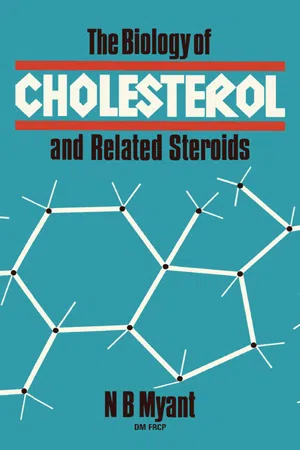
The Biology of Cholesterol and Related Steroids focuses on the study of sterols in relation to living organisms. The publication first takes a look at the analysis of sterols and related steroids and the distribution of sterols and related steroids in nature, as well as the processes of extraction and separation and presence of sterols in plants, fungi, vertebrates, and invertebrates. The text then ponders on biosynthesis of sterols and metabolism of cholesterol. Topics include formation of fatty acid esters of cholesterol, steroid hormones, biosynthetic pathway to sterols, reaction mechanisms, and comparative aspects of sterol synthesis. The manuscript examines the developmental aspects of cholesterol metabolism and sterols in biological membranes. The book also reviews cholesterol synthesis in animal tissues, sterol metabolism in isolated cells, and epidemiology of the plasma cholesterol. Discussions focus on selection of statistical populations, genetic influences, regulation of sterol synthesis, general aspects of sterol metabolism, and removal of cell cholesterol in vivo. The publication is a dependable source of data for biochemists and readers interested in the biology of cholesterol and steroids.
Information
Chapter 1
Chemistry
Publisher Summary
This chapter provides an overview of the chemistry of sterol and steroids. Many substances present in animals and plants are related structurally to cholesterol. All these substances have a nucleus containing the four-ringed carbon skeleton of cyclopentenophenanthrene and are known as steroids. The term sterol commonly refers to any unsaponifiable steroid alcohol with an aliphatic side-chain of 8–10 carbon atoms and a hydroxyl group at C-3. Certain aspects of the stereochemistry of organic molecules are of fundamental importance in the biogenesis and metabolism of cholesterol and other steroids. The conformation of a substituent in the steroid nucleus has a considerable influence on its stability and reactivity. As adjacent axial groups are closer to each other than are adjacent equatorial groups, and repel each other more strongly, a substituent is usually more stable if it is equatorial than if it is axial. The conformation of substituents influences the behavior of steroids during adsorption or partition chromatography, and may significantly limit or facilitate the chromatographic separation of isomers.
1 THE DISCOVERY OF CHOLESTEROL AND PLANT STEROLS
2 DEFINITIONS
2.1 Steroid and sterol
2.2 Some stereochemical terms
2.2.1 Stereoisomerism
2.2.2 Configuration
2.2.3 Prochirality and chirality
2.2.4 A brief diversion on chirality in nature
2.2.5 Conformation
2.2.6 Relative and absolute configuration
3 RULES FOR STEROID NOMENCLATURE
3.1 The need for a system
3.2 Numbering of carbon atoms
3.3 Configuration
3.4 The side-chain
3.5 The sequence-rule procedure
3.6 A disadvantage of the R/S system
3.7 Parent steroids
3.8 The language of steroid nomenclature
3.9 Trivial names
3.10 Nomenclature of isotopically labelled steroids
4 THE CONFORMATION OF THE STEROID RING SYSTEM
5 THE STEREOCHEMISTRY OF CHOLESTEROL
6 HISTORY OF THE ELUCIDATION OF STEROID STRUCTURE AND CONFIGURATION
6.1 Early history
6.2 Background to later history
6.3 The functional groups and the side-chain
6.4 The four steroid rings
6.5 Configuration
7 SOME PHYSICAL AND CHEMICAL PROPERTIES
7.1 Physical constants
7.2 Liquid crystal formation
7.3 Some chemical reactions of cholesterol
7.3.1 Formation of digitonides
7.3.2 Formation of a dibromide
7.3.3 Oxidation by molecular oxygen
7.3.4 Colour reactions of sterols
7.3.4.1 The Liebermann-Burchard reaction
7.3.4.2 The Lifschütz reaction
7.3.4.3 Other colour reactions
7.3.4.4 Mechanism of colour reactions
1 THE DISCOVERY OF CHOLESTEROL AND PLANT STEROLS
The study of gallstones during the latter half of the eighteenth century led to the discovery that the major constituent of most human gallstones is a white crystalline substance soluble in alcohol and ether. Chevreul (1816) named this substance Cholestérine (Gr. choie, bile; stereos, solid) but the name cholesterol was adopted by French and English workers when Berthelot (1859) showed that Cholesterine was an alcohol. By the 1840’s the compound now known as cholesterol had been shown to be a normal constituent of many animal tissues and in 1843 Vogel showed that it was present in the atheromatous lesions of human arteries. In the early years of the present century relatively simple colorimetric and gravimetric methods were developed for the assay of cholesterol in plasma and tissues. The availability of these methods for routine work opened the way for the study of cholesterol by clinicians, pathologists and epidemiologists and is largely responsible for the fact that, in relation to human health and disease, we now have so much more information about cholesterol than about other lipids.
Substances closely resembling cholesterol began to be isolated from fungi and green plants several decades after the discovery and characterization of cholesterol. The first unequivocal report of such a substance was that of Tanret (1889), who isolated a cholesterol-like crystalline compound from rye seeds infected with ergot and called it ergostérine (now called ergosterol). In 1906, Windaus and Hauth isolated from Calabar beans (Physostigma venenosum) a substance, similar to cholesterol, which they designated stigmasterin. Since then, a great many other ‘sterols’ have been isolated from the non-saponifiable fraction obtained from various parts of plants. Some of these are mentioned in Chapter 3.
2 DEFINITIONS
2.1 Steroid and sterol
Many substances present in animals and plants, including those with such diverse biological functions as bile acids, sex hormones and the sapogenins, are related structurally to cholesterol. All these substances have a nucleus containing the four-ringed carbon skeleton of cyclopentenophenanthrene (1.1) and are known as steroids. The general structural formula for the steroids, including the designation of the four rings, is shown in (1.2). R1 and R2 are usually methyl groups and R3 is usually a side-chain. However, in some steroids R1 is absent (as in oestrone), in others R2 is modified (as in aldosterone) and in some there is no side-chain.
The term sterol is used with different shades of meaning by different writers and cannot be defined precisely. Most commonly it refers to any unsaponifiable steroid alcohol with an aliphatic side-chain of 8–10 carbon atoms and a hydroxyl group at C-3. The word may be prefixed, as in hydroxysterol (any sterol with one or more hydroxyl groups additional to that at C-3) and phytosterol (sterols present in plants). The term stenol usually refers to sterols with one or more nuclear double bonds, and stanol to their saturated homologues. Tetra...
Table of contents
- Cover image
- Title page
- Table of Contents
- Inside Front Cover
- Copyright
- Preface
- Acknowledgements
- Partial List of Abbreviations
- Conversion table for cholesterol concentration (mg/100 ml ≡ mmol/l)
- Chapter 1: Chemistry
- Chapter 2: Analysis of Sterols and Related Steroids
- Chapter 3: The Distribution of Sterols and Related Steroids in Nature
- Chapter 4: The Biosynthesis of Sterols
- Chapter 5: The Metabolism of Cholesterol
- Chapter 6: Developmental Aspects of Cholesterol Metabolism
- Chapter 7: Sterols in Biological Membranes
- Chapter 8: Cholesterol Synthesis in Animal Tissues
- Chapter 9: Sterol Metabolism in Isolated Cells
- Chapter 10: Cholesterol Metabolism in the Whole Body
- Chapter 11: The Plasma Cholesterol: Composition and Metabolism
- Chapter 12: The Epidemiology of the Plasma Cholesterol
- Chapter 13: Cholesterol and Atherosclerosis
- Chapter 14: Disorders of Cholesterol Metabolism: Introduction
- Chapter 15: Disorders of Cholesterol Metabolism: The Hyperlipoproteinaemias
- Chapter 16: Disorders of Cholesterol Metabolism: The Hypolipoproteinaemias
- Chapter 17: Sterol Storage Diseases
- Chapter 18: Cholesterol Gallstones; Plasma Cholesterol in Liver Disease
- Index
Trusted by 375,005 students
Access to over 1.5 million titles for a fair monthly price.
Study more efficiently using our study tools.
Frequently asked questions
Yes, you can cancel anytime from the Subscription tab in your account settings on the Perlego website. Your subscription will stay active until the end of your current billing period. Learn how to cancel your subscription
No, books cannot be downloaded as external files, such as PDFs, for use outside of Perlego. However, you can download books within the Perlego app for offline reading on mobile or tablet. Learn how to download books offline
Perlego offers two plans: Essential and Complete
- Essential is ideal for learners and professionals who enjoy exploring a wide range of subjects. Access the Essential Library with 800,000+ trusted titles and best-sellers across business, personal growth, and the humanities. Includes unlimited reading time and Standard Read Aloud voice.
- Complete: Perfect for advanced learners and researchers needing full, unrestricted access. Unlock 1.5M+ books across hundreds of subjects, including academic and specialized titles. The Complete Plan also includes advanced features like Premium Read Aloud and Research Assistant.
We are an online textbook subscription service, where you can get access to an entire online library for less than the price of a single book per month. With over 1.5 million books across 990+ topics, we’ve got you covered! Learn about our mission
Look out for the read-aloud symbol on your next book to see if you can listen to it. The read-aloud tool reads text aloud for you, highlighting the text as it is being read. You can pause it, speed it up and slow it down. Learn more about Read Aloud
Yes! You can use the Perlego app on both iOS and Android devices to read anytime, anywhere — even offline. Perfect for commutes or when you’re on the go.
Please note we cannot support devices running on iOS 13 and Android 7 or earlier. Learn more about using the app
Please note we cannot support devices running on iOS 13 and Android 7 or earlier. Learn more about using the app
Yes, you can access The Biology of Cholesterol and Related Steroids by N. B. Myant in PDF and/or ePUB format, as well as other popular books in Biological Sciences & Biology. We have over 1.5 million books available in our catalogue for you to explore.