eBook - ePub
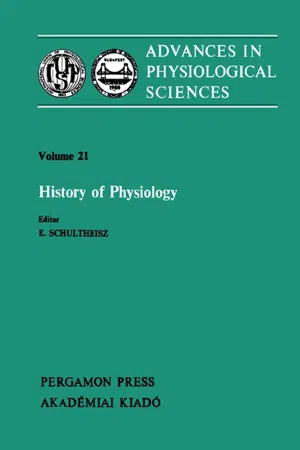
History of Physiology
Proceedings of the 28th International Congress of Physiological Sciences, Budapest, 1980
- 224 pages
- English
- ePUB (mobile friendly)
- Available on iOS & Android
eBook - ePub
History of Physiology
Proceedings of the 28th International Congress of Physiological Sciences, Budapest, 1980
About this book
Advances in Physiological Sciences, Volume 21: History of Physiology covers the proceedings of the symposia of the 28th Congress of Physiology. Comprised of nine chapters, the book reviews the history of physiological studies. The first chapter discusses the beginnings of the quantitative thinking in medicine, while the second chapter tackles the relation of clinical to non-clinical medicine according to Thomas Sydenham. The next chapter reviews the history of comparative physiology, and Chapter 4 discusses the historical development of cognitive psychophysiology. Chapter 5 deals with the study on the medical heritage of Avicenna, and Chapter 6 talks about studies on the anatomy and physiology of the pig fetus and placenta. The seventh chapter tackles physiological concepts in ancient and medieval India, while the eighth chapter discusses Jan Nepomuk Czermak in Hungary. The last chapter presents A Short Summation of Physiology, the first book of physiology in Hungarian. Readers who have an interest in the history of medical studies will find the book appealing, since it focuses on the historical aspect rather than the technical aspect.
Information
ON THE BEGINNINGS OF QUANTITATIVE THINKING IN MEDICINE (NICHOLAS OF CUSA AND THE IDIOT)
Emil Schultheisz, Central State Hospital, 4 Kútvölgyi út, Budapest, Hungary
Publisher Summary
Clinical and theoretically nonclinical medicine did not develop quite separately, but followed a nearly common path. This is particularly true for the period called the classical background period of modern, partly experimental, medicine both in clinical and nonclinical disciplines. It is generally known that nonclinical medicine is the same as experimental medicine. Experimental medicine can be said to have evolved during the Renaissance. This chapter outlines some of the literary data that came to shape the late mediaeval and Renaissance approach to scientific development in an era when qualitative elements were slowly replaced by quantifiable data in medical thinking. These efforts had laid the foundations of modern medicine during the second half of the 17th century.
Personally, I am convinced that clinical and theoretically non-clinical medicine did not develop quite separately, but followed a nearly common path. This was particularly true for the period I shall call the “classical background period” of modern, partly experimental, medicine both in clinical and non-clinical disciplines.
It is generally known that non-clinical medicine is the same as experimental medicine.
Experimental medicine may be said to have evolved during the Renaissance. But the predecessor is Herophilos /300 BC/. Markellinos writes as follows: “Herophilos placed such a great faith in the frequency of the pulse as a reliable symptom that he constructed a clepsydra with a capacity corresponding to the normal pulse beat at each age. In visiting patients he set up the clepsydra and felt the pulse of feverish, then the more the pulse beats exceeded the normal number by the time the clepsydra was filled, all the more was the pulse accelerated, according to his explanations, that is to say the more or less was the fever” [1].
Nicholas of Cusa /1401–1464/ was an extremely creative scholar and an excessively productive writer. Apart from theological writing, Cusanus is notable for his great influence on mediaeval thought. His versatile genius embraced law and government, metaphysics, astronomy, philosophy, and natural sciences. The works of Cusanus became widely known among the scholars of his age. Therefore it is not surprising that the subject of later experiments and the way of thinking of Jan Baptist von Helmont /1577–1644/ are very similar to those found in Cusa’s Idiota de staticis experimentis. The Idiota comprises four books: De sapientia /two books/, De mente, and De staticis experimentis. This work was completed in September of 1450. The four volumes of the Idiota were written in dialogue form in which Cusa’s opinions are expressed by the Idiot or citizen /i.e. the layman, in modern terms/ in response to the questions posed by the Orator.
Both the style of communication between the Orator and the Idiot and the concept of the knowledge that could be gained by understanding the differences existing between Orator and Idiot are clearly revealed in the passage quoted from a later English translation of 1650 /printed for William Leake, London/.
“AUTHOR. In the Roman FORUM or Market place, a certaine poore Idiot, or private man, met a very rich Oratour, whom courteously smiling he thus spoke unto.
ORATOR. How canst thou being an Idiot, be brought to the knowledge of thy ignorance?
IDIOT. Not by they bookes, but Gods books.
ORATOR. Which are they?
IDIOT. Those which he wrote with his own finger” [2].
The Idiot claims that such a work would be most welcome, whereupon the Orator attests that no man could do better than the Idiot. Lack of enthusiasm keeps the Idiot from carrying out the work.
“ORAT. Tell me the profit of it, and the meanes how to doe it, and I will see what I myselfe, or some other, at my entreaty can doe at it.
ID. By the differences of Weights, I thinke wee may more truly come to the secret of things, and that many things may be known by a more probable conjecture” [3].
About 15 pages of arguments follow. Then the Orator continues:
“ORAT. These be fine things, but might not the same be done in Herbs, and all the kinds of woods, flesh, living creatures, and humars?
ID. In all I thinke. For weighing a piece of Wood, and then burning it throughly, and then weighing the ashes, it is knowne how much water there was in the wood, for there is nothing that hath a heavie weight but water and earth. It is knowne moreover by the divers weight of wood in aire, water and dyle, how much the water that is in wood, is heavier or lighter than clean spring water, and so how much aire there is in it. So by the diversity of the weight of ashes, how much fire there is in them: and of the Elemens may bee gotten by a nearer conjecture, though precision be always inattingible. And as I have said, of Wood, so may be done with Herbs, flesh, and other things” [4].
The ideas deriving from the De staticis experimentis which led John Dee /1570/, the well-known scientist, to praise Nicholas of Cusa’s quantitative use of the balance [5], and later, in 1614, prompted Santorio Santorio /1561–1636/ to write his De statica medicina [6]. In the same tradition Stephen Hales /1677–1761/ wrote his Vegetable Staticks /1727/, later to form a part of his two-volume Statical Essays /1738/, regarded as the first English treatise on plant physiology [7].
Cusa essentially begins with the sceptical idea of the impossibility of attainment of perfect or complete knowledge on this earth, and the need for approaching truth by short, incomplete steps which are true as far as they go. These are his “conjectures” which nonetheless comprehend real knowledge, and are increasingly subject to accumulating experience, participating thus effectively in conceiving the truth as it is. For, in agreement with Plato /ca. 427–347 BC/, he believed that “the knowledge which we have will answer to the truth which we have” [8]. A natural development of this view was his doctrine of “Learned Ignorance”, that the more we learn, the more we come to a realization of our own real ignorance in the face of infinity.
Cusa objected on reason and logic to the scholastics in learning about God, the Universe, or the world around us. In metaphysics he makes a distinction between reason and intellect: Reason must think in opposites. A is either B or not B. A figure is either a circle or not a circle. A square is not a circle. To reason, a circle and a square are separate, yet as the number of sides increases toward infinity, the difference between a polygon and circle disappears, and the law of opposites no longer holds, but a new law appears, the coincidence of opposites. This is an act of intellect. God is of course both Being and Non-Being, and the reconciliation of opposites in God gives the real validity to the whole argument [9].
In the physical world, reason and logic represent the fundamental approach to wisdom. Observation and measurement are so important that they become practically the etalon of the human mind. This is expressed in the very first pages, which echo the words of a sermon of Johannes Tauler /ca. 1300–1361/, one of the great German mystics /known as the “Illuminated Doctor”/, who had written that “The great masters of Paris read big books and turn the pages; this is good, but others read the living book where everything lives eternally and turn to the heavens and the earth…” [10].
Cusa’s association of the mind and measurement comes later on in the form of a Latin pun: “I think there is not, nor even was, any perfect man that did not frame some conception of the mind, such as it was I for my part, have a conception, that the mind is the bond and measure of all things, and I conjecture it is called Mens a Mensurando, the mind from measuring” [11].
As mentioned before, Cusa’s observations on natural philosophy are contained in The Fourth Booke CONCERNING STATICK EXPERIMENTS; OR EXPERIMENTS OF THE BALLANCE.
A discussion of the value of measurement is presented under a whole range of situations. The weight of water is first considered, recalling Marcus Pollio Vitruvius /Roman architect and engineer of the 1st century BC/ who, “writing of Architecture, bids us chuse such a place to dwell in, as hath light and airy waters, and avoid them places, whose waters are heavie and earthy” [12]. They continue with the specific gravity of blood and urine, in sickness and health, at various ages, and in different countries, then with medicinal “Herbs, Stocks, Leaves, Fruits, Seeds, and Juyc...
Table of contents
- Cover image
- Title page
- Table of Contents
- ADVANCES IN PHYSIOLOGICAL SCIENCES
- Copyright
- FOREWORD
- AN EVENT IN THE HISTORY OF PHYSIOLOGY: Transfer of the Aristotelian Corpus of Science and the Hippocratic-Galenic Corpus of Medicine to the Islamic World by the Nestorians
- Chapter 1: ON THE BEGINNINGS OF QUANTITATIVE THINKING IN MEDICINE (NICHOLAS OF CUSA AND THE IDIOT)
- Chapter 2: THE RELATION OF CLINICAL TO NON-CLINICAL MEDICINE ACCORDING TO THOMAS SYDENHAM (1624–1689)
- Chapter 3: THE HISTORY OF COMPARATIVE PHYSIOLOGY
- Chapter 4: THE HISTORICAL DEVELOPMENT OF COGNITIVE PSYCHOPHYSIOLOGY: THEORY AND MEASUREMENT
- Chapter 5: STUDY ON THE MEDICAL HERITAGE OF AVICENNA (IBN SINA)
- Chapter 6: STUDIES ON THE ANATOMY AND PHYSIOLOGY OF THE PIG FETUS AND PLACENTA: AN HISTORICAL REVIEW
- Chapter 7: PHYSIOLOGICAL CONCEPTS IN ANCIENT AND MEDIEVAL INDIA
- Chapter 8: JAN NEPOMUK CZERMAK IN HUNGARY
- Chapter 9: A PHYSIOLOGIÁNAK RÖVID SOMMÁJA — A SHORT SUMMATION OF PHYSIOLOGY THE FIRST BOOK OF PHYSIOLOGY IN HUNGARIAN
- NAME INDEX
Trusted by 375,005 students
Access to over 1.5 million titles for a fair monthly price.
Study more efficiently using our study tools.
Frequently asked questions
Yes, you can cancel anytime from the Subscription tab in your account settings on the Perlego website. Your subscription will stay active until the end of your current billing period. Learn how to cancel your subscription
No, books cannot be downloaded as external files, such as PDFs, for use outside of Perlego. However, you can download books within the Perlego app for offline reading on mobile or tablet. Learn how to download books offline
Perlego offers two plans: Essential and Complete
- Essential is ideal for learners and professionals who enjoy exploring a wide range of subjects. Access the Essential Library with 800,000+ trusted titles and best-sellers across business, personal growth, and the humanities. Includes unlimited reading time and Standard Read Aloud voice.
- Complete: Perfect for advanced learners and researchers needing full, unrestricted access. Unlock 1.5M+ books across hundreds of subjects, including academic and specialized titles. The Complete Plan also includes advanced features like Premium Read Aloud and Research Assistant.
We are an online textbook subscription service, where you can get access to an entire online library for less than the price of a single book per month. With over 1.5 million books across 990+ topics, we’ve got you covered! Learn about our mission
Look out for the read-aloud symbol on your next book to see if you can listen to it. The read-aloud tool reads text aloud for you, highlighting the text as it is being read. You can pause it, speed it up and slow it down. Learn more about Read Aloud
Yes! You can use the Perlego app on both iOS and Android devices to read anytime, anywhere — even offline. Perfect for commutes or when you’re on the go.
Please note we cannot support devices running on iOS 13 and Android 7 or earlier. Learn more about using the app
Please note we cannot support devices running on iOS 13 and Android 7 or earlier. Learn more about using the app
Yes, you can access History of Physiology by E. Schultheisz in PDF and/or ePUB format, as well as other popular books in Biological Sciences & Zoology. We have over 1.5 million books available in our catalogue for you to explore.