eBook - ePub
Fluorinated Coatings and Finishes Handbook
The Definitive User's Guide
- 395 pages
- English
- ePUB (mobile friendly)
- Available on iOS & Android
eBook - ePub
About this book
The Handbook of Fluorinated Coatings and Finishes: The Definitive User's Guide is both a reference and a tutorial for understanding fluoropolymer coatings. It discusses the basics of fluorocoating formulations, including ingredients and production processes. Also covered are the coating and curing processes, and defects and trouble-shooting solutions when things do not work as expected, testing performance, and sample commercial applications. It addresses important questions frequently posed by end-user design engineers, coaters, and coatings suppliers in their quest for superior product qualities and shorter product and process development time.
Information
1 Fundamentals
1.1 Introduction
Fluoropolymer coatings are widely used in many industries, though the consumer and many engineers and scientists are only aware of their use as nonstick coatings for cookware. There are hundreds of applications, some of which are discussed later in this book. This work will be useful to students, engineers, paint applicators, and the end-users that buy and specify fluoropolymer-coated parts.
This book aims to:
1. Provide information on coating formulation including what is in a fluoropolymer paint and why.
2. Provide guidelines on the performance of the various types of coatings to aid in selection or provide an understanding on why some coatings work or do not work in an application.
3. Provide collections of data on raw materials for potential formulators.
4. Provide application and curing information.
The first two volumes of this series cover in detail the technology of the fluorinated polymers that are used as raw materials in fluorinated coatings. It is important to understand what these important raw materials are and what their properties are because they are imparted to the coatings in which they are used. One may also want to understand the shortcomings or limits of the finishes. The first two volumes of this series cover in great detail the chemistry and use of the raw fluoropolymers.[1][2] Those texts provide extensive property comparisons. This book on coatings could not possibly contain performance properties of all fluorinated coatings because they number in the thousands.
While there are literally thousands of fluorine-containing polymers described in the technical and academic literature and those known only in the laboratory, this work will focus on the commercially available materials.
1.2 The Discovery of Fluoropolymers
The story of the discovery of fluoropolymers by DuPont has been related by many. It began not by a well-designed purposeful experiment based on polymerization or organic chemistry. The first fluoropolymer was discovered by accident. Dr. Roy Plunkett (earned his Ph.D. at Ohio State University in 1936) of the DuPont Company was the image of a classical chemist: ingenious, but more important, observant.[3] In 1938, he had been at DuPont for only two years and was doing research on the development of fluorinated refrigerants in a joint venture of DuPont and General Motors called Kinetic Chemicals.
This work took place in what is now known as DuPont’s Jackson Laboratory on the site of the Chambers Works in New Jersey across the Delaware River from Wilmington. It is now in the shadow of the Delaware Memorial Bridge. He was experimenting with tetrafluoroethylene (TFE) looking for a synthetic route to a useful refrigerant (CClF2-CHF2).[4] The effort was spurred by the desire to create safe, nonflammable, nontoxic, colorless, and odorless refrigerants.
On the morning of April 6, 1938, when Plunkett checked the pressure on a cylinder of TFE that he was certain was full, he found no pressure. Many chemists might have thought the cylinder had leaked its contents, but the observant Plunkett noted that the cylinder had not lost weight. Charles Pederson reflected on this day in his Nobel Laureate lecture of December 8, 1987, “….I noticed commotion in the laboratory of Roy Plunkett, which was across the hall from my own. I investigated and witnessed the sawing open of a cylinder from which was obtained the first sample of Teflon® fluoropolymer.” After opening, shaking the cylinder upside down yielded a few grams of a waxy looking white powder–the first polymer of tetrafluoroethylene. (See Fig. 1.1.)
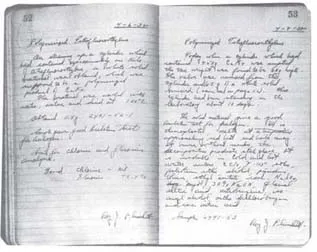
Figure 1.1 Photograph of two pages from the research notebook of Dr. Roy Plunkett recording the discovery of polytetrafluoroethylene on April 6, 1938.
(Courtesy of DuPont.)
Plunkett analyzed the white powder and it was conclusively proven to be polytetrafluoroethylene (PTFE). The slippery PTFE could not be dissolved in any solvent, acid, or base, and upon melting formed a stiff clear gel without flow. Later, research led to the discovery of processing techniques similar to those used with metal powders (sintering). At the time, the Manhattan Project was seeking new corrosion-resistant materials for gaskets, packings, and liners for UF6 handling. PTFE provided the answer and was used in production. The US government maintained a veil of secrecy over the PTFE project until well after the end of World War II. For security reasons, it was called by a code name, K 416. The US government took all of the output from the small, heavil...
Table of contents
- Cover image
- Title page
- Table of Contents
- Copyright
- Dedication
- William Andrew Publishing
- PDL Fluorocarbon Series Editor’s Preface
- Preface
- Acknowledgments
- Chapter 1: Fundamentals
- Chapter 2: Producing Monomers, Polymers, and Fluoropolymer Finishing
- Chapter 3: Introductory Fluoropolymer Coating Formulations
- Chapter 4: Binders
- Chapter 5: Pigments, Fillers, and Extenders
- Chapter 6: Solvent Systems
- Chapter 7: Additives
- Chapter 8: Substrates and Substrate Preparation
- Chapter 9: Liquid Formulations
- Chapter 10: Application of Liquid Coatings
- Chapter 11: Powder Coating Fluoropolymers
- Chapter 12: Fluoropolymer Coating Processing Technology
- Chapter 13: Measurement of Coating Performance
- Chapter 14: Recognizing, Understanding, and Dealing with Coating Defects
- Chapter 15: Commercial Applications and Uses
- Chapter 16: Health and Safety
- Appendix I: Chemical Resistance of Fluoropolymers
- Appendix II: Permeability of Fluoropolymers
- Appendix III: Permeation of Automotive Fuels Through Fluoroplastics
- Appendix IV: Permeation of Chemicals Through Fluoroplastics
- Trade Names
- Glossary
- Index
- Plastics Design Library
Trusted by 375,005 students
Access to over 1.5 million titles for a fair monthly price.
Study more efficiently using our study tools.
Frequently asked questions
Yes, you can cancel anytime from the Subscription tab in your account settings on the Perlego website. Your subscription will stay active until the end of your current billing period. Learn how to cancel your subscription
No, books cannot be downloaded as external files, such as PDFs, for use outside of Perlego. However, you can download books within the Perlego app for offline reading on mobile or tablet. Learn how to download books offline
Perlego offers two plans: Essential and Complete
- Essential is ideal for learners and professionals who enjoy exploring a wide range of subjects. Access the Essential Library with 800,000+ trusted titles and best-sellers across business, personal growth, and the humanities. Includes unlimited reading time and Standard Read Aloud voice.
- Complete: Perfect for advanced learners and researchers needing full, unrestricted access. Unlock 1.5M+ books across hundreds of subjects, including academic and specialized titles. The Complete Plan also includes advanced features like Premium Read Aloud and Research Assistant.
We are an online textbook subscription service, where you can get access to an entire online library for less than the price of a single book per month. With over 1.5 million books across 990+ topics, we’ve got you covered! Learn about our mission
Look out for the read-aloud symbol on your next book to see if you can listen to it. The read-aloud tool reads text aloud for you, highlighting the text as it is being read. You can pause it, speed it up and slow it down. Learn more about Read Aloud
Yes! You can use the Perlego app on both iOS and Android devices to read anytime, anywhere — even offline. Perfect for commutes or when you’re on the go.
Please note we cannot support devices running on iOS 13 and Android 7 or earlier. Learn more about using the app
Please note we cannot support devices running on iOS 13 and Android 7 or earlier. Learn more about using the app
Yes, you can access Fluorinated Coatings and Finishes Handbook by Laurence W. McKeen in PDF and/or ePUB format, as well as other popular books in Technology & Engineering & Industrial & Technical Chemistry. We have over 1.5 million books available in our catalogue for you to explore.