eBook - ePub
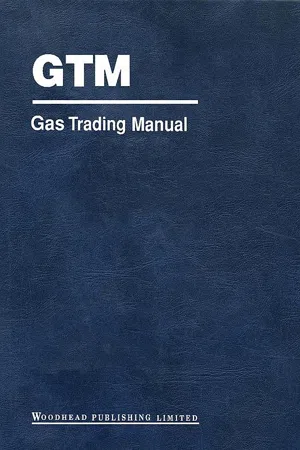
Gas Trading Manual
A Comprehensive Guide to the Gas Markets
- 600 pages
- English
- ePUB (mobile friendly)
- Available on iOS & Android
eBook - ePub
About this book
Since its launch in 2001, Gas Trading Manual (GTM) has established itself as the leading information source on the international gas market. Compiled from the contributions of some of the most senior and widely respected figures in the trade, this edition provides detailed and accurate analysis on all aspects of this complex business from the geography of gas through to the markets, trading instruments, contracts, gas pricing, accounting and taxation. This edition further enhances its reputation as the indispensable practical companion for all those involved in the trading of gas.
Information
Part 1
Introduction to gas trading
1
Changing nature of the gas trade
Geoff Moore; Gay Wenban-Smith Independent Consultants
1.1 Prologue
There has been a commercial transformation in the gas industries of some of the major consuming countries that is as radical as some of the great technical revolutions – for example, the conversion from manufactured gas to natural gas, or the development of Liquefied Natural Gas (LNG) for long-haul gas transportation.
Because this commercial revolution has taken place over a number of years, and because, in some senses, it has been a government administered process, it has not always been seen as having worldwide application. However, like many commercial activities in a world of reasonably free trade, it is spreading from its originating economies of North America to Europe via Great Britain changing the organisation of the natural gas industry, creating opportunities for entrepreneurs and establishing new market structures for trading gas.
In Britain, a short-term traded gas market must now be regarded as established. There is a recognised ‘market price’ for gas that is now also being used in longer-term gas purchase contracts. And there is considerable interest in developing gas trading markets in the Continent of Europe and beyond wherever the gas market is liberal and competitive – at least at the wholesale level – as it is, for example, in some of the Mercosur countries of South America.
But there has not yet been a complete transformation in Europe. Although some countries have grasped the new ideology with enthusiasm, some have not. And some individual industry players are large enough to obstruct changes that threaten their interests. The European Union is finding that it cannot single-handedly enforce new regimes, and that it has opponents within.
Gas Trading Manual (GTM) is about this transformation and the development of gas trading, which constitutes a very major part of it.
1.2 Definitions
Gas Trading Manual (GTM) is indeed a ‘manual’ – a work of reference rather than bedtime reading. Its loose-leaf format is designed for updating as time goes on and as the world gas industry changes at a quickening pace. It is compartmentalised so that any topic of interest can be clearly identified and used selectively. Though no one chapter can stand entirely on its own without some prior knowledge of the industry, it is intended that the cumulative effect of selective reading will give a thorough grounding in the chosen subject of ‘gas trading’.
By ‘gas’ we generally refer to natural gas, mainly methane, which is defined and described in detail in Chapter 2 Fundamentals of the gas market. The days of manufactured gas are not entirely over as significant pockets of its use remain. Indeed a man-made substitute for natural gas may well be required in the future. The convenient properties of gas as a form of energy and the vast investment in the gas infrastructure will work to prolong its use when exhaustion of reserves becomes an issue.
The word ‘trading’ is used generally in the manual in its widest form – almost synonymous with ‘commerce’. However, the main emphasis of GTM is a slightly narrower meaning that identifies and concentrates on the radical reform that the gas market is experiencing in many parts of the world. Trading here is used with the meaning of short-term, innovative, even speculative trading as is familiar in ‘spot markets’ for other commodities. This meaning is similar to that attached to oil trading, characterised and explained in our sister publication Oil Trading Manual (OTM).
1.3 Gas market structures
1.3.1 International gas trade
The conventional view, at least until the last decade, was that gas did not travel well. Gas, being less dense than oil, is comparatively expensive to transport. It does not figure in world trade in the way that oil does, despite the fact that its points of production and consumption are very similar to those of oil. This is not surprising as gas is – to a large extent – a joint product with oil and the energy hungry parts of the world are also natural markets for gas.
Though gas travelled thousands of miles in liquefied form well before the last decade, this was an expensive and somewhat freaky activity. Bulk long-haul gas transportation by pipeline always seemed to be associated with, or attributed some element of subsidy, reflecting – perhaps – the perceived riskiness of investing in transportation infrastructure. Some evidence to support the view is to be found in the statistic that only 22 per cent of world gas production enters international trade, compared with 59 per cent for oil1.
Along with the view that gas is an essentially local activity was a belief that long-term contracts were endemic to the gas industry to give security of supply for importers and, as discussed further below, to justify the investment in infrastructure. The so-called conventional view is challenged, if not debunked, in Chapter 3 The geography of gas, and it is proposed that these long-term contract structures must inevitably adapt as economics and attitudes develop.
1.3.2 Influence of infrastructure
Another, perhaps dated, view is th...
Table of contents
- Cover image
- Title page
- Table of Contents
- Dedication
- Copyright page
- Introduction
- Acknowledgements
- Preface to second edition
- Contributors
- Abbreviations
- Index
- Part 1: Introduction to gas trading
- Part 2: European gas markets
- Part 3: Administration
- Part 4: Gas and electricity
Trusted by 375,005 students
Access to over 1.5 million titles for a fair monthly price.
Study more efficiently using our study tools.
Frequently asked questions
Yes, you can cancel anytime from the Subscription tab in your account settings on the Perlego website. Your subscription will stay active until the end of your current billing period. Learn how to cancel your subscription
No, books cannot be downloaded as external files, such as PDFs, for use outside of Perlego. However, you can download books within the Perlego app for offline reading on mobile or tablet. Learn how to download books offline
Perlego offers two plans: Essential and Complete
- Essential is ideal for learners and professionals who enjoy exploring a wide range of subjects. Access the Essential Library with 800,000+ trusted titles and best-sellers across business, personal growth, and the humanities. Includes unlimited reading time and Standard Read Aloud voice.
- Complete: Perfect for advanced learners and researchers needing full, unrestricted access. Unlock 1.5M+ books across hundreds of subjects, including academic and specialized titles. The Complete Plan also includes advanced features like Premium Read Aloud and Research Assistant.
We are an online textbook subscription service, where you can get access to an entire online library for less than the price of a single book per month. With over 1.5 million books across 990+ topics, we’ve got you covered! Learn about our mission
Look out for the read-aloud symbol on your next book to see if you can listen to it. The read-aloud tool reads text aloud for you, highlighting the text as it is being read. You can pause it, speed it up and slow it down. Learn more about Read Aloud
Yes! You can use the Perlego app on both iOS and Android devices to read anytime, anywhere — even offline. Perfect for commutes or when you’re on the go.
Please note we cannot support devices running on iOS 13 and Android 7 or earlier. Learn more about using the app
Please note we cannot support devices running on iOS 13 and Android 7 or earlier. Learn more about using the app
Yes, you can access Gas Trading Manual by David Long,Geoff Moore,Gay Wenban-Smith in PDF and/or ePUB format, as well as other popular books in Business & International Business. We have over 1.5 million books available in our catalogue for you to explore.