- 484 pages
- English
- ePUB (mobile friendly)
- Available on iOS & Android
eBook - ePub
Environmental Engineering
About this book
Environmental Engineering, Second Edition provides a comprehensive introduction to air, water, noise, and radioactive materials pollution and its control. Legal and regulatory principles and risk analysis are included in addition to engineering principles.
The text presents the engineering principles governing the generation and control of air and water pollutants, solid and hazardous waste, and noise. Water quality and drinking water treatment are discussed, as well as the elements of risk analysis. Radioactive waste generation and treatment in relation to the nuclear fuel cycle, are discussed. The health and environmental effects of all these pollutants are discussed. An introduction to the Federal laws and regulations governing pollution is included.
- This text embraces the latest thinking in environmental engineering
- Includes updates in regulation and current pollution abatement technologies
Information
Chapter 1
Environmental Engineering
Environmental engineering is a relatively new profession with a long and honorable history. The descriptive title of “environmental engineer” was not used until the 1960s, when academic programs in engineering and public health schools broadened their scope and required a more accurate title to describe their curricula and their graduates. The roots of this profession, however, go back as far as recorded history. These roots reach into several major disciplines including civil engineering, public health, ecology, chemistry, and meteorology. From each foundation, the environmental engineering profession draws knowledge, skill, and professionalism. From ethics, the environmental engineer draws concern for the greater good.
CIVIL ENGINEERING
Throughout western civilization settled agriculture and the development of agricultural skills created a cooperative social fabric and spawned the growth of communities, as well as changed the face of the earth with its overriding impact on the natural environment. As farming efficiency increased, a division of labor became possible, and communities began to build public and private structures that engineered solutions to specific public problems. Defense of these structures and of the land became paramount, and other structures subsequently were built purely for defensive purposes. In some societies the conquest of neighbors required the construction of machines of war. Builders of war machines became known as engineers, and the term “engineer” continued to imply military involvement well into the eighteenth century.
In 1782 John Smeaton, builder of roads, structures, and canals in England, recognized that his profession tended to focus on the construction of public facilities rather than purely military ones, and that he could correctly be designated a civil engineer. This title was widely adopted by engineers engaged in public works (Kirby et al. 1956).
The first formal university engineering curriculum in the United States was established at the U.S. Military Academy at West Point in 1802. The first engineering course outside the Academy was offered in 1821 at the American Literary, Scientific, and Military Academy, which later became Norwich University. The Renssalaer Polytechnic Institute conferred the first truly civil engineering degree in 1835. In 1852, the American Society of Civil Engineers was founded (Wisely 1974).
Water supply and wastewater drainage were among the public facilities designed by civil engineers to control environmental pollution and protect public health. The availability of water had always been a critical component of civilizations. Ancient Rome, for example, had water supplied by nine different aqueducts up to 80 km (50 miles) long, with cross sections from 2 to 15 m (7 to 50 ft). The purpose of the aqueducts was to carry spring water, which even the Romans knew was better to drink than Tiber River water.
As cities grew, the demand for water increased dramatically. During the eighteenth and nineteenth centuries the poorer residents of European cities lived under abominable conditions, with water supplies that were grossly polluted, expensive, or nonexistent. In London the water supply was controlled by nine different private companies and water was sold to the public. People who could not afford to pay for water often begged or stole it. During epidemics of disease the privation was so great that many drank water from furrows and depressions in plowed fields. Droughts caused water supplies to be curtailed and great crowds formed to wait their “turn” at the public pumps (Ridgway 1970).
In the New World the first public water supply system consisted of wooden pipes, bored and charred, with metal rings shrunk on the ends to prevent splitting. The first such pipes were installed in 1652, and the first citywide system was constructed in Winston-Salem, NC, in 1776. The first American water works was built in the Moravian settlement of Bethlehem, PA. A wooden water wheel, driven by the flow of Monocacy Creek, powered wooden pumps that lifted spring water to a hilltop wooden reservoir from which it was distributed by gravity (American Public Works Association 1976). One of the first major water supply undertakings was the Croton Aqueduct, started in 1835 and completed six years later. This engineering marvel brought clear water to Manhattan Island, which had an inadequate supply of groundwater (Lankton 1977).
Although municipal water systems might have provided adequate quantities of water, the water quality was often suspect. One observer noted that the poor used the water for soup, the middle class dyed their clothes in it, and the very rich used it for top-dressing their lawns.
The earliest known acknowledgment of the effect of impure water is found in Susruta Samhitta, a collection of fables and observations on health, dating back to 2000 BCE, which recommended that water be boiled before drinking. Water filtration became commonplace toward the middle of the nineteenth century. The first successful water supply filter was in Parsley, Scotland, in 1804, and many less successful attempts at filtration followed (Baker 1949). A notable failure was the New Orleans system for filtering water from the Mississippi River. The water proved to be so muddy that the filters clogged too fast for the system to be workable. This problem was not alleviated until aluminum sulfate (alum) began to be used as a pretreatment to filtration. The use of alum to clarify water was proposed in 1757, but was not convincingly demonstrated until 1885. Disinfection of water with chlorine began in Belgium in 1902 and in America, in Jersey City, NJ, in 1908. Between 1900 and 1920 deaths from infectious disease dropped dramatically, owing in part to the effect of cleaner water supplies.
Human waste disposal in early cities presented both a nuisance and a serious health problem. Often the method of disposal consisted of nothing more than flinging the contents of chamberpots out the window (Fig. 1–1). Around 1550, King Henri II repeatedly tried to get the Parliament of Paris to build sewers, but neither the king nor the parliament proposed to pay for them. The famous Paris sewer system was built under Napoleon III, in the nineteenth century (De Camp 1963).
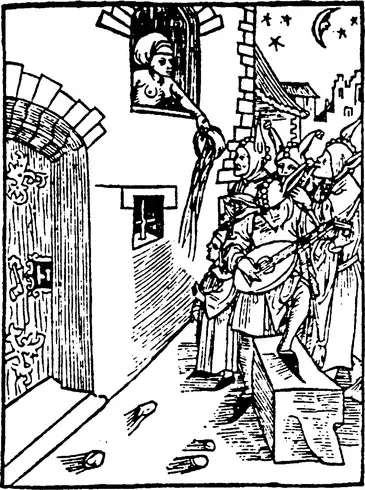
Figure 1-1 Human excreta disposal, from an old woodcut (source: W. Reyburn, Flushed with Pride. McDonald, London, 1969).
Stormwater was considered the main “drainage” problem, and it was in fact illegal in many cities to discharge wastes into the ditches and storm sewers. Eventually, as water supplies developed,1 the storm sewers were used for both sanitary waste and stormwater. Such “combined sewers” existed in some of our major cities until the 1980s.
The first system for urban drainage in America was constructed in Boston around 1700. There was surprising resistance to the construction of sewers for waste disposal. Most American cities had cesspools or vaults, even at the end of the nineteenth century. The most economical means of waste disposal was to pump these out at regular intervals and cart the waste to a disposal site outside the town. Engineers argued that although sanitary sewer construction was capital intensive, sewers provided the best means of wastewater disposal in the long run. Their argument prevailed, and there was a remarkable period of sewer construction between 1890 and 1900.
The first separate sewerage systems in America were built in the 1880s in Memphis, TN, and Pullman, IL. The Memphis system was a complete failure. It used small pipes that were to be flushed periodically. No manholes were constructed and cleanout became a major problem. The system was later removed and larger pipes, with manholes, were installed (American Public Works Association 1976).
Initially, all sewers emptied into the nearest watercourse, without any treatment. As a result, many lakes and rivers became grossly polluted and, as an 1885 Boston Board of Health report put it, “larger territories are at once, and frequently, enveloped in an atmosphere of stench so strong as to arouse the sleeping, terrify the weak and nauseate and exasperate everybody.”
Wastewater treatment first consisted only of screening for removal of the large floatables to protect sewage pumps. Screens had to be cleaned manually, and wastes were buried or incinerated. The first mechanical screens were installed in Sacramento, CA, in 1915, and the first mechanical comminutor for grinding up screenings was installed in Durham, NC. The first complete treatment systems were operational by the turn of the century, with land spraying of the effluent being a popular method of wastewater disposal.
Civil engineers were responsible for developing engineering solutions to these water and wastewater problems of these facilities. There was, however, little appreciation of the broader aspects of environmental pollution control and management until the mid-1900s. As recently as 1950 raw sewage was dumped into surface waters in the United States, and even streams in public parks and in U.S. cities were fouled with untreated wastewater. The first comprehensive federal water pollution control legislation was enacted by the U.S. Congress in 1957, and secondary sewage treatment was not required at all before passage of the 1972 Clean Water Act. Concern about clean water has come from the public health professions and from the study of the science of ecology.
PUBLIC HEALTH
Life in cites during the middle ages, and through the industrial revolution, was difficult, sad, and usually short. In 1842, the Report from the Poor Law Commissioners on an Inquiry into the Sanitary Conditions of the Labouring Population of Great Britain described the sanitary conditions in this manner:
Many dwellings of the poor are arranged around narrow courts having no other opening to the main street than a narrow covered passage. In these courts there are several occupants, each of whom accumulated a heap. In some cases, each of these heaps is piled up separately in the court, with a general receptacle in the middle for drainage. In others, a plot is dug in the middle of the court for the general use of all the occupants. In some the whole courts up to the very doors of the houses were covered with filth.
The great rivers in urbanized areas were in effect open sewers. The River Cam, like the Thames, was for many years grossly polluted. There is a tale of Queen Victoria visiting Trinity College at Cambridge, and saying to the Master, as she looked over the bridge abutment, “What are all those pieces of paper floating down the river?” To which, with great presence of mind, he replied, “Those, ma’am, are notices that bathing is forbidden” (Raverat 1969).
During the middle of the nineteenth century, public health measures were inadequate and often counterproductive. The germ theory of disease was not as yet fully appreciated, and epidemics swept periodically over the major cities of the world. Some intuitive public health measures did, however, have a positive effect. Removal of corpses during epidemics, and appeals for cleanliness, undoubtedly helped the public health.
The 1850s have come to be known as the “Great Sanitary Awakening.” Led by tireless public health advocates like Sir Edwin Chadwick in England and Ludwig Semmelweiss in Austria, proper and effective measures began to evolve. John Snow’s classic epidemiological study of the 1849 cholera epidemic in London stands as a seminally important investigation of a public health problem. By using a map of the area and identifying the residences of those who contracted the disease, Snow was able to pinpoint the source of the epidemic as the water from a public pump on Broad Street. Removal of the handle from the Broad Street pump eliminated the source of the cholera pathogen, and the epidemic subsided.2 Waterborne diseases have become one of the major concerns of the public health. The control of such diseases by providing safe and pleasing water to the public has been one of the dramatic successes of the public health profession.
Today the concerns of public health encompass not ...
Table of contents
- Cover image
- Title page
- Table of Contents
- Copyright
- Dedication
- Preface
- Chapter 1: Environmental Engineering
- Chapter 2: Assessing Environmental Impact
- Chapter 3: Risk Analysis
- Chapter 4: Water Pollution
- Chapter 5: Measurement of Water Quality
- Chapter 6: Water Supply
- Chapter 7: Water Treatment
- Chapter 8: Collection of Wastewater
- Chapter 9: Wastewater Treatment
- Chapter 10: Sludge Treatment and Disposal
- Chapter 11: Nonpoint Source Water Pollution
- Chapter 12: Solid Waste
- Chapter 13: Solid Waste Disposal
- Chapter 14: Reuse, Recycling, and Resource Recovery
- Chapter 15: Hazardous Waste
- Chapter 16: Radioactive Waste
- Chapter 17: Solid and Hazardous Waste Law
- Chapter 18: Meteorology and Air Pollution
- Chapter 19: Measurement of Air Quality
- Chapter 20: Air Pollution Control
- Chapter 21: Air Pollution Law
- Chapter 22: Noise Pollution
- Conversion Factors
- Elements of the Periodic Table
- Physical Constants
- List of Symbols
- Appendix E: Bibliography
- Index
Trusted by 375,005 students
Access to over 1.5 million titles for a fair monthly price.
Study more efficiently using our study tools.
Frequently asked questions
Yes, you can cancel anytime from the Subscription tab in your account settings on the Perlego website. Your subscription will stay active until the end of your current billing period. Learn how to cancel your subscription
No, books cannot be downloaded as external files, such as PDFs, for use outside of Perlego. However, you can download books within the Perlego app for offline reading on mobile or tablet. Learn how to download books offline
Perlego offers two plans: Essential and Complete
- Essential is ideal for learners and professionals who enjoy exploring a wide range of subjects. Access the Essential Library with 800,000+ trusted titles and best-sellers across business, personal growth, and the humanities. Includes unlimited reading time and Standard Read Aloud voice.
- Complete: Perfect for advanced learners and researchers needing full, unrestricted access. Unlock 1.5M+ books across hundreds of subjects, including academic and specialized titles. The Complete Plan also includes advanced features like Premium Read Aloud and Research Assistant.
We are an online textbook subscription service, where you can get access to an entire online library for less than the price of a single book per month. With over 1.5 million books across 990+ topics, we’ve got you covered! Learn about our mission
Look out for the read-aloud symbol on your next book to see if you can listen to it. The read-aloud tool reads text aloud for you, highlighting the text as it is being read. You can pause it, speed it up and slow it down. Learn more about Read Aloud
Yes! You can use the Perlego app on both iOS and Android devices to read anytime, anywhere — even offline. Perfect for commutes or when you’re on the go.
Please note we cannot support devices running on iOS 13 and Android 7 or earlier. Learn more about using the app
Please note we cannot support devices running on iOS 13 and Android 7 or earlier. Learn more about using the app
Yes, you can access Environmental Engineering by Ruth Weiner,Robin Matthews in PDF and/or ePUB format, as well as other popular books in Technology & Engineering & Environmental Management. We have over 1.5 million books available in our catalogue for you to explore.