eBook - ePub
Materials Ageing and Degradation in Light Water Reactors
Mechanisms and Management
- 440 pages
- English
- ePUB (mobile friendly)
- Available on iOS & Android
eBook - ePub
Materials Ageing and Degradation in Light Water Reactors
Mechanisms and Management
About this book
Light water reactors (LWRs) are the predominant class of nuclear power reactors in operation today; however, ageing and degradation can influence both their performance and lifetime. Knowledge of these factors is therefore critical to safe, continuous operation. Materials ageing and degradation in light water reactors provides a comprehensive guide to prevalent deterioration mechanisms, and the approaches used to handle their effects.Part one introduces fundamental ageing issues and degradation mechanisms. Beginning with an overview of ageing and degradation issues in LWRs, the book goes on to discuss corrosion in pressurized water reactors and creep deformation of materials in LWRs. Part two then considers materials' ageing and degradation in specific LWR components. Applications of zirconium alloys in LWRs are discussed, along with the ageing of electric cables. Materials management strategies for LWRs are then the focus of part three. Materials management strategies for pressurized water reactors and VVER reactors are considered before the book concludes with a discussion of materials-related problems faced by LWR operators and corresponding research needs.With its distinguished editor and international team of expert contributors, Materials ageing and degradation in light water reactors is an authoritative review for anyone requiring an understanding of the performance and durability of this type of nuclear power plant, including plant operators and managers, nuclear metallurgists, governmental and regulatory safety bodies, and researchers, scientists and academics working in this area.
- Introduces the fundamental ageing issues and degradation mechanisms associated with this class of nuclear power reactors
- Considers materials ageing and degradation in specific light water reactor components, including properties, performance and inspection
- Chapters also focus on material management strategies
Information
1
Overview of ageing and degradation issues in light water reactors (LWRs)
K.L. Murty, North Carolina State University, USA
K. Ramaswamy, Bhabha Atomic Research Center, India
Abstract: A typical light water reactor (LWR) has components like the clad, the internals, the reactor pressure vessel (RPV), the heat exchanger tubes, etc., made from different materials. Some of these components experience pressure and temperature effects while others experience an additional contribution from high neutron flux. These components undergo degradation to various extents based on the severity of service conditions and their inherent material properties. This chapter presents an overview of the various deformation modes that materials are known to undergo under reactor operating conditions, and the known theoretical or empirical relations between the crucial material and environmental parameters are outlined. Materials degradation phenomena briefly described in the chapter include radiation damage, plastic deformation, fracture and fatigue, following which radiation effects on these phenomena, as well as corrosion are enumerated. Degradation mechanisms of concern to specific nuclear reactor structures are detailed in the last section with emphasis on fuel, cladding and internals.
Key words
nuclear reactor
damage
degradation
hydride embrittlement
life prediction
mechanical property
creep
fatigue
fracture
irradiation creep
corrosion
irradiation assisted stress corrosion
1.1 Introduction
This chapter provides a review of materials ageing and degradation encountered in light water reactors (LWRs). Ageing of any engineering structure ‒ through exposure to pressure, temperature and environment ‒ can manifest as changes in the material properties which may be classified into three major categories: (1) changes in dimensions or shape of the structure, (2) changes in material weight due to oxidation, corrosion and erosion and (3) changes in physical or mechanical properties without any noticeable change in dimensions. The in-service component(s) may undergo more than one of the above changes simultaneously, and when these changes affect plant safety, production efficiency or economy they are viewed as degradation. In a thermal energy based power plant (nuclear or fossil fired), various energy transfer stages with complex heavy engineering are involved before the final stage generation of electric energy is achieved. At each stage of energy transfer, the machinery involved undergoes ageing and the material properties undergo degradation with continuous use. The severity of degradation may vary from simple and minor to serious and complex. For the core components of a nuclear reactor in a nuclear power plant (NPP), there is an additional influence of the severe radiation environment that accelerates the ageing. The types of nuclear reactors vary in their design features according to the type of fuel and coolant used. The choice of materials for their construction differs according to the reactor design as well as to previous experience in operating nuclear reactors. The components in the reactor core must tolerate exposure to the coolant media (high-temperature water, liquid metals, gas or liquid salts), stresses and vibrations as well as an intense field of high energy neutrons. Ageing of materials under this extreme environment can lead to reduced performance and, in the worst cases, sudden failure of the components.
A common consideration given in a power plant design at any installation (nuclear/thermal) is the safety requirement. The concern for safety increases as the material properties get degraded from their initial values with prolonged exposure to service conditions. Thus, intermittent surveillance campaigns are mandatory in an operating installation for the evaluation of the health of the components ‒ even if the initial design adhered to strict safety norms. For this, we must be able to identify the critical components that can possibly undergo ageing degradation and decide the frequency of the inspection campaigns. The outcome of such campaigns can forewarn of any impending failure and suggest replacement of components such that the designed life of the plant can be reached ‒ and if reached, the campaign can advise if the life of the component can be extended beyond the design life. In the worst case, the campaign outcome may suggest shutdown of the plant if safe continued operation of the component cannot be ensured. The cost of such campaigns and subsequent component replacements should be recoverable by putting the plant back into operation. The following statement with regard to nuclear installations is pertinent:1
With the present 60-year licenses beginning to expire between the years of 2029 and 2039 for the first group of NPP that came online between 1969 and 1979 utilities are likely to initiate planning of base-load replacement power by 2014 or earlier. If the option to extend current plant lifetimes is not available, strategic planning and investment required to maintain the current LWR fleet may not happen in a sustainable manner. The research window for supporting the utility’s decisions to invest in lifetime extension and to support NRC decisions to extend the license must start now and is likely to extend through the following 20-year period (i.e. 2010 to 2029), with higher intensity for the first 10 years. The LWR’s R&D Program represents the beginning of timely collaborative research needed to retain the existing nuclear power infrastructure of the United States.
Our understanding of the behaviour of the service material in that environment is based on years of operating experience of a reactor. Sustained research and development is required to develop newer materials. Further, it is from the examination of the ageing/aged materials we learn the role of new environmental parameters that were unthought-of during the design stage, and allow us to modify our safety codes in future designs. Specific ageing and degradation mechanism depends on the component in question and the various conditions such as temperature, load and environment to which the materials are exposed. A typical NPP can be considered to consist of seven different components: (i) fuel, (ii) structural components, (iii) moderator/reflector, (iv) control, (v) coolant, (vi) shields and (vii) safety systems. Each of these components has specific requirements and selection criteria based on which suitable and economic materials are chosen.2
Fission based nuclear reactors can be classified as thermal and fast, based on the energy of the neutrons and the thermal reactors can further be categorized as boiling water reactor (BWR) and pressurized water reactor (PWR). The latter type can further be classified as light water cooled and heavy water cooled. We will confine ourselves here to the LWRs that use the steam-cycle conversion system wherein the steam produced by nuclear fission drives a conventional turbine generator to produce electricity. A steam generator is used in PWRs to produce steam while the direct cycle BWRs generate steam in the reactor core thereby not requiring a separate steam generator; Fig. 1.1a and 1.1b are schematics of PWR and BWR, respectively, with important structural components indicated.3
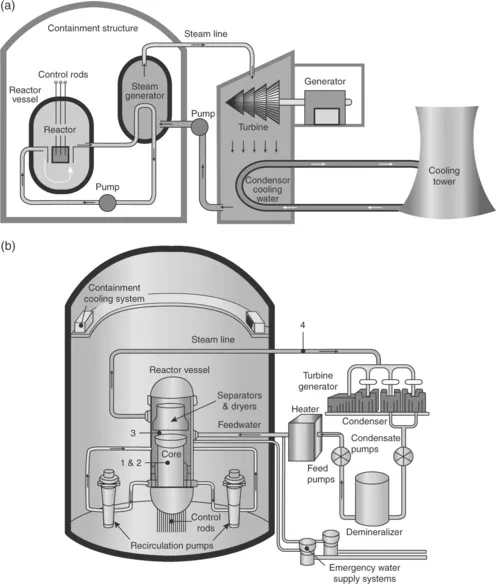
1.1 Schematics of (a) PWR (www.aboutnu...
Table of contents
- Cover image
- Title page
- Table of Contents
- Copyright
- Contributor contact details
- Woodhead Publishing Series in Energy
- Foreword
- Preface
- Chapter 1: Overview of ageing and degradation issues in light water reactors (LWRs)
- Chapter 2: Corrosion in pressurized water reactors (PWRs)
- Chapter 3: Creep deformation of materials in light water reactors (LWRs)
- Chapter 4: Properties of zirconium alloys and their applications in light water reactors (LWRs)
- Chapter 5: Performance and inspection of zirconium alloy fuel bundle components in light water reactors (LWRs)
- Chapter 6: Ageing of electric cables in light water reactors (LWRs)
- Chapter 7: Materials management strategies for pressurized water reactors (PWRs)
- Chapter 8: Materials management strategies for VVER reactors
- Chapter 9: Materials-related problems faced by light water reactor (LWR) operators and corresponding research needs
- Index
Trusted by 375,005 students
Access to over 1.5 million titles for a fair monthly price.
Study more efficiently using our study tools.
Frequently asked questions
Yes, you can cancel anytime from the Subscription tab in your account settings on the Perlego website. Your subscription will stay active until the end of your current billing period. Learn how to cancel your subscription
No, books cannot be downloaded as external files, such as PDFs, for use outside of Perlego. However, you can download books within the Perlego app for offline reading on mobile or tablet. Learn how to download books offline
Perlego offers two plans: Essential and Complete
- Essential is ideal for learners and professionals who enjoy exploring a wide range of subjects. Access the Essential Library with 800,000+ trusted titles and best-sellers across business, personal growth, and the humanities. Includes unlimited reading time and Standard Read Aloud voice.
- Complete: Perfect for advanced learners and researchers needing full, unrestricted access. Unlock 1.5M+ books across hundreds of subjects, including academic and specialized titles. The Complete Plan also includes advanced features like Premium Read Aloud and Research Assistant.
We are an online textbook subscription service, where you can get access to an entire online library for less than the price of a single book per month. With over 1.5 million books across 990+ topics, we’ve got you covered! Learn about our mission
Look out for the read-aloud symbol on your next book to see if you can listen to it. The read-aloud tool reads text aloud for you, highlighting the text as it is being read. You can pause it, speed it up and slow it down. Learn more about Read Aloud
Yes! You can use the Perlego app on both iOS and Android devices to read anytime, anywhere — even offline. Perfect for commutes or when you’re on the go.
Please note we cannot support devices running on iOS 13 and Android 7 or earlier. Learn more about using the app
Please note we cannot support devices running on iOS 13 and Android 7 or earlier. Learn more about using the app
Yes, you can access Materials Ageing and Degradation in Light Water Reactors by K L Murty,K. L. Murty in PDF and/or ePUB format, as well as other popular books in Technology & Engineering & Mechanical Engineering. We have over 1.5 million books available in our catalogue for you to explore.