- 480 pages
- English
- ePUB (mobile friendly)
- Available on iOS & Android
eBook - ePub
About this book
Computational Fluid Dynamics enables engineers to model and predict fluid flow in powerful, visually impressive ways and is one of the core engineering design tools, essential to the study and future work of many engineers. This textbook is designed to explcitly meet the needs engineering students taking a first course in CFD or computer-aided engineering. Fully course matched, with the most extensive and rigorous pedagogy and features of any book in the field, it is certain to be a key text.
- The only course text available specifically designed to give an applications-lead, commercial software oriented approach to understanding and using Computational Fluid Dynamics (CFD).
- Meets the needs of all engineering disciplines that use CFD.
- The perfect CFD teaching resource: clear, straightforward text, step-by-step explanation of mathematical foundations, detailed worked examples, end-of-chapter knowledge check exercises, and homework assignment questions
Information
Subtopic
Business IntelligenceIndex
BusinessChapter 1 Introduction
1.1 WHAT IS COMPUTATIONAL FLUID DYNAMICS
Computational fluid dynamics has certainly come of age in industrial applications and academia research. In the beginning this popular field of study was primarily limited to high-technology engineering areas of aeronautics and astronautics, but now it is a widely adopted methodology for solving complex problems in many modern engineering fields. CFD, derived from different disciplines of fluid mechanics and heat transfer, is also finding its way into other important uncharted areas especially in process, chemical, civil, and environmental engineering. Construction of new and better improved system designs and optimization carried out on existing equipments through computational simulations are resulting in enhanced efficiency and lower operating costs. With the concerns of global warming and increasing world population, engineers in power-generation industries are heavily relying on CFD to reduce development and retrofitting costs. These computational studies are currently being performed to address pertinent issues relating to technologies for clean and renewable power as well as meeting strict regulation challenges of emissions control and substantial reduction of environmental pollutants.
Nevertheless, the basic question remains: What actually is computational fluid dynamics? In retrospect, it has certainly become a new branch integrating not only the disciplines of fluid mechanics with mathematics but also with computer science as illustrated in Fig. 1.1. Let us briefly discuss each of these individual disciplines. Fluid mechanics is essentially the study of fluids either in motion (fluid in dynamic mode) or at rest (fluid in stationary mode). CFD is particularly dedicated to the former, fluids that are in motion, and how the fluid flow behavior influences processes that may include heat transfer and possibly chemical reactions in combusting flows. This directly infers to the fluid dynamics description appearing in the terminology. Additionally, the physical characteristics of the fluid motion can usually be described through fundamental mathematical equations, usually in partial differential form, which govern a process of interest and are often called governing equations in CFD (see Chapter 3 for more insights). In order to solve these mathematical equations, they are converted by computer scientists using high-level computer programming languages into computer programs or software packages. The computational part simply means the study of the fluid flow through numerical simulations, which involves employing computer programs or software packages performed on high-speed digital computers to attain the numerical solutions. Another question arises: Do we actually require the expertise of three specific people from each discipline—fluids engineering, mathematics, and computer science—to come together for the development of CFD programs or even to conduct CFD simulations? The answer is obviously no, and more likely it is expected that this field demands a person who will proficiently obtain some subsets of the knowledge from each discipline.

FIGURE 1.1 The different disciplines contained within computational fluid dynamics
CFD has also become one of the three basic methods or approaches that can be employed to solve problems in fluid dynamics and heat transfer. As demonstrated in Fig. 1.2, each approach is strongly interlinked and does not lie in isolation. Traditionally, both experimental and analytical methods have been used to study the various aspects of fluid dynamics and to assist engineers in the design of equipment and industrial processes involving fluid flow and heat transfer. With the advent of digital computers, the computational (numerical) aspect has emerged as another viable approach. Although the analytical method is still practiced by many and experiments will continue to be significantly performed, the trend is clearly toward greater reliance on the computational approach for industrial designs, particularly when the fluid flows are very complex.
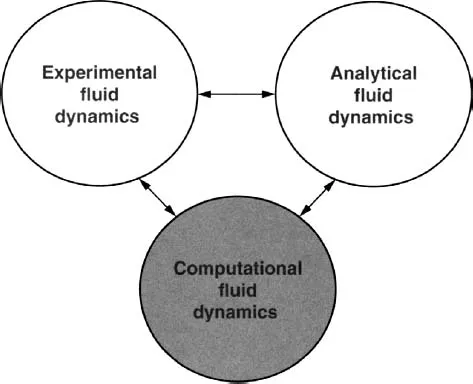
FIGURE 1.2 The three basic approaches to solve problems in fluid dynamics and heat transfer
In the past, potential or novice users would probably learn CFD by investing a substantial amount of time writing their own computer programs. With the increasing demands from industries or even within academia to acquire the knowledge of CFD in a much shorter time frame, it is not surprising that the interest in abandoning writing computer programs is escalating in favor of using more commercially available software packages. Multipurpose CFD programs are gradually earning the approval, and with the advancement of models that better encapsulate the flow physics, these software packages are also gaining wide acceptance. There are numerous advantages in applying these computer programs. Since the mundane groundwork of writing and testing of these computer codes has been thoroughly carried out by the “developers” of respective software companies, today’s potential or novice CFD users are comforted by not having to deal with these types of issues. Such a program can be readily employed to solve numerous fluid-flow problems.
Despite the well-developed methodologies within the computational codes, CFD is certainly more than just being proficient in operating these software packages. Bearing this in mind, the primary focus of this book is thus oriented to better educate potential or novice users in employing CFD in a more judicious manner, equally supplementing the understanding of underlying basic concepts and the technical know-how in better tackling fluid-flow problems. Other users who are inclined to pursue a postgraduate research study, or are currently undergoing research through the development of new mathematical models to solve more complex flow problems, should consult other CFD books (e.g., Fletcher, 1991; Anderson, 1995; Versteeg and Malalasekera, 1995). We intend to concentrate on presenting a step-by-step procedure of initially understanding the physics of new fluid dynamics problems at hand, developing new mathematical models to represent the flow physics, and implementing appropriate numerical techniques or methods to test these models in a CFD program in the future.
CFD has indeed become a powerful tool to be employed either for pure or applied research or industrial applications. Computational simulations and analyses are increasingly performed in many fluid engineering applications that include airplanes (aerospace engineering), motor vehicles (automotive engineering), breathing and blood flow (biomedical engineering), fluid flowing through pumps and pipes (chemical engineering), rivers and pollutants (civil and environmental engineering), turbines and furnaces (power engineering), and swimming and golf (sports engineering). Through CFD, one can gain an increased knowledge of how system components are expected to perform, so as to make the required improvements for design and optimization studies. CFD actually asks the question: What if …? before a commitment is undertaken to execute any design alteration. When one ponders the planet we live in, almost everything revolves in one way or another around a fluid or moves within a fluid.
More recently, CFD is revolutionizing the teaching and learning of fluid mechanics and thermal science in higher education institutions through visualization of complex fluid flows. Development of some CFD-based educational software packages such as FlowLab by ANSYS® Inc., Fluent® has allowed students to visually reinforce the concepts of fluid flow and heat transfer through a “Virtual Fluids Laboratory.” This software also allows teachers to create their own examples or customize predefined existing ones. Using carefully constructed examples, students are introduced to the effective use of CFD for solving fluid-flow problems and can instinctively develop an intuitive feel for the flow physics. In the next section, we discuss some important advantages and further expound on how CFD has evolved and is applied in practice.
1.2 ADVANTAGES OF COMPUTATIONAL FLUID DYNAMICS
With the rapid advancement of digital computers, CFD is poised to remain at the forefront of cutting edge research in the sciences of fluid dynamics and heat transfer. Also, the emergence of CFD as a practical tool in modern engineering practice is steadily attracting much interest and appeal.
There are many advantages in considering computational fluid dynamics. Firstly, the theoretical development of the computational sciences focuses on the construction and solution of the governing equations and the study of various approximations to these equations. CFD presents the perfect opportunity to study specific terms in the governing equations in a more detailed fashion. New paths of theoretical development are realized, which could not have been possible without the introduction of this branch of computational approach. Secondly, CFD complements experimental and analytical approaches by providing an alternative cost-effective means of simulating real fluid flows. Particularly, CFD substantially reduces lead times and costs in designs and production compared to experimental-based approach and offers the ability to solve a range of complicated flow problems where the analytical approach is lacking. These advantages are realized through the increasing performance power in computer hardware and its declining costs. Thirdly, CFD has the capacity of simulating flow conditions that are not reproducible in experimental tests found in geophysical and biological fluid dynamics, such as nuclear accident scenarios or scenarios that are too huge or too remote to be simulated experimentally (e.g., Indonesian Tsunami of 2004). Fourthly, CFD can provide rather detailed, visualized, and comprehensive information when compared to analytical and experimental fluid dynamics.
In practice, CFD permits alternative designs to be evaluated over a range of dimensionless parameters that may include the Reynolds number, Mach number, Rayleigh number, and flow orientation. The utilization of such an approach is usually very effective in the early stages of development for fluid-system designs. It may also prove to be significantly cheaper in contrast to the everincreasing spiraling cost of performing experiments. In many cases, where details of the fluid flow are important, CFD can provide detailed information and understanding of the flow processes to be obtained, such as the occurrence of flow separation or whether the wall temperature exceeds some maximum limit. With technological improvements and competition requiring a higher degree of optimal designs and as new high technological applications demand precise prediction of flow behaviors, experimental development may eventually be too costly to initiate. CFD presents an alternative option.
Nevertheless, the favorable appraisal of CFD thus far does not suggest that it will soon replace experimental testing as a means to gather information for design purposes. Instead it is considered a viable alternative. For example, wind-tunnel testing is a typical piece of experimental equipment that still provides invaluable information for the simulation of real flows at reduced scale. For the design of engineering components, especially in an aircraft that depends critically on the flow behavior, carrying out wind-tunnel experiments remains an economically viable alternative than full-scale measurement. Wind tunnels are very effective for obtaining the global information of the complete lift and drag on a body and the surface distributions at key locations. In other applications where CFD still remains a relatively primitive state of development, experiment-based approach remains th...
Table of contents
- Cover
- Title Page
- Copyright
- Preface
- Acknowledgments
- Table of Contents
- Chapter 1: Introduction
- Chapter 2: CFD Solution Procedure—A Beginning
- Chapter 3: Governing Equations for CFD—Fundamentals
- Chapter 4: CFD Techniques—The Basics
- Chapter 5: CFD Solution Analysis—Essentials
- Chapter 6: Practical Guidelines for CFD Simulation and Analysis
- Chapter 7: Some Applications of CFD with Examples
- Chapter 8: Some Advanced Topics in CFD
- Appendices
- References
- Further Suggested Reading
- Index
Trusted by 375,005 students
Access to over 1.5 million titles for a fair monthly price.
Study more efficiently using our study tools.
Frequently asked questions
Yes, you can cancel anytime from the Subscription tab in your account settings on the Perlego website. Your subscription will stay active until the end of your current billing period. Learn how to cancel your subscription
No, books cannot be downloaded as external files, such as PDFs, for use outside of Perlego. However, you can download books within the Perlego app for offline reading on mobile or tablet. Learn how to download books offline
Perlego offers two plans: Essential and Complete
- Essential is ideal for learners and professionals who enjoy exploring a wide range of subjects. Access the Essential Library with 800,000+ trusted titles and best-sellers across business, personal growth, and the humanities. Includes unlimited reading time and Standard Read Aloud voice.
- Complete: Perfect for advanced learners and researchers needing full, unrestricted access. Unlock 1.5M+ books across hundreds of subjects, including academic and specialized titles. The Complete Plan also includes advanced features like Premium Read Aloud and Research Assistant.
We are an online textbook subscription service, where you can get access to an entire online library for less than the price of a single book per month. With over 1.5 million books across 990+ topics, we’ve got you covered! Learn about our mission
Look out for the read-aloud symbol on your next book to see if you can listen to it. The read-aloud tool reads text aloud for you, highlighting the text as it is being read. You can pause it, speed it up and slow it down. Learn more about Read Aloud
Yes! You can use the Perlego app on both iOS and Android devices to read anytime, anywhere — even offline. Perfect for commutes or when you’re on the go.
Please note we cannot support devices running on iOS 13 and Android 7 or earlier. Learn more about using the app
Please note we cannot support devices running on iOS 13 and Android 7 or earlier. Learn more about using the app
Yes, you can access Computational Fluid Dynamics by Jiyuan Tu,Guan Heng Yeoh,Chaoqun Liu in PDF and/or ePUB format, as well as other popular books in Business & Business Intelligence. We have over 1.5 million books available in our catalogue for you to explore.