eBook - ePub
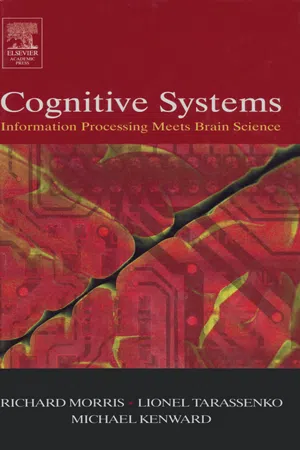
Cognitive Systems - Information Processing Meets Brain Science
- 310 pages
- English
- ePUB (mobile friendly)
- Available on iOS & Android
eBook - ePub
Cognitive Systems - Information Processing Meets Brain Science
About this book
Cognitive Systems - Information Processing Meets Brain Science presents an overview of the exciting, truly multidisciplinary research by neuroscientists and systems engineers in the emerging field of cognitive systems, providing a cross-disciplinary examination of this cutting-edge area of scientific research. This is a great example of where research in very different disciplines touches to create a new emerging area of research. The book illustrates some of the technical developments that could arise from our growing understanding of how living cognitive systems behave, and the ability to use that knowledge in the design of artificial systems. This unique book is of considerable interest to researchers and students in information science, neuroscience, psychology, engineering and adjacent fields.
- Represents a remarkable collection of relevant experts from both the life sciences and computer science
- Includes state-of-the-art reviews of topics in cognitive systems from both a life sciences and a computer science perspective
- Discusses the impact of this research on our lives in the near future
Information
Section 1
How to Design a Cognitive System
How to Design a Cognitive System: Introduction
As computer systems become more complex, the likelihood of system failure increases accordingly. The designers of tomorrow’s computer systems are starting to include the ability of the system to self-repair at the top of their list of desirable characteristics. Scientists at IBM have recently come up with a list of characteristics for the next generation of computers which not only includes the ability to self-repair but also the ability to self-organize, the ability to adapt to changing environments or workload, the ability to interact with other systems in a dynamic way and the ability to anticipate users’ actions.
The chapter ‘Large-scale, small-scale systems’, written by Jim Austin, Dave Cliff, Robert Ghanea-Hercock and Andy Wright, sets out to present a biology-inspired view of what these complex adaptive systems might be. As with neurobiology, they consider systems made up of large numbers of relatively simple components, for example ultra-massive parallel processors. The components of these systems may interact in non-linear ways. These can then give rise to large-scale behaviour which cannot necessarily be predicted from knowledge of the characteristics of the individual components and their small-scale local interactions. This phenomenon has sometimes been described, perhaps unhelpfully, as emergent behaviour or computation.
Cliff and Wright take the reader on a whistle-stop tour of artificial intelligence (AI), at the beginning of which they elegantly describe the engineering approach as ‘seeking simply to create artificial systems that reliably exhibit some desired level of cognitive performance or behaviour’. They point out that, for much of its history, research in AI largely ignored biology. This is changing, prompted in part by the realization that the increasingly large computing systems being designed today are becoming more difficult to build and control. (It is no accident, however, that the Foresight Project adopted the all-inclusive banner of cognitive systems, rather than that of artificial intelligence.)
Biology also strongly influences a recent development in AI, autonomous agents. Cliff and colleagues define autonomous agents as ‘entities that are capable of coordinating perception and action, for extended periods of time, and without human intervention, in the pursuit of some set of goals’. They include in their review both physical autonomous agents, such as robots, and agents with no physical embodiment, such as software agents that exist purely in virtual environments.
The interest in gathering insights from biology has been fuelled by the increasing availability of data concerning the properties and behaviour of the elements of complex biological systems at the individual level, be they genes, proteins or cells. David Willshaw, in Chapter 1, argues that one unifying principle of organization is self-organization, which is found throughout the biological and physical world.
Many of the intricate patterns seen in nature, such as the patterns of zebra stripes, the paths formed by social insects, cloud convection and snow-flake patterns, are examples of self-organization. Willshaw defines self-organization as ‘those aspects of organization that result from interactions between the elements of the system as well as external influences that do not themselves provide ordering information’. He identifies three forms of self-organization: self-organization in development, self-organization as a complement to experiential changes and self-organization as a complement to damage. More than half of the chapter is devoted to the first of these.
During development, self-organization relieves the genome of much of the burden of specifying the exact numbers and positioning of nerve cells and the connections that they make. The internal, self-organizing dynamics combine with external influences, such as random activity in the participating nerve cells.
There is much less that can be said about how self-organization operates during cognitive development, within the processes of memory storage and retrieval and as a response to insult, in all cases acting against a background of continual neural change. Willshaw in Chapter 1 and Austin and colleagues in Chapter 2 agree that knowledge about how the nervous system continually self-organizes in response to change will be relevant to the design of artificial cognitive systems.
One issue to be faced in the design of the large distributed systems described by Wright is how to organize large amounts of data for efficient storage and rapid retrieval. Willshaw suggests that these large-scale systems may need to rely on software agents that independently harvest information for integration and self-organize to maximize their utility to the overall system.
Cliff and colleagues in Chapter 2 paint a picture of a future in which federated networks of computing facilities will house tens of thousands of servers, all connected on an ultra-high bandwidth network and providing computing on demand. These facilities, which could come on-stream within the next five years, will use techniques inspired by biology to provide self-healing resilience to load fluctuations, component failures and attack by computer viruses and worms.
Willshaw speculates that the self-organizing capabilities of complex biological systems could help to create a new generation of hardware devices that dynamically and organically reconfigure themselves. This is echoed in the 20-year ‘vision’ sketched out by Cliff and colleagues where silicon is no longer the dominant substrate for computing devices, being replaced instead by genetically engineered organic substrates. However, Cliff and Ghanea-Hercock also point out that this vision of the future is threatened by the pace of developments in quantum computing. Does self-organization play a part at the quantum level?
CHAPTER 1
Self-organization in the Nervous System
David Willshaw
Publisher Summary
The term self-organization refers to the process by which individuals organize their communal behavior to create global order by interactions amongst themselves rather than through external intervention or instruction. As a highly complex and dynamic system involving many different elements interacting with each other, the nervous system displays many features of self-organization. This chapter discusses three forms of neural self-organization namely self-organization in development, self-organization as a complement to experiential changes, and self-organization as a complement to damage. Self-organization in development is concerned the development of the nervous system. Since a key challenge in our understanding of the nervous system is to comprehend how such a highly structured yet complex system can emerge from a single fertilized egg. Self-organization as a complement to experiential changes refers to later stages in development, when self-organization plays a role along with other mechanisms such as those involving external signals arising from the sensory environment. Self-organization as a complement to damage is attributed to the adult nervous system that can respond to surgical or accidental damage. The facility for damaged brain to regenerate is either minimal or non-existent, which implies that the brain can self-organize, allowing healthy regions to take over functions previously carried out by other regions.
1. Introduction
1.1. Self-organization in the Nervous System
1.2. Outline of the Chapter
2. Self-organization in Development
2.1. Self-organization and Pattern Formation
2.2. Making the Correct Numbers of Cells: Cell Death
2.3. Development of Connections
3. The Role of Self-organization in Experiential Change
3.1. Feature Maps
3.2. Self-organization and the Acquisition of Cognitive Function
4. Self-organization as a Response to Damage
4.1. Self-reorganization
4.2. Can the Nervous System Regenerate After All?
5. Open Questions
5.1. Questions for the Neurosciences
5.2. Inspiration for Other Sciences – ‘Cognitive Systems’
1 INTRODUCTION
The term self-organization is commonly held to describe the process by which individuals organize their communal behaviour to create global order by interactions amongst themselves rather than through external intervention or instruction. Despite this term receiving only scant mention in dictionaries, it has been used to describe many different types of activities. The clouds formed by birds in the sky, the coo...
Table of contents
- Cover image
- Title page
- Table of Contents
- Contributors
- Preface
- Introduction Brain Science and Information Technology – Do They Add Up?
- Section 1: How to Design a Cognitive System
- Section 2: Cognitive Systems in Touch with the World
- Section 3: Cognitive Systems in Action
- Section 4: Memory
- Section 5: Science applied
- Index
Trusted by 375,005 students
Access to over 1.5 million titles for a fair monthly price.
Study more efficiently using our study tools.
Frequently asked questions
Yes, you can cancel anytime from the Subscription tab in your account settings on the Perlego website. Your subscription will stay active until the end of your current billing period. Learn how to cancel your subscription
No, books cannot be downloaded as external files, such as PDFs, for use outside of Perlego. However, you can download books within the Perlego app for offline reading on mobile or tablet. Learn how to download books offline
Perlego offers two plans: Essential and Complete
- Essential is ideal for learners and professionals who enjoy exploring a wide range of subjects. Access the Essential Library with 800,000+ trusted titles and best-sellers across business, personal growth, and the humanities. Includes unlimited reading time and Standard Read Aloud voice.
- Complete: Perfect for advanced learners and researchers needing full, unrestricted access. Unlock 1.5M+ books across hundreds of subjects, including academic and specialized titles. The Complete Plan also includes advanced features like Premium Read Aloud and Research Assistant.
We are an online textbook subscription service, where you can get access to an entire online library for less than the price of a single book per month. With over 1.5 million books across 990+ topics, we’ve got you covered! Learn about our mission
Look out for the read-aloud symbol on your next book to see if you can listen to it. The read-aloud tool reads text aloud for you, highlighting the text as it is being read. You can pause it, speed it up and slow it down. Learn more about Read Aloud
Yes! You can use the Perlego app on both iOS and Android devices to read anytime, anywhere — even offline. Perfect for commutes or when you’re on the go.
Please note we cannot support devices running on iOS 13 and Android 7 or earlier. Learn more about using the app
Please note we cannot support devices running on iOS 13 and Android 7 or earlier. Learn more about using the app
Yes, you can access Cognitive Systems - Information Processing Meets Brain Science by Richard G.M. Morris,Lionel Tarassenko,Michael Kenward in PDF and/or ePUB format, as well as other popular books in Computer Science & Artificial Intelligence (AI) & Semantics. We have over 1.5 million books available in our catalogue for you to explore.