Essential MATLAB for Engineers and Scientists, Sixth Edition, provides a concise, balanced overview of MATLAB's functionality that facilitates independent learning, with coverage of both the fundamentals and applications. The essentials of MATLAB are illustrated throughout, featuring complete coverage of the software's windows and menus. Program design and algorithm development are presented clearly and intuitively, along with many examples from a wide range of familiar scientific and engineering areas.
This updated edition includes the latest MATLAB versions through 2016a, and is an ideal book for a first course on MATLAB, or for an engineering problem-solving course using MATLAB, as well as a self-learning tutorial for professionals and students expected to learn and apply MATLAB.
- Updated to include all the newer features through MATLAB R2016a
- Includes new chapter on complex variables analysis
- Presents a comparison of execution time between compiled and un-compiled code that includes examples
- Describes the new H2 graphics features
The objectives of this chapter are to enable you to use some simple MATLAB commands from the Command Window, to examine various MATLAB desktop and editing features, to learn some of the new features of the MATLAB R2016a Desktop, to learn to write scripts in the Editor and Run them from the Editor, and to learn some of the new features associated with the tabs (in particular, the PUBLISH and APPS features). In this chapter you learn that MATLAB is a matrix-based computer system designed to assist in scientific and engineering problem solving. You also learn that one way to use MATLAB is to enter commands and statements on the command line in the Command Window. In this case the commands you enter are carried out immediately. You are also introduced to a number of useful built-in commands and functions.
Keywords
MATLAB R2016a; Elementary commands; Editing and executing commands
The objectives of this chapter are:
■ To enable you to use some simple MATLAB commands from the Command Window.
■ To examine various MATLAB desktop and editing features.
■ To learn some of the new features of the MATLAB R2016a Desktop.
■ To learn to write scripts in the Editor and Run them from the Editor.
■ To learn some of the new features associated with the tabs (in particular, the PUBLISH and APPS features).
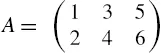
MATLAB is a powerful technical computing system for handling scientific and engineering calculations. The name MATLAB stands for Matrix Laboratory, because the system was designed to make matrix computations particularly easy. A matrix is an array of numbers organized in m rows and n columns. An example is the following
array:
Any one of the elements in a matrix can be plucked out by using the row and column indices that identify its location. The elements in this example are plucked out as follows:
,
,
,
,
,
. The first index identifies the row number counted from top to bottom; the second index is the column number counted from left to right. This is the convention used in MATLAB to locate information in an array. A computer is useful because it can do numerous computations quickly, so operating on large numerical data sets listed in tables as arrays or matrices of rows and columns is quite efficient.
This book assumes that you have never used a computer before to do the sort of scientific calculations that MATLAB handles, but are able to find your way around a computer keyboard and know your operating system (e.g., Windows, UNIX or MAC-OS). The only other computer-related skill you will need is some very basic text editing.
One of the many things you will like about MATLAB (and that distinguishes it from many other computer programming systems, such as C++ and Java) is that you can use it interactively. This means you type some commands at the special MATLAB prompt and get results immediately. The problems solved in this way can be very simple, like finding a square root, or very complicated, like finding the solution to a system of differential equations. For many technical problems, you enter only one or two commands—MATLAB does most of the work for you.
There are three essential requirements for successful MATLAB applications:
■ You must learn the exact rules for writing MATLAB statements and using MATLAB utilities.
■ You must know the mathematics associated with the problem you want to solve.
■ You must develop a logical plan of attack—the algorithm—for solving a particular problem.
This chapter is devoted mainly to the first requirement: learning some basic MATLAB rules. Computer programming is a precise science (some would also say an art); you have to enter statements in precisely the right way. There is a saying among computer programmers: Garbage in, garbage out. It means that if you give MATLAB a gar...
Table of contents
Cover image
Title page
Table of Contents
Copyright
Preface
Essentials
Introduction
Chapter 1: Introduction
Chapter 2: MATLAB Fundamentals
Chapter 3: Program Design and Algorithm Development
Chapter 4: MATLAB Functions and Data Import-Export Utilities
Chapter 5: Logical Vectors
Chapter 6: Matrices and Arrays
Chapter 7: Function M-files
Chapter 8: Loops
Chapter 9: MATLAB Graphics
Chapter 10: Vectors as Arrays and Other Data Structures
Chapter 11: Errors and Pitfalls
Applications
Introduction
Chapter 12: Dynamical Systems
Chapter 13: Simulation
Chapter 14: Introduction to Numerical Methods
Chapter 15: Signal Processing
Chapter 16: SIMULINK
Chapter 17: Symbolics Toolbox
Appendix A: Syntax: Quick Reference
Appendix B: Operators
Appendix C: Command and Function: Quick Reference
Appendix D: Solutions to Selected Exercises
Index
Trusted by 375,005 students
Access to over 1.5 million titles for a fair monthly price.
Study more efficiently using our study tools.
Frequently asked questions
Yes, you can cancel anytime from the Subscription tab in your account settings on the Perlego website. Your subscription will stay active until the end of your current billing period. Learn how to cancel your subscription
No, books cannot be downloaded as external files, such as PDFs, for use outside of Perlego. However, you can download books within the Perlego app for offline reading on mobile or tablet. Learn how to download books offline
Perlego offers two plans: Essential and Complete
Essential is ideal for learners and professionals who enjoy exploring a wide range of subjects. Access the Essential Library with 800,000+ trusted titles and best-sellers across business, personal growth, and the humanities. Includes unlimited reading time and Standard Read Aloud voice.
Complete: Perfect for advanced learners and researchers needing full, unrestricted access. Unlock 1.5M+ books across hundreds of subjects, including academic and specialized titles. The Complete Plan also includes advanced features like Premium Read Aloud and Research Assistant.
Both plans are available with monthly, semester, or annual billing cycles.
We are an online textbook subscription service, where you can get access to an entire online library for less than the price of a single book per month. With over 1.5 million books across 990+ topics, we’ve got you covered! Learn about our mission
Look out for the read-aloud symbol on your next book to see if you can listen to it. The read-aloud tool reads text aloud for you, highlighting the text as it is being read. You can pause it, speed it up and slow it down. Learn more about Read Aloud
Yes! You can use the Perlego app on both iOS and Android devices to read anytime, anywhere — even offline. Perfect for commutes or when you’re on the go. Please note we cannot support devices running on iOS 13 and Android 7 or earlier. Learn more about using the app
Yes, you can access Essential MATLAB for Engineers and Scientists by Daniel T. Valentine,Brian H. Hahn,Brian Hahn,Daniel Valentine in PDF and/or ePUB format, as well as other popular books in Ciencia de la computación & Inteligencia empresarial. We have over 1.5 million books available in our catalogue for you to explore.