- 320 pages
- English
- ePUB (mobile friendly)
- Available on iOS & Android
eBook - ePub
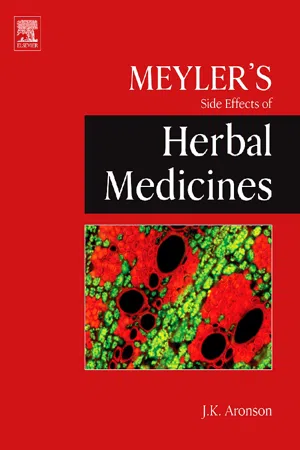
Meyler's Side Effects of Herbal Medicines
About this book
Meyler's Side Effects of Herbal Medicines, named to Doody's Core Titles for 2013, is a derivatrive work based on the acclaimed Meyler's Side Effect of Drugs, Fifteenth Edition. This book summarizes the adverse effects of a large range of herbal medicines and the active ingredients that they contain. It includes extensive lists of the families of plants that are used as herbal medicines, including the Latin names of genera and species as well as the common names of individual plants. It features not only herbal medicines but information on important compounds such as tropane alkaloids, cardiac glycosides, nicotine, and pyrolizidine alkaloids.
The book is divided into three separate sections:
- Family – Each monograph is organized under a family of plants (for example, Liliaceae)
- Genera – The various genera that are included under the family name are tabulated (for example, the family Liliaceae contains 94 genera)
- Species – In each monograph, some species are dealt with separately (for example, in Liliaceae, four species are included under their Latin names and major common names)
Each monograph includes the following information:
- Alternative common names
- Active ingredients
- Uses – both traditional and modern
- Adverse effects
- References
Drug names are designated by their recommended or proposed International Non-proprietary Names (rINN or pINN); when those are not available, clinical names or brand names are used.
The material is drawn from the fifteenth edition of the internationally renowned encyclopedia, Meyler's Side Effects of Drugs, and the latest volumes in the companion series, Side Effects of Drugs Annuals.
This volume is critical for any health professional or homeopathic practitioner with an interest in herbal medicines.
- Named to Doody's Core Titles 2013, a collection development tool for health sciences libraries of all sizes, by Doody Enterprises
- Surpasses the Physician's Desk Reference © by including clinical case studies and independent expert analysis
- Complete index of drug names
- Most complete cross referencing of drug-drug interactions available
Information
Topic
MedicineSubtopic
PharmacologyHerbal Medicines – Acanthaceae – Zygophyllaceae
Acanthaceae
General information
The genera in the family Acanthaceae (Table 5) include the wild petunia and the water willow.
Table 5. The genera of Acanthaceae
| Acanthus (acanthus) |
| Andrographis (false waterwillow) |
| Anisacanthus (desert honeysuckle) |
| Asystasia (asystasia) |
| Barleria (Philippine violet) |
| Barleriola (barleriola) |
| Blechum (blechum) |
| Carlowrightia (wrightwort) |
| Crossandra (crossandra) |
| Dicliptera (foldwing) |
| Dyschoriste (snakeherb) |
| Elytraria (scalystem) |
| Eranthemum (eranthemum) |
| Graptophyllum (graptophyllum) |
| Hemigraphis (hemigraphis) |
| Henrya (henrya) |
| Holographis |
| Hygrophila (swampweed) |
| Hypoestes (hypoestes) |
| Justicia (water-willow) |
| Megaskepasma (Brazilian red-cloak) |
| Nelsonia (nelsonia) |
| Nomaphila (nomaphila) |
| Odontonema (toothedthread) |
| Oplonia (oplonia) |
| Pachystachys (pachystachys) |
| Pseuderanthemum (pseuderanthemum) |
| Ruellia (wild petunia) |
| Sanchezia (sanchezia) |
| Siphonoglossa (tube tongue) |
| Stenandrium (shaggytuft) |
| Strobilanthes |
| Teliostachya (teliostachya) |
| Tetramerium (tetramerium) |
| Thunbergia (thunbergia) |
| Yeatesia (bractspike P) |
Andrographis paniculata (false waterwillow)
Andrographis paniculata is a shrub that is found throughout India and other Asian countries and is sometimes called Indian Echinacea. In China it is known as Chuan Xin Lian and Kan Jang. Its constituents include diterpenoid lactones (andrographolides), paniculides, farnesols, and flavonoids. It has been used to treat viral infections, such as colds and influenza.
In a double-blind, placebo-controlled study of the use of andrographis 1200 mg/day in 61 patients there were no changes in liver or kidney function, blood counts, or other laboratory measures (1).
A systematic review of all clinical reports of adverse events resulting from treatment of upper respiratory tract infections with Andrographis paniculata found only mild, infrequent and reversible adverse events (2). The most frequent ones included pruritus, fatigue, headache, and diarrhea.
Adverse effects
Skin
In two double-blind placebo-controlled studies of Andrographis paniculata in a total of 225 patients there were two cases of urticaria (3).
References
1. Hancke J, Burgos R, Caceres D, Wikman G. A double-blind study with a new monodrug Kan Jang: decrease of symptoms and improvement in the recovery from common colds. Phytother Res. 1995;9(8):559–562.
2. Coon JT, Ernst E. Andrographis paniculata in the treatment of upper respiratory tract infections: a systematic review of safety and efficacy. Planta Med. 2004;70:293–298.
3. Melchior J, Spasov AA, Ostrovskij OV, Bulanov AE, Wikman G. Double-blind, placebo-controlled pilot and phase III study of activity of standardized Andrographis paniculata Herba extract fixed combination (Kan jang) in the treatment of uncomplicated upper-respiratory tract infection. Phytomedicine. 2000;7(5):341–350.
Acoraceae
General Information
Acorus calamus was originally classified as a member of the arum family (Araceae), but is now designated as belonging to its own family, the Acoraceae, of which it is the only member.
Acorus calamus
Acorus calamus (calamus root, sweet flag, rat root, sweet sedge, flag root, sweet calomel, sweet myrtle, sweet cane, sweet rush, beewort, muskrat root, pine root) contains several active constituents called “asarones.” The basic structure is 2,4,5-trimethoxy-1-propenylbenzene, which is related to the hallucinogen 3,4-methylenedioxyphenylisopropylamine (MDA). The amounts of the asarones in calamus rhizomes vary considerably with the botanical variety. For example, there are high concentrations in triploid calamus from Eastern Europe but none detectable in the diploid North American variety.
Acorus calamus has been used as a hallucinogen since ancient times and it has several uses in folk medicine. It may have been one of the constituents of the Holy Oil that God commanded Moses to make (Exodus 30) and is mentioned by ancient writers on medicine, such as Hippocrates, Theophrastus, Dioscorides, and Celsus (http://www.a1b2c3.com/drugs/var002.htm).
Acorus calamus has in vitro antiproliferative and immunosuppressive actions (1).
Acorus calamus contains beta-asarone [(Z)-1,2,4-trimethoxy-5-prop-1-enyl-benzene], which is carcinogenic (2). Commercial calamus preparations have mutagenic effects in bacteria (3), while calamus oil (Jammu variety) is carcinogenic in rats.
Walt Whitman’s 39 “Calamus poems” are to be found in his well-known collection “Leaves of Grass.”
References
1. Mehrotra S, Mishra KP, Maurya R, et al. Anticellular and immunosuppressive properties of ethanolic extract of Acorus calamus rhizome. Int Immunopharmacol. 2003;3(1):53–61.
2. Bertea CM, Azzolin CM, Bossi S, Doglia G, Maffei ME. Identification of an EcoRI restriction site for a rapid and precise determination of beta-asarone-free Acorus calamus cytotypes. Phytochemistry. 2005;66(5):507–514.
3. Sivaswamy SN, Balachandran B, Balanehru S, Sivaramakrishnan VM. Mutagenic activity of south Indian food items. Indian J Exp Biol. 1991;29(8):730–737.
Algae
General Information
Algae are members of the kingdom Protista. They include Bacillariophyta (unicellular diatoms), Charophyta (freshwater stoneworts), Chrysophyta (photosynthetic, unicellular organisms), Cyanobacteria (photosynthetic bacteria), Dinophyta (dinoflagellates), and the various types of seaweeds.
There are three major groups of seaweeds: the green algae (Chlorophyta), the brown algae (Phaeophyta), and the red algae (Rhodophyta).
Kelp is a general name for seaweed preparations obtained from different species of Phaeophyta (such as Ascophyllum nodosum, Fucus vesiculosus, Fucus serratus, Laminaria species, and Macrocystis pyrifera). As kelp contains iodine...
Table of contents
- Cover image
- Title page
- Table of Contents
- Copyright
- Preface
- Herbal Medicines – Introduction and General Information
- Herbal Medicines – Acanthaceae – Zygophyllaceae
- Compounds found in Herbal products
- Index of drug names
Trusted by 375,005 students
Access to over 1.5 million titles for a fair monthly price.
Study more efficiently using our study tools.
Frequently asked questions
Yes, you can cancel anytime from the Subscription tab in your account settings on the Perlego website. Your subscription will stay active until the end of your current billing period. Learn how to cancel your subscription
No, books cannot be downloaded as external files, such as PDFs, for use outside of Perlego. However, you can download books within the Perlego app for offline reading on mobile or tablet. Learn how to download books offline
Perlego offers two plans: Essential and Complete
- Essential is ideal for learners and professionals who enjoy exploring a wide range of subjects. Access the Essential Library with 800,000+ trusted titles and best-sellers across business, personal growth, and the humanities. Includes unlimited reading time and Standard Read Aloud voice.
- Complete: Perfect for advanced learners and researchers needing full, unrestricted access. Unlock 1.5M+ books across hundreds of subjects, including academic and specialized titles. The Complete Plan also includes advanced features like Premium Read Aloud and Research Assistant.
We are an online textbook subscription service, where you can get access to an entire online library for less than the price of a single book per month. With over 1.5 million books across 990+ topics, we’ve got you covered! Learn about our mission
Look out for the read-aloud symbol on your next book to see if you can listen to it. The read-aloud tool reads text aloud for you, highlighting the text as it is being read. You can pause it, speed it up and slow it down. Learn more about Read Aloud
Yes! You can use the Perlego app on both iOS and Android devices to read anytime, anywhere — even offline. Perfect for commutes or when you’re on the go.
Please note we cannot support devices running on iOS 13 and Android 7 or earlier. Learn more about using the app
Please note we cannot support devices running on iOS 13 and Android 7 or earlier. Learn more about using the app
Yes, you can access Meyler's Side Effects of Herbal Medicines by Jeffrey K. Aronson in PDF and/or ePUB format, as well as other popular books in Medicine & Pharmacology. We have over 1.5 million books available in our catalogue for you to explore.