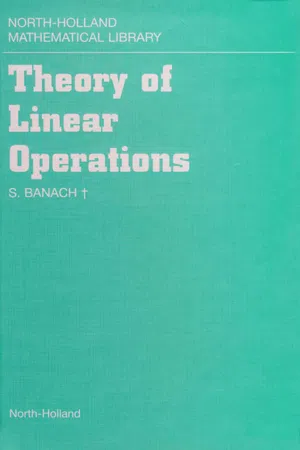
This classic work by the late Stefan Banach has been translated into English so as to reach a yet wider audience. It contains the basics of the algebra of operators, concentrating on the study of linear operators, which corresponds to that of the linear forms a1x1 + a2x2 + ... + anxn of algebra.The book gathers results concerning linear operators defined in general spaces of a certain kind, principally in Banach spaces, examples of which are: the space of continuous functions, that of the pth-power-summable functions, Hilbert space, etc. The general theorems are interpreted in various mathematical areas, such as group theory, differential equations, integral equations, equations with infinitely many unknowns, functions of a real variable, summation methods and orthogonal series.A new fifty-page section (``Some Aspects of the Present Theory of Banach Spaces'') complements this important monograph.
Let a complete metric space E be given. Suppose that to each ordered pair (x,y) of elements of the space E there corresponds a unique element z of this space called the sum of x and y and which we will denote by the symbol x + y.
Suppose further that E is a group under this sum operation, i.e. that
I1.
I2. there exists in E a zero–element θ such that one has
I3. to each element x of E there corresponds an element (which we will denote by -x) which satisfies the equation
It follows easily from these axioms that:
a) there exists only one zero–element θ in E,
b) one has (−x) + (x) = θ for each x ε E.
c) x + y = x + z implies y = z.
Suppose further that the following axioms are satisfied:
II1.
II2.
The complete metric spaces satisfying these axioms will be called G-spaces.
Remark. We will write x − y instead of x + (−y) and −x + y instead of (−x) + y.
§2. Properties of sub-groups
Let E be a G-space. For an element x ε E and a set H ⊆ E, we will denote by xH and Hx respectively the set of all elements y ε E such that y = x + z (z + x, respectively) where z ε H.
Clearly, one always has the identities
and the analogous identities for H1x and H2x.
It is easily shown that if H has any of the properties closed, open, nowhere dense, of category I, of category II or B-measurable then the set xH also has the same properties. If z is an interior point of H, x + z is an interior point of xH.
A non-empty set H ⊆ E is called a subgroup of E, when the conditions x ε H and y ε H imply x + y ε H and −x ε H. Clearly then also θ ε H.
A set is said to be connected when it cannot be expressed as the union of two non-empty disjoint relatively closed subsets of itself. If E is a connected set and H is a subset of E which is both open and closed, one has H = E, for otherwise the set E\H would also be non-empty and closed.
Theorem 1.
Every sub...
Table of contents
Cover image
Title page
Table of Contents
North-Holland Mathematical Library
Copyright page
Preface
Introduction
Chapter I: Groups
Chapter II: General vector spaces
Chapter III: F-spaces
Chapter IV: Normed spaces
Chapter V: Banach spaces
Chapter VI: Compact operators
Chapter VII: Biorthogonal sequences
Chapter VIII: Linear functionals
Chapter IX: Weakly convergent sequences
Chapter X: Linear functional equations
Chapter XI: Isometry, equivalence, isomorphism
Chapter XII: Linear dimension
Weak convergence in Banach spaces
Remarks
Index
Some aspects of the present theory of Banach spaces
Bibliography
Trusted by 375,005 students
Access to over 1.5 million titles for a fair monthly price.
Study more efficiently using our study tools.
Frequently asked questions
Yes, you can cancel anytime from the Subscription tab in your account settings on the Perlego website. Your subscription will stay active until the end of your current billing period. Learn how to cancel your subscription
No, books cannot be downloaded as external files, such as PDFs, for use outside of Perlego. However, you can download books within the Perlego app for offline reading on mobile or tablet. Learn how to download books offline
Perlego offers two plans: Essential and Complete
Essential is ideal for learners and professionals who enjoy exploring a wide range of subjects. Access the Essential Library with 800,000+ trusted titles and best-sellers across business, personal growth, and the humanities. Includes unlimited reading time and Standard Read Aloud voice.
Complete: Perfect for advanced learners and researchers needing full, unrestricted access. Unlock 1.5M+ books across hundreds of subjects, including academic and specialized titles. The Complete Plan also includes advanced features like Premium Read Aloud and Research Assistant.
Both plans are available with monthly, semester, or annual billing cycles.
We are an online textbook subscription service, where you can get access to an entire online library for less than the price of a single book per month. With over 1.5 million books across 990+ topics, we’ve got you covered! Learn about our mission
Look out for the read-aloud symbol on your next book to see if you can listen to it. The read-aloud tool reads text aloud for you, highlighting the text as it is being read. You can pause it, speed it up and slow it down. Learn more about Read Aloud
Yes! You can use the Perlego app on both iOS and Android devices to read anytime, anywhere — even offline. Perfect for commutes or when you’re on the go. Please note we cannot support devices running on iOS 13 and Android 7 or earlier. Learn more about using the app
Yes, you can access Theory of Linear Operations by S. Banach in PDF and/or ePUB format, as well as other popular books in Computer Science & Computer Science General. We have over 1.5 million books available in our catalogue for you to explore.