- 520 pages
- English
- ePUB (mobile friendly)
- Available on iOS & Android
eBook - ePub
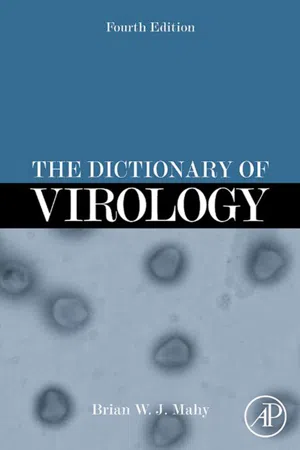
The Dictionary of Virology
About this book
Completely revised and updated to take into account the new taxonomy and grouping changes made by the International Committee on Taxonomy of Viruses in their 8th Report, The Dictionary of Virology provides an authoritative and concise list of all viruses affecting vertebrate species, from humans to fish.
- Includes the new viruses of medical or veterinary importance that have emerged since 2001, such as the new human coronaviruses, SARS and NL63 and a new subtype of influenza (H1N2)
- Includes new terms in virology
- Extensive cross-referencing and illustrative tables further enhance the use of this book
Information
C
C1q complement protein The first component of the classical complement pathway, the first line of defense against viruses. Human C1q binds directly to certain viruses, and this result in activation of the complement system and neutralization of the virus by virolysis (damage to the virion envelope).
C2 The second component of complement.
C211 cells (CCL 123) A cell line derived from a skin biopsy obtained from a 11-year-old Caucasian male with Cri du Chat syndrome. The cell line has a partial deletion of the short arm of chromosome 4.
C3 complement protein The third component of complement which can directly activate the alternative pathway, and can cause opsonization of an antigen. Reacts fourth in the hemolytic complement activation sequence, and is the most abundant of the complement proteins.
C3a complement protein A biologically active fragment of C3, which is an anaphylatoxin.
C4 complement protein The fourth component of complement which actually reacts second in the hemolytic complement activation sequence.
C5 complement protein The fifth component of complement. Activated by C5 convertase, which splits off a small fragment, C5a, leaving C5b, the remainder of the molecule, which forms a complex with C6, C7, C8, and C9 known as the membrane attack complex that has an affinity for cell membranes and mediates immune cytolysis and hemolysis.
C5a complement protein A 74 residue peptide derived from C5 by tryptic cleavage. A chemotactic factor and anaphylatoxin.
C6/36 cells A line of insect cells derived from the mosquito, Aedes albopictus. Supports the growth of many arboviruses, including dengue virus.
Barth OM (1992) Mem Inst Oswaldo Cruz 87, 565
Barth OM (1992) Mem Inst Oswaldo Cruz 87, 565
CA protein The capsid protein (p24) of HIV which forms the viral core enclosing the genome and enzymes required for infectivity.
Cabassou virus (CABV) A species in the genus Alphavirus, antigenically related to Venezuelan equine encephalitis virus. No association with human disease.
Cacao virus (CACV) A strain of Chilibre virus in the genus Phlebovirus, in the Chilibre antigenic complex of the sandfly fever group. Isolated from Lutzomyia sp in Panama. Not reported to cause disease in humans.
Cache Valley virus (CVV) A strain of Bunyamwera virus in the genus Orthobunyavirus. Isolated in N Dakota, Maryland, Virginia and Indiana, USA, and in Jamaica. Mosquito-borne. Antibodies are found in humans, monkeys, horses, cattle, deer, and wild rodents. Can cause disease in humans, but as laboratories rarely test for it, the true incidence is unknown.
Blackmore CGM and Grimstad PR (1998) Am J Trop Med Hyg 59, 704
Campbell GL et al (2006) Emerg Infect Dis 12, 854
Inverson JO et al (1979) Can J Microbiol 25, 760
Blackmore CGM and Grimstad PR (1998) Am J Trop Med Hyg 59, 704
Campbell GL et al (2006) Emerg Infect Dis 12, 854
Inverson JO et al (1979) Can J Microbiol 25, 760
Cacipacore virus (CPCV) A species in the genus Flavivirus, in the Japanese encephalitis group, with no known vector. Isolated from the blackfaced antbird, Formicarius analis, in Para, Brazil.
Batista WC et al (2001) Virus Res 75, 35
Batista WC et al (2001) Virus Res 75, 35
CaCo2 cell line A continuous human colon adenocarcinoma cell line derived from a 72-year-old Caucasian male. Can be used for isolation and growth of human astroviruses.
Willcocks MM et al (1990) Arch Virol 113, 73
Willcocks MM et al (1990) Arch Virol 113, 73
Caddo Canyon virus (CDCV) An unassigned, ungrouped member of the Bunyaviridae family. Isolated from the tick, Ixodes baergi, in Caddo canyon, Oklahoma, USA.
caesium chloride density gradient centrifugation Method for separating molecules or viruses according to their density. Sedimentation ceases when the molecules reach the position in the gradient that is the same as their own buoyant density, termed ‘the isopycnic point.’
Caimito virus (CAIV) A tentative species in the genus Phlebovirus, antigenically unrelated to other members of the genus. Isolated from the fan fly, Lutzomyia lephilator, in central Panama. Not reported to cause human disease.
Cajazeira virus (CAJV) An unclassified virus isolated from the viscera of bats of undetermined species in the Amazon region of Brazil.
Calabazo virus (CALV) A species in the genus Hantavirus. Isolated from cane mice, Zygodontomys brevicauda, in Panama. Not so far associated with human disease.
Vincent MJ et al (2000) Virology 277, 14
Vincent MJ et al (2000) Virology 277, 14
Calchaqui virus (CQIV) A tentative species in the genus Vesiculovirus. Isolated from mosquitoes, Aedeomyia squamipennis, in Argentina.
Calisher CH et al (1987) Am J Trop Med Hyg 36, 114
Calisher CH et al (1987) Am J Trop Med Hyg 36, 114
calf diarrhea virus See neonatal calf diarrhea coronavirus, bovine rotavirus, and bovine noroviruses.
calf lymph vaccine When vaccination against smallpox began in the 1880s, it was produced on the skin of calves,...
Table of contents
- Cover image
- Title page
- Table of Contents
- Copyright page
- Preface to the Fourth Edition
- A
- B
- C
- D
- E
- F
- G
- H
- I
- J
- K
- L
- M
- N
- O
- P
- Q
- R
- S
- T
- U
- V
- W
- X
- Y
- Z
- Appendix
- Abbreviations
Trusted by 375,005 students
Access to over 1.5 million titles for a fair monthly price.
Study more efficiently using our study tools.
Frequently asked questions
Yes, you can cancel anytime from the Subscription tab in your account settings on the Perlego website. Your subscription will stay active until the end of your current billing period. Learn how to cancel your subscription
No, books cannot be downloaded as external files, such as PDFs, for use outside of Perlego. However, you can download books within the Perlego app for offline reading on mobile or tablet. Learn how to download books offline
Perlego offers two plans: Essential and Complete
- Essential is ideal for learners and professionals who enjoy exploring a wide range of subjects. Access the Essential Library with 800,000+ trusted titles and best-sellers across business, personal growth, and the humanities. Includes unlimited reading time and Standard Read Aloud voice.
- Complete: Perfect for advanced learners and researchers needing full, unrestricted access. Unlock 1.5M+ books across hundreds of subjects, including academic and specialized titles. The Complete Plan also includes advanced features like Premium Read Aloud and Research Assistant.
We are an online textbook subscription service, where you can get access to an entire online library for less than the price of a single book per month. With over 1.5 million books across 990+ topics, we’ve got you covered! Learn about our mission
Look out for the read-aloud symbol on your next book to see if you can listen to it. The read-aloud tool reads text aloud for you, highlighting the text as it is being read. You can pause it, speed it up and slow it down. Learn more about Read Aloud
Yes! You can use the Perlego app on both iOS and Android devices to read anytime, anywhere — even offline. Perfect for commutes or when you’re on the go.
Please note we cannot support devices running on iOS 13 and Android 7 or earlier. Learn more about using the app
Please note we cannot support devices running on iOS 13 and Android 7 or earlier. Learn more about using the app
Yes, you can access The Dictionary of Virology by Brian W.J. Mahy in PDF and/or ePUB format, as well as other popular books in Biological Sciences & Microbiology. We have over 1.5 million books available in our catalogue for you to explore.