- 776 pages
- English
- ePUB (mobile friendly)
- Available on iOS & Android
eBook - ePub
About this book
Global populations have grown rapidly in recent decades, leading to ever increasing demands for shelter, resources, energy and utilities. Coupled with the worldwide need to achieve lower impact buildings and conservation of resources, the need to achieve sustainability in urban environments has never been more acute. This book critically reviews the fundamental issues and applied science, engineering and technology that will enable all cities to achieve a greater level of metropolitan sustainability, and assist nations in meeting the needs of their growing urban populations.Part one introduces key issues related to metropolitan sustainability, including the use of both urban metabolism and benefit cost analysis. Part two focuses on urban land use and the environmental impact of the built environment. The urban heat island effect, redevelopment of brownfield sites and urban agriculture are discussed in depth, before part three goes on to explore urban air pollution and emissions control. Urban water resources, reuse and management are explored in part four, followed by a study of urban energy supply and management in part five. Solar, wind and bioenergy, the role of waste-to-energy systems in the urban infrastructure, and smart energy for cities are investigated. Finally, part six considers sustainable urban development, transport and planning.With its distinguished editor and international team of expert contributors, Metropolitan sustainability is an essential resource for low-impact building engineers, sustainability consultants and architects, town and city planners, local/municipal authorities, and national and non-governmental bodies, and provides a thorough overview for academics of all levels in this field.
- Critically reviews the fundamental issues and applied science, engineering and technology that will enable all cities to achieve a greater level of metropolitan sustainability
- Will assist nations in meeting the needs of their growing urban populations
- Chapters discuss urban land use, the environmental impact of the build environment, the urban heat island effect, urban air pollution and emissions control, among other topics
Information
Part I
Metropolitan sustainability: an introduction
1
A living city: using urban metabolism analysis to view cities as life forms
S. Pincetl, University of California, Los Angeles, USA
Abstract:
Urban metabolism (UM) is an accounting of inputs into urban systems, the work that gets done and the waste that results from the urban system using those inputs. To date, accounting has been limited to energy, materials, water, nutrients and waste that enter and leave a city at the city scale. This chapter suggests that for UM to be of use in sustainability, UM needs to be downscaled to the census block (for socio-demographic understanding of the users of energy), by sector (to understand how the economy uses energy) and to include life cycle analysis of economic key sectors.
Key words
urban metabolism
sustainability
energy use
materials and waste flows
life cycle analysis
mass balance
emergy
1.1 Introduction: urban metabolism (UM), or urban energy systems
The industrialization of the late nineteenth century was enabled by an unprecedented new energy source: fossil energy. Before, human societies used muscle power from animals and humans. The discovery of fossil energy that packs much more energy bang-for-the-buck has allowed the tremendous growth of cities and economic activity in the twentieth century. This growth has continued into the twenty-first century, which is on course to be the century where more people live in cities than in the countryside – a first in human history. According to the World Health Organization (WHO), as of 2010, more than half of all people live in an urban area, though fewer than 10% of urban dwellers live in megacities (cities of more than ten million people (WHO, 2011)).
Over the past 100–150 years, the systems to support cities have become increasingly complex and interdependent, accreting infrastructure and activities. Pipelines carrying gasoline, natural gas, water and information crisscross entire countries to supply urban populations. Huge warehousing districts serve as staging areas for the distribution of materials and goods to cities. Transmission lines span landscapes to bring power into urban areas. Cities concentrate energy and resources drawn from near and far for use in relatively compact spaces. This requires enormous investments in infrastructure, both physical and institutional. While on a daily basis most of this has become part of daily life, normalized even, this complex set of physical and human social supply networks is fundamental to the functioning of society and cities; it is also insufficiently examined. In addition, while there is an understanding that cities should become more sustainable and reduce their environmental impact, the actual physical impact of cities on global biogeochemical cycling and ecological processes is understudied (Decker et al., 2000). This means that making genuine reductions is a guessing game since there is not very good information about energy and materials use in cities.
Why is this important? Peter Vitousek and colleagues, in a widely cited 1997 paper in Science, explained that between one-third and one-half of the land surface of the earth has been transformed by human action (Vitousek et al., 1997) (Fig. 1.1). They go on to state that the use of land to yield goods and services represents the most substantial human alteration of the earth system, and that there is real concern that the earth will not be able to sustain the pace and scale of such extractive activity. Better accounting of the material basis upon which urban systems depend seems timely. Furthermore, the relationship between the way urban systems are organized and resource consumption also needs to be taken into account. Are there perverse policies and incentives relative to energy and resource use that reinforce high use rather than parsimonious ones? Is the system simply unexamined such that this high use of resources is not understood well?
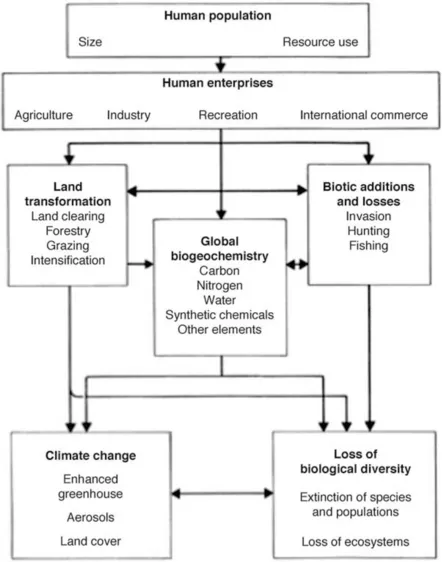
1.1 A conceptual model illustrating humanity's direct and indirect effects on the earth system. (source: Vitousek et al., 1997)
Urban metabolism (UM), or the accounting of energy and material flows into cities and the waste products generated, is an initial means to quantify the amount of inputs extracted from the earth for urban use and, ultimately, the physical impact of cities on global biogeochemical cycling and ecological processes. To date, UM has quantified aggregate flows of energy, materials, water, nutrients and waste at the city level. Studies on nearly 50 cities have been conducted by engineers. This chapter suggests the use of UM methods for urban sustainability metrics and proposes additions to improve its utility for sustainability needs.
1.1.1 Evolution of UM analysis
The first UM study was conducted by Abel Wolman in 1965 for a hypothetical city of one million people. His paper ‘The metabolism of cities’ was a pioneering article that framed the city as a closed metabolic unit requiring inputs of materials that are converted and ejected as waste outputs. Wolman foreshadowed ecological footprint analysis, later proposed by Wackernagel and Rees (1996). He noted that the footprints of cities were no longer constrained to the geographic or political boundaries used to define them. A water resources engineer by profession, Wolman was concerned about the pressures on natural systems and resources of an increasingly affluent population (Wolman, 1965). He developed the UM concept as a method for the quantification of inputs – energy, water nutrients, materials and waste – in cities. He identified the three pressing metabolic challenges faced by urban regions as water supply management, sewage disposal and air pollution control. Wolman’s seminal research was the first attempt to highlight system-wide impacts of goods consumption and waste generation in the urban environment (Decker et al., 2000). For sustainability programs to be implemented, understanding the materials and resources cities metabolize, where inputs come from and where waste goes, is critical. UM is a first step in this framework and will contribute to determining what processes are susceptible to alterations such that their impacts can be minimized or eliminated.
Wolman had been part of a group of biophysical and social scientists who participated in a remarkable 1955 international conference on ‘Man’s role in changing the face of the earth’ (Thomas, 1956). The papers at this conference expressed a strong concern about the limited natural base of minerals in the face of rapidly increasing demand. With World War II and the huge increase in the use of minerals and metals harnessed for the war effort, worries about meeting the demand for materials were being expressed in various sectors, including the 1952 report of the President’s Materials Policy Commission (Paley, 1952) in which the federal government surveyed the nation’s mineral resources (Fischer-Kowalski, 2003). This study, for example, stated that the USA would no longer be able to satisfy its own needs for fossil fuels by the mid-1970s and that the nation would become dependent on foreign sources.
It should be noted that a handful of economists pointed to pressures on natural systems and the potential of limits along the lines of Wolman’s concerns beginning in the late 1960s, laying the groundwork for ecological economics. For example, in 1971, Georgescu-Roegen, in The Entropy Law and the Economic Process, argued that the second law of thermodynamics was a limiting factor in economic growth. Thermodynamics is a branch of physics that deals with energy and the work of a system. The first law defines the relationship between the various forms of energy present in a system and the work that system does. It states that matter/energy cannot be created nor can it be destroyed: the quantity of matter/energy remains the same. The second law of thermodynamics takes this concept to the next step. While the quantity may remain the same, the quality deteriorates: once gasoline is burned, it can never be burned again, though its component elements have not disappeared from the earth. Human societies require significant energy inputs that are then dissipated when used in activities, degrading the quality of the input. Ecological economists have argued that it is important to recognize these processes because they will ultimately constrain economic growth as good-quality inputs are used and energy is dissipated into the atmosphere in the form of heat and/or pollution (see articles in the Journal of Ecological Economics, founded in 1989, for such discussions). As high- quality resources are irretrieva...
Table of contents
- Cover image
- Title page
- Table of Contents
- Copyright
- Contributor contact details
- Woodhead Publishing Series in Energy
- Introduction
- Part I: Metropolitan sustainability: an introduction
- Part II: Earth: urban land use and the environmental impact of the built environment
- Part III: Wind: urban air pollution and emissions control
- Part IV: Water: urban water resources, reuse and managemen
- Part V: Fire: urban energy supply and management
- Part VI: Sustainable urban development, transport and planning
- Index
Trusted by 375,005 students
Access to over 1.5 million titles for a fair monthly price.
Study more efficiently using our study tools.
Frequently asked questions
Yes, you can cancel anytime from the Subscription tab in your account settings on the Perlego website. Your subscription will stay active until the end of your current billing period. Learn how to cancel your subscription
No, books cannot be downloaded as external files, such as PDFs, for use outside of Perlego. However, you can download books within the Perlego app for offline reading on mobile or tablet. Learn how to download books offline
Perlego offers two plans: Essential and Complete
- Essential is ideal for learners and professionals who enjoy exploring a wide range of subjects. Access the Essential Library with 800,000+ trusted titles and best-sellers across business, personal growth, and the humanities. Includes unlimited reading time and Standard Read Aloud voice.
- Complete: Perfect for advanced learners and researchers needing full, unrestricted access. Unlock 1.5M+ books across hundreds of subjects, including academic and specialized titles. The Complete Plan also includes advanced features like Premium Read Aloud and Research Assistant.
We are an online textbook subscription service, where you can get access to an entire online library for less than the price of a single book per month. With over 1.5 million books across 990+ topics, we’ve got you covered! Learn about our mission
Look out for the read-aloud symbol on your next book to see if you can listen to it. The read-aloud tool reads text aloud for you, highlighting the text as it is being read. You can pause it, speed it up and slow it down. Learn more about Read Aloud
Yes! You can use the Perlego app on both iOS and Android devices to read anytime, anywhere — even offline. Perfect for commutes or when you’re on the go.
Please note we cannot support devices running on iOS 13 and Android 7 or earlier. Learn more about using the app
Please note we cannot support devices running on iOS 13 and Android 7 or earlier. Learn more about using the app
Yes, you can access Metropolitan Sustainability by F Zeman in PDF and/or ePUB format, as well as other popular books in Technology & Engineering & Environmental Science. We have over 1.5 million books available in our catalogue for you to explore.