
- 224 pages
- English
- ePUB (mobile friendly)
- Available on iOS & Android
eBook - ePub
About this book
An increasingly important feature across the technical textile industry is to produce textiles faster and to have more effective new product development (NPD). New product development in textiles: Innovation and production not only provides a fascinating overview of how products are launched, but is also a source of practical guidance for developing textile products successfully.
Part one provides a general overview of innovation and textile product development that introduces the reader to the principles of developing and defining new products. Part two goes on to discuss a collection of international studies from across the textile industry. Chapters describe actual new product development projects, identifying the problems that were faced and what can be learnt from these projects, such as customer co-creation and methods for reducing the risk in NPD. Topics range from technical textiles and apparel to the end uses of textiles used within the automotive and packaging industries.
With its distinguished editor and international team of expert contributors New product development in textiles: Innovation and production is an essential guide for academics and textile development professionals worldwide, in sectors ranging from design, production and marketing through to management.
- Provides a fascinating overview of how products are launched
- A source of practical guidance for developing textile products successfully
- Covers topics from technical textiles and apparel to the end uses of textiles used within the automotive and packaging industries
Information
Part I
General overview of innovation and textile product development
1
Innovation and new product development in textiles
S. Frumkin, S. Bradley and M. Weiss, Philadelphia University, USA
Abstract:
This chapter reviews the nature of innovation, particularly the concept of ‘disruptive innovation’ and the forces driving market change. It then discusses ways companies can innovate, before specifically considering the nature of innovation in the textile industry. The chapter concludes with a series of case studies of how both larger and smaller textile companies have successfully developed innovative products.
Key words
innovation
competition
corporate strategy
competitive advantage
globalization
textile innovation
1.1 Introduction: incremental change versus disruptive innovation
The concept of innovation is not new to the marketplace. A review of the history of civilization shows many changes in technology, design, markets and marketing, distribution and business structure. Innovation to meet these changes is expensive; in healthy economic conditions it prospers whilst in difficult times it moves to the back burner of tactical corporate strategy. In the field of textiles, innovation has resulted in a wide range of natural and synthetic fabrics that are lighter, smarter, multi-functional and with a wider range of engineered properties.
Over-arching terms in the field of innovation have been used by many business writers, academicians and industrialists to define the process of innovation. A number of years ago Harvard Professor Clayton M. Christensen wrote The Innovator’s Dilemma (1997), a book followed by a number of others that redefined innovation for other educators, students and the business community at large. Christensen’s ideas on innovation help to explain why successful, competently managed companies can trip up even when they are in tune with their customer base and invest in leading technologies.
Christensen called changes that seep into the marketplace as continual product and process renewal ‘incremental change’, such as the introduction of individual new fibers, yarns and fabrics in the textile industry. Such an example would be the use of stretch yarn, from the early introduction of Spandex (an anagram of the word expands), to Lycra or elastane. Lycra, invented by DuPont chemist Joseph Shivers in 1959, is stronger and more durable than rubber and is known for its exceptional stretch and recovery properties (elasticity). These new fibers allowed companies to extend existing product lines and applications. Many companies have proved adept at anticipating and making these incremental changes.
Christensen contrasts incremental change with ‘disruptive innovation’. This happens when what Christensen calls disruptive technology enters the marketplace, often developed by a new player unbeknown to the leading companies. Disruptive technologies create a new value proposition in the consumer’s mind that overturns the perceived value of existing products. An example in textiles is the introduction of man-made fibers in the last century. Their introduction transformed a marketplace that had been dominated by natural fibers. It led to a completely new generation of fibers and applications as well as an entirely new set of textile companies in the market.
The concept of disruptive innovation has changed the basic concepts of strategy. Strategy is traditionally rooted in supply and demand conditions, and in concepts such as market share and competitiveness against existing rivals in the marketplace. This concept of strategy no longer applies when disruptive innovation makes both an existing company and its competitors irrelevant. Traditional concepts of strategy need to be replaced by a concept such as ‘blue ocean’ strategy proposed by Kim and Mauborgne (2005). This strategy suggests that companies can create a space in the marketplace that did not previously exist, a blue ocean, in contrast to more traditional companies operating in an established market, the red ocean. The red ocean is everything that currently is in existence.
These concepts of disruptive innovation and the need for a blue ocean strategy are endorsed by key figures in business today, such as Lou Mulkern, editorial director at DBA Public Relations in New York, one of the country’s premier PR agencies specializing in consumer electronics. He has been involved in the hightech PR business for more than 25 years as both a journalist and PR executive. He has worked with global companies such as Toshiba, TDK, Amazon, Newegg (the second-largest online-only retailer in the US), and others to help refine and communicate their key messages.
Mulkern states that in the PR and media business, people are fond of saying things such as ‘perception is reality’. However, in press releases for his clients, touting their new products or services, Mulkern maintains that he always tries to resist the urge to use words such as ‘innovation’ and ‘innovative’, so as not to dilute their impact; that is, unless the products or services truly live up to the high standard of innovation. ‘Innovation is actually a very specific quality,’ he notes, ‘and it should be reserved for things that really offer people something new and exciting in their lives’ (Mulkern, 2009). Mulkern links innovation with leadership. A company that truly innovates, either by creating ‘first-ever’ type products or providing ahead-of-the-curve services, is, by definition, also a company that exhibits leadership. In this way, leadership and innovation are really inseparable. From a PR perspective, both are very highly sought after qualities for businesses.
True innovation of this kind is hard to define. In this respect Mulkern refers to US Supreme Court Justice Potter Stewart, who famously attempted to explain the meaning of pornography in 1963 with the words, ‘I shall not today attempt further to define it … but I know it when I see it’ (Concurring, Jacobellis v Ohio, 378 US 184 (1964)). Innovation of this kind is about changing the rules of the game. An example is a manufacturer such as Toshiba and a product such as the DVD. With its combination of dramatically increased functionality and convenience, this new technology automatically rendered existing technologies (such as VHS) obsolete and created new possibilities in the market.
One of the companies that Mulkern has worked with that he states really takes innovation to heart, is Toshiba, whose corporate slogan is, in fact, ‘Leading innovation’. He notes that Toshiba’s commitment to innovation goes back over a hundred years. One of the company’s founders, Hisashige Tanaka, is revered in Japan as a quintessential inventor and innovator. He became famous for creating intricate mechanical dolls, as well as a perpetual or ‘10 000-year’ clock that is still on display at the Science Museum in Tokyo. He also built Japan’s first working model of a steam locomotive. The company he founded in 1875, Tanaka Engineering Works, manufactured electric bulbs, cables, prototype telephones, industrial machinery and other products, later becoming today’s Toshiba. The company’s many innovations include the release of Japan’s first rice cookers in 1955 and the DVD in the mid-1990s, as well as breakthroughs in IT and communications, laptops and mobile computing.
Mulkern believes that manufacturers such as Toshiba, who are serious about innovation, need, like Tanaka Hisashige, to be endlessly inventive with a fascination for what technology can do. More than that, however, they need to be focused on how developments in technology can make life easier, more fun or more efficient. Innovation without a clear understanding of how the design of a product and its capabilities will benefit consumers – like that original rice cooker – will simply not be adopted by consumers.
This interest in, and willingness to embrace, the new means that innovative companies need to adapt and change continually. Some of the most durable and successful companies today are nothing like they were when they were founded. Take, for example, IBM (International Business Machine), 3M (Minnesota and Mining) or even retailers such as the Dayton-Hudson Corporation, now operating as Target.
The International Business Machine Company (IBM®) was founded in 1896 as the Tabulating Machine Company, a company that produced one of the first generation data processing machines. Today IBM is one of the world’s most valuable brands, second only to Coca-Cola, and the world’s fourth largest technology company. With 400 000 employees worldwide, IBM is the second largest (in market capitalization) and the second most profitable information technology and services employer in the world according to the Forbes 2000 list, with sales of greater than 100 billion US dollars.
The Minnesota Mining and Manufacturing Company was founded in Two Harbors, Minnesota in 1902, later becoming 3M™. The company’s roots were in mining stone from quarries for use in grinding wheels. Today they are known for a wide range of innovative products that began with their first exclusive product: Three-M-ite cloth. Today the company has over 76 000 employees that produce over 55 000 products. 3M has operations in more than 60 countries and its products are available in more than 200 countries (Fig. 1.1).
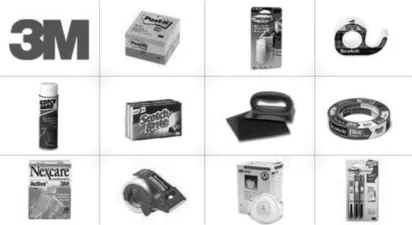
1.1 3M™ products (courtesy of the 3M™ Corporation).
The Target Corporation (Target) was founded in Minneapolis, Minnesota in 1902 as the Dayton Dry Goods Company. It became one of the pioneers of discount merchandising, opening its first Target discount store in 1962. In 1966 it branched out into discount book selling. Through growing expertise in sourcing and buying in bulk, strong financial control and acquisitions, the Target subsidiary grew to dwarf and absorb its parent company Dayton Hudson, becoming the Target Corporation. Target today is the second largest discount retailer in the US, behind Walmart, ranking 28th on the Fortune list of 500 leading US companies. Among other achievements, it has become the largest hardcover book seller in the US. The company now provides design services (Target Commercial Interiors), has a major online presence and manages a global private label business. Target retail stores are typically spacious, feature in-store dining facilities and include grocery departments, e-trade locations, pharmacies, pre-packed deli items and a wide range of other product lines in well-designed, shopper-friendly environments. Target has traditionally been more successful in the field of affordable fashion than its rival Walmart, which has had to continually replace its design and merchandising team.
1.2 Forces for innovation
One...
Table of contents
- Cover image
- Title page
- Table of Contents
- Copyright
- Contributor contact details
- Woodhead Publishing Series in Textiles
- Introduction
- Part I: General overview of innovation and textile product development
- Part II: New product development of textiles
- Index
Trusted by 375,005 students
Access to over 1.5 million titles for a fair monthly price.
Study more efficiently using our study tools.
Frequently asked questions
Yes, you can cancel anytime from the Subscription tab in your account settings on the Perlego website. Your subscription will stay active until the end of your current billing period. Learn how to cancel your subscription
No, books cannot be downloaded as external files, such as PDFs, for use outside of Perlego. However, you can download books within the Perlego app for offline reading on mobile or tablet. Learn how to download books offline
Perlego offers two plans: Essential and Complete
- Essential is ideal for learners and professionals who enjoy exploring a wide range of subjects. Access the Essential Library with 800,000+ trusted titles and best-sellers across business, personal growth, and the humanities. Includes unlimited reading time and Standard Read Aloud voice.
- Complete: Perfect for advanced learners and researchers needing full, unrestricted access. Unlock 1.5M+ books across hundreds of subjects, including academic and specialized titles. The Complete Plan also includes advanced features like Premium Read Aloud and Research Assistant.
We are an online textbook subscription service, where you can get access to an entire online library for less than the price of a single book per month. With over 1.5 million books across 990+ topics, we’ve got you covered! Learn about our mission
Look out for the read-aloud symbol on your next book to see if you can listen to it. The read-aloud tool reads text aloud for you, highlighting the text as it is being read. You can pause it, speed it up and slow it down. Learn more about Read Aloud
Yes! You can use the Perlego app on both iOS and Android devices to read anytime, anywhere — even offline. Perfect for commutes or when you’re on the go.
Please note we cannot support devices running on iOS 13 and Android 7 or earlier. Learn more about using the app
Please note we cannot support devices running on iOS 13 and Android 7 or earlier. Learn more about using the app
Yes, you can access New Product Development in Textiles by L Horne in PDF and/or ePUB format, as well as other popular books in Technology & Engineering & Industrial Engineering. We have over 1.5 million books available in our catalogue for you to explore.