eBook - ePub
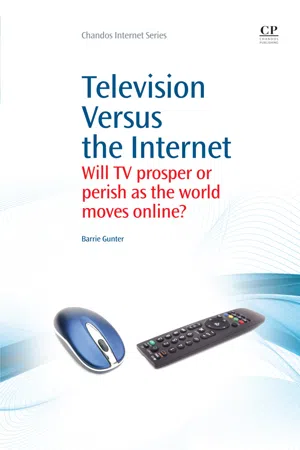
Television Versus the Internet
Will TV Prosper or Perish as the World Moves Online?
- 208 pages
- English
- ePUB (mobile friendly)
- Available on iOS & Android
eBook - ePub
About this book
This book will explore the questions raised by the technological developments that have encouraged the multiplication of TV channels. TV is moving through a period of rapid change. Governments around the world are switching from analogue to digital forms of transmission to further expand the amount of content that TV signals can carry. At the same time, competition for eyeballs has also grown from outside that traditional marketplace with the emergence of the Internet. The roll-out of broadband and increased bandwidth has had the greatest impact on television because online technology can readily convey the same content. All these changes have created a great deal more competition for viewers within the traditional TV marketplace. The Internet has proven to be especially popular with young people who have adopted its applications to a far greater extent than their elders, though even the latter have now begun to take up online activities in significant numbers. Are these audiences the same? Do people make a choice between these two media or do they use them both at different times and for different reasons? Can television utilise the Internet in profitable ways to enhance its market position? Will television have to evolve from its current state to provide the kinds of content reception services to which people have become accustomed in the online world? If it does need to change to survive, will this nevertheless mean a radical new configuration of content and the disappearance of 'channels' with fixed, pre-determined programme schedules?
- Examines the implications of new interactive communications technologies for the way people will use television in the future
- Presents an analysis of changing styles of television viewing and changing orientations towards television
- Examines the growing importance of the broadband internet as a source of information and entertainment
Information
1
Audience evolution patterns
New communications technologies have opened up significantly enhanced choices for media consumers in obtaining entertainment and information. This development has not simply been reflected in the growth of television channels facilitated by digital transmission technology, but also in the range of other technologies – fixed and mobile – through which electronic content can be received. Multi-channel TV packages have spread far and wide and the majority of viewers in the UK had adopted them even before the digital switch-over. In consequence, television audiences have fragmented and the major channels that have been broadcasting the longest have experienced significant erosion of their audiences with important implications for their future viability. The emergence of the Internet and its dramatic penetration of the population have added to the complexity of the communications and media environment. Is television as a medium under threat as the Internet pulls users towards it for reasons that could displace the relevance of television in their lives? Is the Internet cannibalising television audiences, or is that claim over-stated?
The convergence of previously distinct technologies such as sound and visual broadcasting, computing, and telecommunications has meant that the same pieces of kit can be used to send and receive content and that that content can be sent and received in a number of forms – audio, picture and text. Hence, mass communications and interpersonal communications can be accommodated by the same technological apparatus. Historically, these communications forms and systems were carried by different technologies with different types of organisation providing these distinctive communications services. Technological convergence has meant that such distinctions are disappearing. It also means that communications organisations are changing to become multi-media businesses rather than single-medium businesses. Telecommunications companies, for example, no longer conceive of themselves simply as providers of a communications infrastructure; they now recognise the importance to their business future of also becoming content providers. Broadcasters can generate revenue not simply through the sale of airtime to advertisers or sale of programmes to other broadcasters, but also by engaging their audiences interactively via the telephone. All these actors are evolving as businesses in response to the opportunities and challenges presented to them by the growth of digital communications technologies. The traditional business models of these industries are being revised as well as consumers becoming empowered by digital technology to expect personalised services on-demand (Berman, 2004).
The expansion of reception technologies also means that media consumers are no longer restricted to receiving entertainment and information via fixed technologies such as their household television and radio sets. Personal digital assistants have built-in telephone and content reception technology. They can be used not only to send voice or text messages one-to-one, but also to receive still and moving images and music. Personal computers (PCs) and laptops can be used for word processing and data analysis, but also represent communications technologies through which multi-media content (audio, visual and text) can be sent and received. When used to download music, films and news via the Internet, PCs compete directly with television for people’s attention. These developments have opened up a wide range of new content reception opportunities for media audiences. The use of increasingly interactive communications technologies has also conditioned new media-related behaviours. Media consumers are significantly more empowered to control the way they consume information and entertainment content and have become accustomed to having not only more choice of content, but also direct influence over the time and place of consumption (OECD, 2008).
Perhaps the most significant development in this context from the mid-1990s has been the emergence and rapid penetration of the Internet. The Internet has been perceived as a direct threat to the longer established media such as newspapers, radio and, perhaps most of all, television (Adoni and Nossek, 2001;Holmewood and Hughes, 2009). One perception is that the time occupied by being online will be subtracted in the case of most media consumers from the time they devote to reading newspapers, listening to radio or watching television. The focus of this book is concerned with the influence of the Internet on the way television is used. Does Internet use displace television viewing? Or can the Internet actually benefit television (and other mass media)?
Growth of media supply and television viewing
Increasingly, national audits of households across the UK have revealed that more and more people own more and more communications equipment (Ofcom, 2009a,2009b). Nearly all households possess at least one television set, and many have more than one. Virtually all households have both landline and mobile telephones and half of all households have personal computers with Internet access. Rapidly growing numbers of British households are signing up to broadband telecommunications networks enabling the faster transfer and larger and larger volumes of multi-media content.
Hence, the UK is experiencing a changing communications environment that has embraced the introduction of new media and the upgrading of established older media. Radio and television services are being technologically upgraded to digital transmission to enhance the quality and volume of content carried. Even newspapers, traditionally consumed in hard copy, are increasingly available in electronic form via the Internet (Ofcom, 2007c).
Even when considering just television, recent times have witnessed radical changes to the nature of the home entertainment it can provide. A handful of television channels have been superseded by multi-channel packages that may offer dozens or even hundreds of channels. On cable and satellite television systems, viewers can order programmes virtually on demand, while broadband technology can allow viewers to order individual programmes for delivery to them whenever they want.
Older media generations were brought up in a world where they had only a handful of television channels and radio stations to choose from and where telecommunications were used only to contact other individuals in one-to-one conversations. The 1980s witnessed a growth in television hours on established television channels and some growth in the number of channels that were available to everyone and via cable and satellite transmission systems for those willing to pay extra. Video recorders also became widespread in households by the later years of this decade. But the range of content choice and degree of control available to media consumers even then was significantly less than in the post-2000 era.
Throughout the 1990s media technologies continued to evolve and diversify. Perhaps the most significant development to occur during this decade was the emergence of the Internet for general public use and consumption. Other developments of comparable significance in terms of their speed of adoption were the rapid spread of multi-channel television packages and mobile telephones. By the end of the first decade of the twenty-first century, virtually everyone in the UK (99%) had some form of basic TV access to the five analogue, terrestrially-transmitted TV channels, while nearly as many (98%) could gain access to digital satellite TV. Digital terrestrial TV services which are free of charge were available to nearly three out of four homes (73%). Other multi-channel platforms including digital cable TV (49%) and Internet protocol television (IPTV) (39%) were available to large minorities (Ofcom, 2009a).
Growth of the Internet
A number of studies have indicated that the Internet market has experienced rapid growth around the world. This growth has been manifest in the penetration of the Internet, the extent to which people claim to use it, and digital log tracking of traffic levels of web sites. By the close of the first decade in the twenty-first century there were 361 million Internet users worldwide, a growth of 380 per cent since 2000. Internet penetration was highest in North America (74%), Australia/Oceania (60%) and Europe (52%) (InternetWorldStats, 2009). In the UK, Internet penetration among people aged 15 and over grew from 30 per cent in 2000 to 76 per cent in 2009. This followed similar growth in ownership at home of personal computers/laptops (46% to 76%). It is worth noting that multi-channel television penetration also increased significantly over this period (36% in 2000 to 90% in 2009) (Ofcom, 2009c).
It is worth taking a closer look at Internet-related data because adoption rates have varied across different sectors of the population. Changing Media (2007) reported steady growth year-on-year in the proportion of the UK population that uses the Internet. In a report produced for the BBC Trust, this agency reported data from a number of UK research sources that showed a fairly consistent increase in the proportion of UK households with Internet access from 50–57 per cent in 2004 to 60–67 per cent in 2007. In the same report, further research conducted by leading market research company Ipsos MORI (2007) was presented that indicated that over one in two people in the UK (55%) claimed to have access to the Internet in 2004 and that by 2007 this figure had risen to nearly two-thirds (65%) of the population. Further figures were reported from research by Eurostat in 2007 that showed the percentage of 16 to 74 year-olds in the UK that had access to the Internet at least once a month over three months increased from around one in two (49%) in 2004 to nearly two-thirds (65%) in 2007 (Changing Media, 2007).
Internet penetration has not reached the same levels for all sectors of the population. In the UK, Changing Media (2007) reported that Internet users tended to be better educated, more affluent and were disproportionately represented by people living in London. There were also marked age differences in the use of the Internet. The youngest adult age groups were the biggest online aficionados. Data that were presented from the Office of National Statistics (ONS), however, revealed that all age groups exhibited year-on-year growth in Internet use between 2006 and 2007: 16–24 s, 83% to 90%; 25–44 s, 79% to 80%; 45–54 s, 68% to 75%; 55–64 s, 52% to 59%; and 65 +, 15% to 24%. Although exhibiting the lowest level of use, the oldest members of the population also exhibited the biggest year-on-year increase.
The data from the ONS were corroborated by research from the Oxford Internet Institute (OII; Dutton and Helsper, 2007). The OII data derived from 2005 and 2007 and were based on large nationwide surveys in the UK. The age-bands used here were different from those used by the ONS, but Internet penetration levels were similar where age-band comparisons could be made between the two sets of data. Once again, Internet use fell steadily with the age of respondents, but increased throughout between 2005 and 2007: under 18 s, 90% to 94%; 18–24 s, 78% to 86%; 25–34 s, 69% to 78%; 35–44 s, 69% to 77%; 45–54 s, 65% to 78%; 55–64 s, 53% to 58%; 65–74 s, 31% to 37%; and 75 +, 20% to 24%.
According to Eurostat data for 2006 reported by Changing Media (2007) both women and men used the Internet on a daily basis to an equal extent (50% in each case) among people aged 16 to 24 years. Among older users aged 24 to 54 years and 55 to 74 years, however, men (54% and 26% respectively) were more likely than women (40% and 13% respectively) to go online every day.
Research from the Oxford Internet Institute confirmed that home access was most prevalent among Internet users but also indicated that this occurred to a much wider extent (89% in 2003; 94% in 2007) than indicated by Ofcom (Dutton and Helsper, 2007). The OII research revealed the greatest magnitude of location increase between 2003 and 2007 was to go online in someone’s house (from 10% to 30% of UK Internet users).
The extent of its penetration outlines the potential of the Internet to compete with television. The more people there are who go online, the greater is the number of households in which the Internet potentially could displace TV viewing. The mere presence of the Internet in households, however, reveals nothing about the extent to which it might be used within specific households. The greater the amount of time people devote to online activities, the more likely it is that their online behaviour could eat into their waking time budget and displace other activities.
Data produced by the Office of National Statistics indicated that by 2007, two-thirds of all Internet users (67%) claimed to go online every day or almost every day. One in four (24%) claimed to go online at least once a week, and fewer than one in ten (9%) said they went online less often than once a week (Changing Media, 2007). These ‘reach’ figures for online behaviour give some idea of the popularity of the Internet, but still fall short of the data we need to fully appreciate how time-consuming online activities can be. Even those who claim to go online every day could vary widely in the amount of time they usually stay online.
Research produced by the EIAA 2006 Mediascope study collected data about online behaviour from the UK, Germany, France, Spain, Italy and the Nordic countries. UK Internet users reported that they remained online for between eight and 18 hours per week. Over a three-year period of monitoring, this study found that reported hours per UK Internet user spent online in a typical week increased progressively across 2005 (10.7 hours), 2006 (11.3 hours) to 2007 (12 hours) (see Changing Media, 2007).
These self-report data are indicative of time spent online but may also be susceptible to inaccuracies of memory on the part of survey respondents. Even more robust data on Internet use can be derived from continuous monitoring of Internet users’ behaviour. Industry assessment agencies such as Nielsen NetRatings specialise in producing such data. Ofcom (2007c) reported data from Nielsen that showed that on average nearly half of UK Internet users (48%) used the Internet at least once during a one-month observation period in April 2007, and spent an average of 30.5 hours online during that spell. This research demonstrates the need to consider how the Internet is used from a number of perspectives.
Confirming findings reported earlier in this chapter, the oldest Internet users, aged 65 and over, were least likely to have gone online at all during April 2007 (16%). The youngest adults, aged 18 ...
Table of contents
- Cover image
- Title page
- Table of Contents
- Copyright
- Preface
- About the author
- Chapter 1: Audience evolution patterns
- Chapter 2: The importance of television and the Internet to media consumers
- Chapter 3: The functional overlaps of television and the Internet
- Chapter 4: The future of television as an information source
- Chapter 5: The future of television as an entertainment source
- Chapter 6: Future audiences, future services
- References
- Index
Trusted by 375,005 students
Access to over 1.5 million titles for a fair monthly price.
Study more efficiently using our study tools.
Frequently asked questions
Yes, you can cancel anytime from the Subscription tab in your account settings on the Perlego website. Your subscription will stay active until the end of your current billing period. Learn how to cancel your subscription
No, books cannot be downloaded as external files, such as PDFs, for use outside of Perlego. However, you can download books within the Perlego app for offline reading on mobile or tablet. Learn how to download books offline
Perlego offers two plans: Essential and Complete
- Essential is ideal for learners and professionals who enjoy exploring a wide range of subjects. Access the Essential Library with 800,000+ trusted titles and best-sellers across business, personal growth, and the humanities. Includes unlimited reading time and Standard Read Aloud voice.
- Complete: Perfect for advanced learners and researchers needing full, unrestricted access. Unlock 1.5M+ books across hundreds of subjects, including academic and specialized titles. The Complete Plan also includes advanced features like Premium Read Aloud and Research Assistant.
We are an online textbook subscription service, where you can get access to an entire online library for less than the price of a single book per month. With over 1.5 million books across 990+ topics, we’ve got you covered! Learn about our mission
Look out for the read-aloud symbol on your next book to see if you can listen to it. The read-aloud tool reads text aloud for you, highlighting the text as it is being read. You can pause it, speed it up and slow it down. Learn more about Read Aloud
Yes! You can use the Perlego app on both iOS and Android devices to read anytime, anywhere — even offline. Perfect for commutes or when you’re on the go.
Please note we cannot support devices running on iOS 13 and Android 7 or earlier. Learn more about using the app
Please note we cannot support devices running on iOS 13 and Android 7 or earlier. Learn more about using the app
Yes, you can access Television Versus the Internet by Barrie Gunter in PDF and/or ePUB format, as well as other popular books in Computer Science & Computer Science General. We have over 1.5 million books available in our catalogue for you to explore.