- 1,008 pages
- English
- ePUB (mobile friendly)
- Available on iOS & Android
eBook - ePub
Essential Medical Physiology
About this book
Essential Medical Physiology, Third Edition, deals with the principal subjects covered in a modern medical school physiology course.
This thoroughly revised version includes chapters on general physiology as well as cardiovascular, respiratory, renal, gastrointestinal, endocrine, central nervous system, and integrative physiology. It contains clinical notes, chapter outlines with page numbers, 2-color figures throughout, and new chapters on Exercise, Diabetic Ketoacidosis, and Maternal Adaptations in Pregnancy.
Among the contributors to this indispensible textbook are leading physiologists Leonard R. Johnson, Stanley G. Schultz, H. Maurice Goodman, John H. Byrne, Norman W. Weisbrodt, James M. Downey, D. Neil Granger, Frank L. Powell, Jr., James A. Schafer, and Dianna A. Johnson.
This text is recommended for medical, graduate, and advanced undergraduate students studying physiology, physicians, and clinical specialists as well as anyone interested in basic human physiology.
- Includes clinical notes
- "Key Points" summarize most important information
- Contains chapter outlines with page numbers
- 2-color figures throughout
- New chapters on Exercise, Diabetic Ketoacidosis, and Maternal Adaptations in Pregnancy
Information
PART I
GENERAL PHYSIOLOGY
CHAPTER 1 The Internal Environment
Homeostasis: The Subject of Physiology
Origin of Our Milieu Interieur
Living Things Are Open Systems
Body Fluid Compartments and Their Contacts with the Outside World
Ionic Composition of the Major Fluid Compartments
Body Fluid Osmolarity and pH
Measuring the Sizes of the Body Fluid Compartments
Plasma Volume
Extracellular Fluid Volume
Total Body Water
Interstitial and Intracellular Fluid Compartments
Alterations in Body Fluid Compartments
Dehydration
Infusion of 2 L of Isotonic Saline (150 mmol/L NaCl)
Infusion of Isotonic Urea (300 mmol/L)
Rapid Infusion of Pure Water
Ingestion of 100 g of NaCl Tablets
Infusion of Isosmotic Saline (NaCl) Solution Containing 20% Albumin
Infusion of Isosmotic (5%) Glucose Solution
KEY POINTS
• Physiologic processes have evolved to maintain the constancy or stability of the internal environment. This tendency toward maintenance of physiologic stability is homeostasis.
• Living things are open systems.
• The total body water is contained within two major compartments—the intracellular compartment and the extracellular compartment. The intracellular compartment is further subdivided into the plasma and the interstitial fluid compartments.
• The intracellular compartment is characterized by low intracellular Na+ and Cl− concentrations and a high K+ concentration. The intracellular compartment comprises approximately 25 L, which is approximately 35% of total body weight.
• The extracellular compartment is divided into the plasma and interstitial compartments; the former comprises approximately 3 L and the latter approximately 12 L. These compartments are characterized by high Na+ and Cl− concentrations and a low K+ concentration.
• Four organs provide the interfaces between the extracellular fluid compartment and the outside world: the skin, alimentary canal, lung, and kidney. The proper interactions among these organs and the external environment is essential for homeostasis.
HOMEOSTASIS: THE SUBJECT OF PHYSIOLOGY
If one had to describe, with a single word, what physiology is all about, that word would be homeostasis. This word was coined by the great American physiologist, Walter B. Cannon, in his book entitled The Wisdom of the Body (1939) and refers to regulatory mechanisms by which biologic systems tend to maintain the internal stability necessary for survival while adjusting to internal or external threats to that stability. If homeostasis is successful, life continues; if it is unsuccessful, disease and perhaps death ensue.
Cannon’s notion of homeostasis was an extension of the concept first introduced by one of the founders of modern physiology, Claude Bernard, a physician by training who made many seminal contributions to our early understanding of digestion, metabolism, vasomotor activity of nerves, neuromuscular transmission, and other areas of physiology. But perhaps his greatest lasting contribution was the notion that all physiologic processes are designed to maintain the internal environment, the milieu interieur, that bathes our cells, tissues, and organs. The following is from his opening lecture in a course in general physiology given at the College de France in 1887:
The living body, though it has need of the surrounding environment, is nevertheless relatively independent of it. This independence which the organism has of its external environment derives from the fact that in the living being, the tissues are in fact withdrawn from direct external influences and are protected by a veritable internal environment which is constituted, in particular, by the fluids circulating in the body.
In short, he suggested that we exist within our own “hot houses” and that our existence depends on our abilities to maintain that “hot house.”
Although this notion may seem trivial now, at the time when it was introduced it was revolutionary. It proved to be prophetic and has influenced all physiologic thinking to this day.
ORIGIN OF OUR MILIEU INTERIEUR
There is good evidence that our predecessors, the protovertebrates or prochordates, migrated from the seas into brackish or fresh water during the Cambrian period, almost 500 million years ago. During that migration, which lasted some 200 million years, they “locked” within themselves a fluid similar in composition to that of the seas from which they emerged. Some of these early vertebrates returned to the oceans, which had become saltier; others stayed in brackish or fresh water; and still others chose to live on land. But, regardless of their final habitats, the “sea” within all vertebrates is remarkably similar in ionic composition to the salinity of the Cambrian seas from which they emerged. This sea that bathes all cells is rich in Na+ and Cl−, in contrast with the intracellular fluid, which, in all living forms including microorganisms, is rich in K+ and poor in Na+ and Cl−.
LIVING THINGS ARE OPEN SYSTEMS
Maintaining a constant internal environment would pose no problem if living things were closed systems, like a solution in a sealed bottle. Instead, however, all freely living forms are open systems constantly exchanging matter and energy with the environment. The remarkable thing is that despite this constant exchange, essential for life, the compositions of our intracellular and extracellular fluids are maintained remarkably constant; this is what homeostasis is all about. How is this accomplished?
BODY FLUID COMPARTMENTS AND THEIR CONTACTS WITH THE OUTSIDE WORLD
The total body water (TBW) in higher animals is distributed among three major compartments: the blood plasma, the interstitial fluid (ISF), and the intracellular fluid (ICF). The plasma is separated from the ISF compartment by highly permeable capillaries; together, plasma and ISF constitute the extracellular fluid (ECF) compartment. This compartment is separated from the ICF compartment by cell membranes, which in most instances, as discussed in Chapter 3, are highly permeable to water but very selective with respect to the passage of solutes. A fourth, small compartment, called the transcellular fluid compartment, consists primarily of fluid in transit in the lumina of epithelial organs (e.g., the gall bladder, stomach, intestines, and urinary bladder), as well as the cerebrospinal fluid and the intraocular fluid.
In an average human adult weighing approximately 70 kg, the TBW makes up approximately 60% of body weight or about 40 L. The distribution of this water among the plasma ISF and ICF compartments is shown in Fig. 1, and the way in which the sizes of these compartments are determined is discussed below. The transcellular fluid compartment in such an individual comprises approximately 2 to 4% of the TBW and contains approximately 1 to 2 L of water.
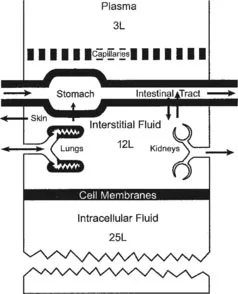
FIGURE 1 Sizes of the major body fluid compartments and the four organs that interface the extracellular fluid and the external environment. Total body water makes up approximately 60% of body weight.
The ECF of all vertebrates is in intimate contact with four organs that interface with the external environment. One is a tube that runs from mouth to anus—the alimentary canal. It is responsible for absorbing water, essential elements, and the metabolites that form our building blocks and fuel our activities; for the most part, however, it is indiscriminant with respect to what it will permit to enter the body. The second organ is the lungs, which are responsible for exchanging o...
Table of contents
- Cover image
- Title page
- Table of Contents
- Copyright
- Dedication
- Contributors
- Preface
- PART I: GENERAL PHYSIOLOGY
- PART II: CARDIOVASCULAR PHYSIOLOGY
- PART III: RESPIRATORY PHYSIOLOGY
- PART IV: RENAL PHYSIOLOGY
- PART V: GASTROINTESTINAL PHYSIOLOGY
- PART VI: ENDOCRINE PHYSIOLOGY
- PART VII: CENTRAL NERVOUS SYSTEM PHYSIOLOGY
- PART VIII: INTEGRATIVE PHYSIOLOGY
- Index
Trusted by 375,005 students
Access to over 1.5 million titles for a fair monthly price.
Study more efficiently using our study tools.
Frequently asked questions
Yes, you can cancel anytime from the Subscription tab in your account settings on the Perlego website. Your subscription will stay active until the end of your current billing period. Learn how to cancel your subscription
No, books cannot be downloaded as external files, such as PDFs, for use outside of Perlego. However, you can download books within the Perlego app for offline reading on mobile or tablet. Learn how to download books offline
Perlego offers two plans: Essential and Complete
- Essential is ideal for learners and professionals who enjoy exploring a wide range of subjects. Access the Essential Library with 800,000+ trusted titles and best-sellers across business, personal growth, and the humanities. Includes unlimited reading time and Standard Read Aloud voice.
- Complete: Perfect for advanced learners and researchers needing full, unrestricted access. Unlock 1.5M+ books across hundreds of subjects, including academic and specialized titles. The Complete Plan also includes advanced features like Premium Read Aloud and Research Assistant.
We are an online textbook subscription service, where you can get access to an entire online library for less than the price of a single book per month. With over 1.5 million books across 990+ topics, we’ve got you covered! Learn about our mission
Look out for the read-aloud symbol on your next book to see if you can listen to it. The read-aloud tool reads text aloud for you, highlighting the text as it is being read. You can pause it, speed it up and slow it down. Learn more about Read Aloud
Yes! You can use the Perlego app on both iOS and Android devices to read anytime, anywhere — even offline. Perfect for commutes or when you’re on the go.
Please note we cannot support devices running on iOS 13 and Android 7 or earlier. Learn more about using the app
Please note we cannot support devices running on iOS 13 and Android 7 or earlier. Learn more about using the app
Yes, you can access Essential Medical Physiology by Leonard R. Johnson in PDF and/or ePUB format, as well as other popular books in Biological Sciences & Cell Biology. We have over 1.5 million books available in our catalogue for you to explore.