- 376 pages
- English
- ePUB (mobile friendly)
- Available on iOS & Android
eBook - ePub
About this book
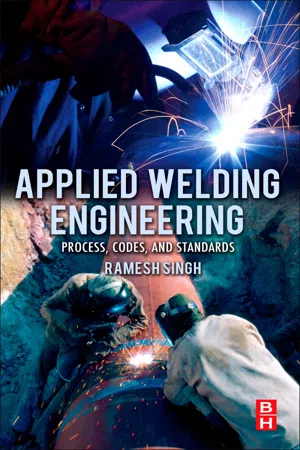
While there are several books on market that are designed to serve a company's daily shop-floor needs. Their focus is mainly on the physically making specific types of welds on specific types of materials with specific welding processes. There is nearly zero focus on the design, maintenance and troubleshooting of the welding systems and equipment. Applied Welding Engineering: Processes, Codes and Standards is designed to provide a practical in-depth instruction for the selection of the materials incorporated in the joint, joint inspection, and the quality control for the final product. Welding Engineers will also find this book a valuable source for developing new welding processes or procedures for new materials as well as a guide for working closely with design engineers to develop efficient welding designs and fabrication procedures.
Applied Welding Engineering: Processes, Codes and Standards is based on a practical approach. The book's four part treatment starts with a clear and rigorous exposition of the science of metallurgy including but not limited to: Alloys, Physical Metallurgy, Structure of Materials, Non-Ferrous Materials, Mechanical Properties and Testing of Metals and Heal Treatment of Steels. This is followed by self-contained sections concerning applications regarding Section 2: Welding Metallurgy & Welding Processes, Section 3: Nondestructive Testing, and Section 4: Codes and Standards. The author's objective is to keep engineers moored in the theory taught in the university and colleges while exploring the real world of practical welding engineering. Other topics include: Mechanical Properties and Testing of Metals, Heat Treatment of Steels, Effect of Heat on Material During Welding, Stresses, Shrinkage and Distortion in Welding, Welding, Corrosion Resistant Alloys-Stainless Steel, Welding Defects and Inspection, Codes, Specifications and Standards.
The book is designed to support welding and joining operations where engineers pass plans and projects to mid-management personnel who must carry out the planning, organization and delivery of manufacturing projects. In this book, the author places emphasis on developing the skills needed to lead projects and interface with engineering and development teams. In writing this book, the book leaned heavily on the author's own experience as well as the American Society of Mechanical Engineers (www.asme.org), American Welding Society (www.aws.org), American Society of Metals (www.asminternational.org), NACE International (www.nace.org), American Petroleum Institute (www.api.org), etc. Other sources includes The Welding Institute, UK (www.twi.co.uk), and Indian Air force training manuals, ASNT (www.asnt.org), the Canadian Standard Association (www.cas.com) and Canadian General Standard Board (CGSB) (www.tpsgc-pwgsc.gc.ca).
- Rules for developing efficient welding designs and fabrication procedures
- Expert advice for complying with international codes and standards from the American Welding Society, American Society of Mechanical Engineers, and The Welding Institute(UK)
- Practical in-depth instruction for the selection of the materials incorporated in the joint, joint inspection, and the quality control for the final product.
Information
Subtopic
Civil EngineeringChapter 1. Introduction
Chapter Outline
Pure Metals and Alloys4
Smelting4
Iron4
Sponge Iron4
Metallurgy is the science and technology of metals and alloys. It can be divided into three general sections; process metallurgy, physical metallurgy and mechanical metallurgy.
Metals are converted into useful forms by alloying – combining them with other elements. Metals are found in nature in the form of oxides.
Keywords
Metallurgy, alloy, ores, smelting
When we talk of metallurgy as being a science of metals, the first question that arises in the mind is what is a metal?
Metals are best described by their properties. They are crystalline in the solid state. Except for mercury, metals are solid at room temperature; mercury is a metal but in liquid form at room temperature. Metals are good conductors of heat and electricity, and they usually have comparatively high density. Most metals are ductile, a property that allows them to be shaped and changed permanently without breaking by the application of relatively high forces. Metals can be either elements, or alloys created by man in pursuit of specific properties. Aluminum, iron, copper, gold and silver are examples of metals which are elements, whereas brass, steel, bronze etc. are examples of manmade alloy metals.
Metallurgy is the science and technology of metals and alloys. The study of metallurgy can be divided into three general sections.
1. Process metallurgy
Process metallurgy is concerned with the extraction of metals from their ores and the refining of metals. A brief discussion on the production of steel, castings and aluminum is included in this section.
2. Physical metallurgy
Physical metallurgy is concerned with the physical and mechanical properties of metals as affected by their composition, processing and environmental conditions. A number of chapters in this section specifically address this topic.
3. Mechanical metallurgy
Mechanical metallurgy is concerned with the response of metals to applied forces. This is addressed in subsequent chapters of this section.
Pure Metals and Alloys
Pure metals are soft and weak and are used only for specialty purposes such as laboratory research work, or electroplating. Foreign elements (metallic or non-metallic) that are always present in any metal may be beneficial, detrimental or have no influence on a particular property. Disadvantageous foreign elements are called impurities, while advantageous foreign elements are called alloying elements. When these are added deliberately, the resulting metal is called an alloy. Alloys are grouped and identified by their primary metal element, e.g. aluminum alloy, iron alloy, copper alloy, nickel alloy etc.
Most of the metallic elements are not found in a usable form in nature. They are generally found in their various oxide forms, called ores. Metals are recovered from these ores by thermal and chemical reactions. We shall briefly discuss some of these processes. Those for the most common and most abundantly used metal – iron – are discussed in the following paragraphs.
Smelting
Smelting is an energy-intensive process used to refine an ore into a usable metal. Most ore deposits contain metals in the reacted or combined form. Magnetite (Fe3O4), hematite (Fe2O3), goethite (αFeO(OH)), limonite (generic formula: FeO(OH).nH2O) and siderite (FeCO3) are iron ores, and Cu5FeSO4 is a copper ore. The smelting process melts the ore, usually for a chemical change to separate the metal, thereby reducing the one to metal or refining it to metal. The smelting process requires lots of energy to extract the metal from the other elements.
There are other methods of extraction of pure metals from their ores: application of heat, leaching in a strong acidic or alkaline solution, and electrolytic processes are all used.
Iron
The modern production process for recovery of iron from ore includes the use of blast furnaces to produce pig iron, which contains carbon, silicon, manganese, sulfur, phosphorus, and many other elements and impurities. Unlike wrought iron, pig iron is hard and brittle and cannot be hammered into a desired shape. Pig iron is the basis of the majority of steel production.
Sponge Iron
Removing the oxygen from the ore by a natural process produces a relatively small percentage of the world’s steel. This natural process uses less energy and is a natural chemical reaction method. The process involves heating naturally occurring iron oxide in the presence of carbon, which produces ‘sponge iron’. In this process the oxygen is removed without melting the ore.
Iron oxide ores, as extracted from the earth, are allowed to absorb carbon by a reduction process. In this natural reduction reaction, as the iron ore is heated with carbon it gives the iron a pock-marked surface, hence the name sponge iron. The commercial process is a solid solution reduction; also called direct-reduced iron (DRI). In this process the iron ore lumps, pellets, or fines are heated in a furnace at 800–1,500°C (1,470– 2,730°F) in a carburizing environment. A reducing gas produced by natural gas or coal, and a mixture of hydrogen and carbon monoxide gas provides the carburizing environment.
The resulting sponge iron is hammered into shapes to produce wrought iron. The conventional integrated steel plants of less than one million tons annual capacity are generally not economically viable, but some of the smaller capacity steel plants use sponge iron as charge to convert iron into steel. Since the reduction process is not energy intensive, the steel mills find it a more environmentally acceptable process. The process also tends to reduce the cost of steel making. The negative aspect of the process is that it is slow and does not support large-scale steel production.
Iron alloys that contain 0.1% to 2% carbon are designated as steels. Iron alloys with greater than 2% carbon are called cast irons.
Chapter 2. Alloys
Chapter Outline
Alloys7
Effects of Alloying Elements8
Carbon Steels8
Sulfur8
Manganese8
Phosphorus9
Silicon9
Alloy Steels9
The Effect of Alloying Elements on Ferrite9
Effects of Alloying Elements on Carbide10
Nickel Steels (2xx Series)10
Nickel-Chromium Steels (3xx Series)10
Manganese Steels (31x Series)10
Molybdenum Steels (4xx Series)11
Chromium Steels (5xx Series)11
An alloy is a substance that has metallic properties and is composed of two or more chemical elements, of which the primary one is a metal. The added elements create intermetallic or interstitial compounds.
Metals are generally alloyed with the aim of improving a property or a specific set of properties. A number of elements are added to steel, including sulfur, manganese, phosphorous, silicon, nickel, aluminum, silicon, copper, and cobalt.
These elements affect the phase transitions and crystal structure of the steel and so change its mechanical properties.
Keywords
alloy, metal, steel, mechanical property, phase transition
Alloys
An alloy is a substance that has metallic properties and is composed of two or more chemical elements, of which at least one, the primary one, is a metal. A binary alloy system is a group of alloys that can be formed by two elements combined in all possible proportions.
Homogeneous alloys consist of a single phase and mixtures consist of several phases. A phase is anything that is homogeneous and physically distinct if viewed under a microscope. When an allotropic metal undergoes a change in crystal structure, it undergoes a phase change.
There are three possible phases in the solid state:
• Pure metal
• Intermediate alloy phase or compound
• Solid solution.
Compounds have their own characteristic physical, mechanical, and chemical properties and exhibit definite melting and freezing points. Intermetallic compounds are formed between dissimilar metals by chemical valence rules, and generally have non-metallic properties; Mg2Sn and Cu2Se are examples of these.
Interstitial compounds are formed between transition metals such as titanium and iron with hydrogen, oxygen, carbon, boron, and nitro...
Table of contents
- Cover image
- Table of Contents
- Front-matter
- Copyright
- Dedication
- Preface
- Acknowledgment
- Chapter 1. Introduction
- Chapter 2. Alloys
- Chapter 3. Physical Metallurgy
- Chapter 4. Structure of Materials
- Chapter 5. Production of Steel
- Chapter 6. Classification of Steels
- Chapter 7. Cast Iron
- Chapter 8. Stainless Steels
- Chapter 9. Non-Ferrous Materials
- Chapter 10. Working with Metals
- Chapter 11. Mechanical Properties and Testing of Metals
- Chapter 12. Heat Treatment of Steels
- Chapter 1. Introduction
- Chapter 2. Physics of Welding
- Chapter 3. Welding and Joining Processes
- Chapter 4. Physical Effect of Heat on Material During Welding
- Chapter 5. Stresses, Shrinkage and Distortion in Weldments
- Chapter 6. Welding Corrosion Resistant Alloys – Stainless Steel
- Chapter 7. Welding Non-Ferrous Metals and Alloys
- Chapter 8. Weld Defects and Inspection
- Chapter 1. Introduction
- Chapter 2. Visual Inspection (VT)
- Chapter 3. Radiography
- Chapter 4. Magnetic Particle Testing
- Chapter 5. Penetrant Testing
- Chapter 6. Ultrasonic Testing
- Chapter 7. Eddy Current Testing
- Chapter 8. Acoustic Emission Testing (AET)
- Chapter 9. Ferrite Testing
- Chapter 10. Pressure Testing
- Chapter 1. Introduction
- Chapter 2. Codes, Specifications and Standards
- Index
Trusted by 375,005 students
Access to over 1.5 million titles for a fair monthly price.
Study more efficiently using our study tools.
Frequently asked questions
Yes, you can cancel anytime from the Subscription tab in your account settings on the Perlego website. Your subscription will stay active until the end of your current billing period. Learn how to cancel your subscription
No, books cannot be downloaded as external files, such as PDFs, for use outside of Perlego. However, you can download books within the Perlego app for offline reading on mobile or tablet. Learn how to download books offline
Perlego offers two plans: Essential and Complete
- Essential is ideal for learners and professionals who enjoy exploring a wide range of subjects. Access the Essential Library with 800,000+ trusted titles and best-sellers across business, personal growth, and the humanities. Includes unlimited reading time and Standard Read Aloud voice.
- Complete: Perfect for advanced learners and researchers needing full, unrestricted access. Unlock 1.5M+ books across hundreds of subjects, including academic and specialized titles. The Complete Plan also includes advanced features like Premium Read Aloud and Research Assistant.
We are an online textbook subscription service, where you can get access to an entire online library for less than the price of a single book per month. With over 1.5 million books across 990+ topics, we’ve got you covered! Learn about our mission
Look out for the read-aloud symbol on your next book to see if you can listen to it. The read-aloud tool reads text aloud for you, highlighting the text as it is being read. You can pause it, speed it up and slow it down. Learn more about Read Aloud
Yes! You can use the Perlego app on both iOS and Android devices to read anytime, anywhere — even offline. Perfect for commutes or when you’re on the go.
Please note we cannot support devices running on iOS 13 and Android 7 or earlier. Learn more about using the app
Please note we cannot support devices running on iOS 13 and Android 7 or earlier. Learn more about using the app
Yes, you can access Applied Welding Engineering by Ramesh Singh in PDF and/or ePUB format, as well as other popular books in Technology & Engineering & Civil Engineering. We have over 1.5 million books available in our catalogue for you to explore.