- 356 pages
- English
- ePUB (mobile friendly)
- Available on iOS & Android
eBook - ePub
Introduction to Non-equilibrium Physical Chemistry
About this book
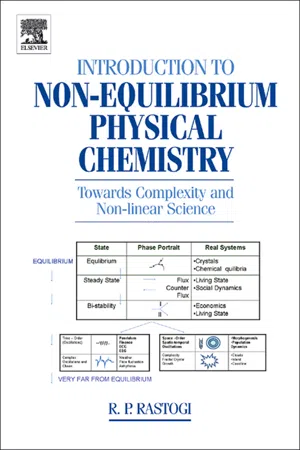
Introduction to Non-equilibrium Physical Chemistry presents a critical and comprehensive account of Non-equilibrium Physical Chemistry from theoretical and experimental angle. It covers a wide spectrum of non-equilibrium phenomena from steady state close to equilibrium to non-linear region involving transition to bistability, temporal oscillations, spatio-temporal oscillations and finally to far from equilibrium phenomena such as complex pattern formation, dynamic instability at interfaces, Chaos and complex growth phenomena (fractals) in Physico-chemical systems.
Part I of the book deals with theory and experimental studies concerning transport phenomena in membranes (Thermo-osmosis,Electroosmotic ) and in continuous systems (Thermal diffusion,Soret effect) close to equilibrium Experimental tests provide insight into the domain of validity of Non-equilibrium Thermodynamics ,which is the major theoretical tool for this region. Later developments in Extended Irreversible Thermodynamics and Non-equilibrium Molecular dynamics have been discussed in the Appendix.
Part II deals with non-linear steady states and bifurcation to multistability, temporal and spatio- temporal oscillations (Chemical waves). Similarly Part II deals with more complex phenomena such as Chaos and fractal growth occurring in very far from equilibrium region. Newer mathematical techniques for investigating such phenomena along with available experimental studies.
Part IV deals with analogous non-equilibrium phenomena occurring in the real systems (Socio-political, Finance and Living systems etc.) for which physico-chemical systems discussed in earlier chapters provide a useful model for development of theories based on non-linear science and science of complexity.
- The book provides a critical account of theoretical studies on non-equilibrium phenomenon from region close to equilibrium to far equilibrium
- Experimental studies have been reported which provide test of the theories and their limitations
- Impacts of the concepts developed in non-equilibrium Physical Chemistry in sociology, economics and other social science and living systems has been discussed
Trusted by 375,005 students
Access to over 1 million titles for a fair monthly price.
Study more efficiently using our study tools.
Information
Chapter 1
INTRODUCTION
Publisher Summary
The great importance of thermodynamics and hydrodynamic methods lies in the fact that they provide a reduced description in simplified language to describe macroscopic systems. This chapter presents a coherent account of developments, both theoretical and experimental, in the advancing field of knowledge related to complex phenomena from equilibrium to far from equilibrium region. It is reasonable to expect that the concepts and thought methodology would be useful for taking a synergetic view of real systems in nature and social surroundings. It also discusses the recent developments in non-equilibrium Physical Chemistry. Traditional Physical Chemistry has largely been concerned with state of matter in equilibrium. Non-equilibrium aspects come up in the case of kinetic theory, chemical kinetics, and ion transport. Real systems like living state, and socio-economic systems are always in non-equilibrium and invoke a number of complicated phenomena. The important feature of the equilibrium state is that variables such as temperature, pressure, chemical potential, and electric potential everywhere are the same in the system. In non-equilibrium state, the thermodynamic variables are not the same everywhere in the system, on account of which gradients of variables develop which act as the cause (force) for generating effects (flows) such as volume flow or heat flow (fluxes). Non-equilibrium thermodynamics has the advantage of being used for identifying cause and effect, i.e., forces and fluxes, and also coupling between the fluxes without a detailed knowledge of the systems.
1.1 Real systems
Traditional Physical Chemistry has largely been concerned with state of matter in equilibrium. Non-equilibrium aspects come up in the case of kinetic theory, chemical kinetics and ion transport. Real systems like living state and socio-economic systems are always in non-equilibrium and invoke a number of complicated phenomena. Science is now getting oriented to the study of such complex systems. From the philosophical angle the question whether science deals with real world [1a] has been raised. The concept of evolution in social systems in contrast to biology is moving towards an interdisciplinary theory of change of state [1b]. This is provoking interest in experimental and theoretical studies of analogous non-equilibrium phenomena in physico-chemical systems which can serve as a model for economists and biologists. Joint effort in understanding complex phenomena with the help of various disciplines is leading to the growth of Synergetics meaning, a new discipline.
1.2 Equilibrium and non-equilibrium states
The important feature of the equilibrium state is that variables such as temperature T, pressure P, chemical potential μ and electric potential ϕ everywhere are the same in the system. There can be two types of equilibrium states, viz. (a) dynamic equilibrium and (b) static equilibrium. Vapour–liquid equilibrium and chemical equilibrium are typical examples of dynamic equilibrium, where in the first case, the rate of condensation and rate of vaporization are equal while in the second case, the rates of forward and backward reactions are equal. Simple crystals belong to the class of static equilibrium.
In non-equilibrium state, the thermodynamic variables are not the same everywhere in the system, on account of which gradients of variables (e.g. grad P, grad T, etc.) develop which act as the cause (force) for generating effects (flows) such as volume flow or heat flow (fluxes). Non-equilibrium thermodynamics has the advantage of being used for identifying cause and effect, i.e. forces and fluxes, and also coupling between the fluxes without a detailed knowledge of the systems. However, for real systems problem arises in identifying variables, fluxes and forces, involved in processes and cross-phenomena. Further in many systems, additional difficulty arises on account of lack of knowledge about the nature and magnitude of the coupling coefficients between fluxes and forces [1].
The systems can be of three types:
Isolated systems in which there is no exchange of matter or energy with the surroundings;
closed systems in which there is no exchange of matter with the surroundings but exchange of energy can occur; and
open systems, which exchange both matter and energy with the surroundings.
1.3 Open systems
Open system is always in non-equilibrium. A closed system can be in non-equilibrium depending on the circumstances. It may have subsystems between which exchange of matter and energy can take place or in the system itself, thermodynamic variables may not be constant in space. A typical example of the former type is thermo-osmosis, which is discussed in Chapter 3, where the two subsystems are separated by a membrane. Example of the latter type is thermal diffusion, which has been discussed in Chapter 5. When the flows and counter-flows in opposite directions are generated by corresponding gradients, steady state is obtained. Both equilibrium and non-equilibrium steady states are time-invariant states, but in the latter case both flows and gradients are present.
Real systems are open systems and may consist of numerous subsystems; global system, human society and human body are typical examples. The nature of subsystems, variables, fluxes and forces, their coupling leading to cross-phenomena, temporal and spatio-temporal changes, pattern formation and self-organization would be discussed in the subsequent chapters.
1.4 Approach to equilibrium
For taking a comprehensive view, it is also desirable to keep in mind the process of approach to equilibrium. Chemical kinetics and kinetic theory of gases have been the traditional tools. Simple reactions have been studied by Monte-Carlo technique or stochastic approach by monitoring random picks of molecules represented by digits on the computer and employing a criterion that accepts or discards potential conversions. The methodology adopted for the study of simple set of simultaneous reactions has been received by Gupta, which involves comparison of experimental results with postulated mechanism [2]. For complex reactions, numeric integration techniques are employed to abstract concentration profiles. The methodology involved is essentially linear kinetics. Chemical kinetics is now moving towards the study of more and more complex reaction network which may simultaneously involve (i) electron transfer reaction, (ii) free-radical reaction, (iii) organic reaction, (iv) inorganic reaction and (v) reaction between organic and inorganic species. For such type of systems, a new methodology called non-linear kinetics involving non-linear differential equations is emerging.
There is considerable error in thermodynamic prediction if true equilibrium is not maintained, a condition never maintained in industry due to time factor. Rastogi and Denbigh [3] investigated this aspect theoretically. As an illustration, they examined the reaction

for which the equilibrium constant K is of the order of 2.18 × 10⁻² at 763.8 K. The energy of activation of the forward reaction and ΔH, the enthalpy change of the reaction, has values of 44 000 cal mol−1 and 3000 cal mol−1, respectively. Let r denote the ratio of the true temperature coefficient of the yield to the temperature coefficient of the yield, which would be predicted on the assumption that the system is at equilibrium. For f = 0.9, the true temperature coefficient of the yield is 10.6 times the value predicted thermodynamically on the supposition of equilibrium. Further when f = 0.99, the corresponding factor is as much as 2.8.
In a similar manner, cooling rate at the rocket nozzle throat used to be computed by assuming isentropic flow [4]. However, it has been shown that the cooling rate at the throat is likely to increase when departure from equilibrium becomes significant [5].
1.5 Non-equilibrium states
There was tremendous interest in mid-twentieth century in exploring general principles for understanding non-equilibrium phenomena along with the development of non-equilibrium thermodynamics and non-equilibrium statistical mechanics. Pioneering work of Professor Prigogine [6] and his school in Brussels stimulated a good deal of interest in the field of non-equilibrium statistical mechanics. Formal solutions of Liouville equation [7] in terms of a Greenian and complete internal propagator leads to a theoretical expression for electrical conductivity tensor, which easily leads to classical formula for electrical conductivity of metals based on the free-electron model [8].
Kinetic theory, non-equilibrium statistical mechanics and non-equilibrium molecular dynamics (NEMD) have proved to be useful in estimating both straight and cross-coefficients such as thermal conductivity, viscosity and electrical conductivity. In a typical case, cross-coefficient in case of electro-osmosis has also been estimated by NEMD. Experimental data on thermo-electric power has been analysed in terms of free electron gas theory and non-equilibrium thermodynamic theory [9]. It is found that phenomenological coefficients are temperature dependent. Free electron gas theory has been used for estimating the coefficients in homogeneous conductors and thermo-couples.
Onsager relations are satisfied, showing that free electron gas theory is consistent with thermodynamic theory. The free electron theory correctly predicts the temperature dependence of thermo-electric power. Similarly, the interpretation of the phenomenon of thermo-osmosis of gases on the basis of non-equilibrium therm...
Table of contents
- Cover image
- Title page
- Table of Contents
- PREFACE
- ACKNOWLEDGEMENTS
- Chapter 1: INTRODUCTION
- Part one: Non-equilibrium steady states close to equilibrium
- Part two: Non-linear steady states - dissipative structure (time order and space order)
- Part three: Complex non-equilibrium phenomena far from equilibrium
- Part four: Non-equilibrium phenomena in nature and society
- EPILOGUE
- Appendix I: DOMAIN OF VALIDITY OF GIBBS EQUATION
- Appendix II: EXTENDED IRREVERSIBLE THERMODYNAMICS
- Appendix III: NON-EQUILIBRIUM MOLECULAR DYNAMICS
- INDEX
Frequently asked questions
Yes, you can cancel anytime from the Subscription tab in your account settings on the Perlego website. Your subscription will stay active until the end of your current billing period. Learn how to cancel your subscription
No, books cannot be downloaded as external files, such as PDFs, for use outside of Perlego. However, you can download books within the Perlego app for offline reading on mobile or tablet. Learn how to download books offline
Perlego offers two plans: Essential and Complete
- Essential is ideal for learners and professionals who enjoy exploring a wide range of subjects. Access the Essential Library with 800,000+ trusted titles and best-sellers across business, personal growth, and the humanities. Includes unlimited reading time and Standard Read Aloud voice.
- Complete: Perfect for advanced learners and researchers needing full, unrestricted access. Unlock 1.4M+ books across hundreds of subjects, including academic and specialized titles. The Complete Plan also includes advanced features like Premium Read Aloud and Research Assistant.
We are an online textbook subscription service, where you can get access to an entire online library for less than the price of a single book per month. With over 1 million books across 990+ topics, we’ve got you covered! Learn about our mission
Look out for the read-aloud symbol on your next book to see if you can listen to it. The read-aloud tool reads text aloud for you, highlighting the text as it is being read. You can pause it, speed it up and slow it down. Learn more about Read Aloud
Yes! You can use the Perlego app on both iOS and Android devices to read anytime, anywhere — even offline. Perfect for commutes or when you’re on the go.
Please note we cannot support devices running on iOS 13 and Android 7 or earlier. Learn more about using the app
Please note we cannot support devices running on iOS 13 and Android 7 or earlier. Learn more about using the app
Yes, you can access Introduction to Non-equilibrium Physical Chemistry by R. P. Rastogi in PDF and/or ePUB format, as well as other popular books in Technology & Engineering & Chemistry. We have over one million books available in our catalogue for you to explore.