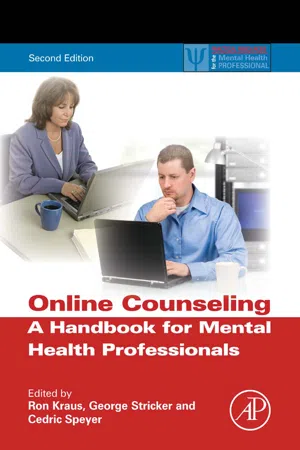
eBook - ePub
Online Counseling
A Handbook for Mental Health Professionals
- 288 pages
- English
- ePUB (mobile friendly)
- Available on iOS & Android
eBook - ePub
About this book
Online Counseling gives practical insight into how professionals can translate and extend their practice to the electronic online medium. The volume provides an overview of current research on the use and effectiveness of counseling online and data on the idiosyncrasies of online behavior and communication. The practical aspects of and skill sets required for counseling online are discussed at length, as are technological, ethical, legal and multicultural issues, treatment strategies, and testing and assessment.
- Foreword by Morgan Sammons and Patrick DeLeon, past president of the American Psychological Association
- The first comprehensive textbook designed to give clinicians and mental health students everything they need to understand and start providing mental health services via the Internet
- Each chapter includes study questions and key terms, making it ideal for use in graduate or continuing education settings
- Includes clear and comprehensive chapters on research and technology related to online counseling
- Contributors include past, present, and elected presidents of the International Society for Mental Health Online (ISMHO), the Inernet's leading resource for professionals interested in online counseling and other methods of delivering mental health services via the Internet
Information
Chapter One. Online Behavior, Communication, and Experience
Michael Fenichel, PhD
Private practice
Chapter Outline
Context is Everything4
Counseling or Therapy Online?6
Life in Cyberspace7
Communicating Accurately and Effectively9
Phenomenology of Twenty-First-Century Daily Life10
Online Behavior in Clinical Practice12
Social Connectedness: Life in the Twenty-First Century14
Conclusion16
Discussion Questions16
References18
Further Reading19
To say that much has changed in the last 10 years, the first decade of a new millennium, is perhaps a vast understatement. Our society has become immersed in a lifestyle often described as the “digital decade,” with an application for every whim, a communication tool for every purpose, and a vast choice of platforms and technology.
In the 1990s it was quite exciting to imagine the dawning of a new era of open world travel, via the “information highway.” Now the highway leads to people’s homes and inboxes and both personal and professional relationships have been revolutionized as a result. Grandmothers watch grandchildren via Skype as the grandchildren turn from the piano to iPhone to Leapster to homework, with Facebook somewhere in between. At the same time, opportunities have opened up for new avenues of employment for entrepreneurs, researchers, students, and educators, and for computer applications involving virtual reality. 1
1See, for example, http://www.fenichel.com/virtual.shtml for a description of clinical and military application demonstrated to be effective in the treatment of trauma.
Context matters. It matters in social situations, work environments, intimate relationships, and public forums. It is the context of this digital age, when an entire generation simply do not know anything else and parents and practitioners alike swear by the power of multi-tasking. This is in spite of the mounting body of applied research suggesting that the brain has not caught up with the applications through a natural process of neurological evolution. This is the prevailing zeitgeist for both potential clients and counselors/therapists/consultants. While some debate can be heard above the din of ringtones, instant messages (IMs), and beeps about the relative value versus the dangers of multi-tasking, of “addiction,” and of human attention morphing into a state of fragmented cognition measured by the onslaught of 140-character tweets and SMS, the fact remains that this is the world in which we live. It is a candy store for some, a menu of limitless tools for others, and simply taken for granted by the generation that evolved from NeoPets and The Sims, to MySpace, Facebook, and various music- and art-focused sites. A new high tech enthusiasm is now trickling up from the younger generations, which were born into an era where they are surrounded by devices, networks, and myriad media options, to adults, who vary in their excitement about and adaptation to the various technologies and social activities online.
Context is Everything
Context is key to understanding human experience and the myriad components of communication, along with the elements of interpersonal relationships. Our unique and shared experiences form the foundation for all meaningful collaborative relationships, including the therapeutic one. Thus, it is essential, in facilitating a professional therapeutic relationship, to fully understand and appreciate context and perspective. Without this there is no possibility of genuine empathy or trust. A decade ago some of the earliest efforts of online researchers and practitioners focused on understanding how online counselors might effectively determine a good “fit” in terms of therapeutic venue and modality. Long before the advent of the Internet, such variables as the matching of goals and expectations between psychotherapist and patient had been shown to constitute a powerful determinant for positive outcomes, whether these were achieved by goal-directed dialogue, behavioral coaching, insight, narrative analysis, or supportive, empathic counseling. Practicing online clinicians have been adapting and adopting new procedures to ensure accurate communication and allow for expression of feeling and mood to be accurately and mutually understood; in short, to promote online empathy.
The multitude of options has long ago moved beyond the choice between “on-the-couch” and “face-to-face” (f2f) therapy paradigms or even the efficacy of one school versus another. People’s needs vary, and yet, as H. S. Sullivan (father of interpersonal psychiatry) pointed out, people also are more alike than otherwise. Now there are many viable choices of method and venue to provide specialized treatments, with an entire continuum of communication tools, from traditional f2f office-based practice to text or video chat, support groups (with and without professional moderation), and self-help resources and communities – along with the burgeoning availability of individual online counseling services.
In the first edition of this book, long before a multitude of training manuals, institutes, and courses began to appear and offer standardized training materials, I sought to underscore how, no matter what the communication tool, it is effective communication that is vital.
In graduate school and beyond, therapists learn that the single most important factor in effective counseling and psychotherapy is the quality of the therapeutic relationship. Having the ability to understand human nature, analyze the dynamics of relationships, and probe the depths of the psyche is an essential contributor to the positive therapeutic relationship, along with the “nonspecific factors” experienced by clients, such as warmth, empathy, and genuineness. Add to the therapeutic relationship the goals and expectations of both client and counselor, along with the processes and tools that facilitate treatment that is experienced as helpful, and this fortuitous combination of an effective working relationship and appropriate clinical interventions is thought to be the key to success. 2
2Notwithstanding the interest and novelty attached to such classic software programs as ELIZA, where in effect the “therapist” (or “fortune teller”) is the computer itself, without human intervention or intelligence.
With the advent of the Internet, communication has been revolutionized and basic tenets of human relationships have been intensified, broadened, and challenged. 3 Opportunities now exist for socially shy, isolated, or physically challenged individuals to reach out for connectedness or support, utilizing the web to seek information, companionship, self-validation, and, increasingly, advice or professional mental health services, such as counseling and psychotherapy. 4 Today’s products and services are being driven by the generation that has been born to multi-task and who take digital options for granted, as prior generations went from wanderlust to familiarity with movies, television, video games, portable music, CDs and DVDs. Trends continue to change within and across generations. Recently, for example, the Pew Research Center (Pew Internet and American Life Project, 2010) has identified a declining interest in blogging in favor of more instant and personally interactive social media such as Facebook. Children and teens are not as interested in tweeting out bird-sized texts as in sending free-form messages and using more creative and diverse media, often simultaneously, usually favoring wireless platforms. Adults, on the other hand, are becoming more engaged by social networks designed for teens and college students, and increasingly populate professional networks and interest groups. When considering where the average person with a computer or smart phone may look for mental health support, the public landscape for seeking such help has clearly changed.
3For example, according to a Harris Poll, by the year 2000 57 percent of all US adults were online, at home or at work, and of this group 86 percent had sought information on health care via the Internet, up from 71 percent of users in 1998. By November 2007, a new Harris Poll found nearly 80 percent of all US adults spend time online, on average 11 hours per week. Source: Reuter News, (2007, November 5). Do you find yourself going online more and more? You're not alone. Retrieved 16 September 2010 from http://www.reuters.com/article/idUSN0559828420071106.
4The Wall Street Journal (June 4, 2002, p. D6) went so far as to announce, “Online Therapy Goes Mainstream.” Written by Robert J. Davis.
Counseling or Therapy Online?
While there can be great debates around the perennial question, “what is therapy?,” there is little doubt that many online clinicians, support communities, and self-help websites are offering “therapeutic” services and experiences. Counseling is available online both as an open-ended process and for a wide range of goal-directed ends, ranging from vocational decision-making to bolstering social confidence, building self-help skills and self-esteem, and fostering a more cohesive sense of self or interpersonal competency. Online mental health practitioners also serve as a bridge to referrals in the f2f community, or to online specialists with expertise in particular presenting issues.
The vast majority of American lives are now touched, if not transformed, by each of us having potential access to everybody else on earth with a computer (or smart phone) and an Internet connection. A society built on mobility via cars and highways has now completely embraced the new technology. The most promising means of getting where and what one wants is now, in many minds, readily accessible on the “information highway” or within one’s social/professional networks. The potential for interactive communication and for broadening our understanding of human behavior across contexts and cultures is profound. An entire generation in the US has integrated the computer and the Internet into their lives as easily as their parents were able to embrace the telephone and television. Often, the first solution in seeking help, support, or information today is to “go online.” Certainly, teens in particular are now equally at ease with IMs as with emailing, using a cell phone, or meeting a group of friends in a chat environment to swap pictures, video, or music.
It is the very ease and naturalness of using the Internet and the computer in daily life now, unencumbered by worries about wires, routers, and so forth, that makes turning to the Internet more commonplace than using a telephone directory or other offline sources of information and support. Add to this the populations already benefiting from telehealth services, such as the geographically isolated, physically challenged, vocationally mobile, and socially inhibited, and there is clearly a huge need that can be filled by online practitioners. The “presenting problems,” can entail interpersonal relationships, addictions, work-related stress, or anxiety, to name but a few areas that mental health practitioners commonly address in all mediums. Working online, however, carries unique challenges and opportunities, which in turn demand additional skills (Fenichel, ...
Table of contents
- Cover Image
- Table of Contents
- Front-matter
- Copyright
- Foreword. Unprecedented Change is Upon Us
- Introduction
- Chapter One. Online Behavior, Communication, and Experience
- Chapter Two. The Psychology of Text Relationships
- Chapter Three. Online Counseling: Does It Work? Research Findings to Date
- Chapter Four. The Technology of Online Counseling
- Chapter Five. Ethical Issues in Online Counseling
- Chapter Six. Legal Issues for Online Counselors
- Chapter Seven. The Business of Online Counseling
- Chapter Eight. Text-based Online Counseling: Email
- Chapter Nine. Text-based Online Counseling: Chat
- Chapter Ten. Counseling Groups Online: Theory and Framework
- Chapter Eleven. Clinical Work with Support Groups Online: Practical Aspects
- Chapter Twelve. Internet-based Psychological Testing and Assessment
- Chapter Thirteen. International and Multicultural Issues
- Chapter Fourteen. The Future of Health Care and Online Counseling
- Index
Trusted by 375,005 students
Access to over 1.5 million titles for a fair monthly price.
Study more efficiently using our study tools.
Frequently asked questions
Yes, you can cancel anytime from the Subscription tab in your account settings on the Perlego website. Your subscription will stay active until the end of your current billing period. Learn how to cancel your subscription
No, books cannot be downloaded as external files, such as PDFs, for use outside of Perlego. However, you can download books within the Perlego app for offline reading on mobile or tablet. Learn how to download books offline
Perlego offers two plans: Essential and Complete
- Essential is ideal for learners and professionals who enjoy exploring a wide range of subjects. Access the Essential Library with 800,000+ trusted titles and best-sellers across business, personal growth, and the humanities. Includes unlimited reading time and Standard Read Aloud voice.
- Complete: Perfect for advanced learners and researchers needing full, unrestricted access. Unlock 1.5M+ books across hundreds of subjects, including academic and specialized titles. The Complete Plan also includes advanced features like Premium Read Aloud and Research Assistant.
We are an online textbook subscription service, where you can get access to an entire online library for less than the price of a single book per month. With over 1.5 million books across 990+ topics, we’ve got you covered! Learn about our mission
Look out for the read-aloud symbol on your next book to see if you can listen to it. The read-aloud tool reads text aloud for you, highlighting the text as it is being read. You can pause it, speed it up and slow it down. Learn more about Read Aloud
Yes! You can use the Perlego app on both iOS and Android devices to read anytime, anywhere — even offline. Perfect for commutes or when you’re on the go.
Please note we cannot support devices running on iOS 13 and Android 7 or earlier. Learn more about using the app
Please note we cannot support devices running on iOS 13 and Android 7 or earlier. Learn more about using the app
Yes, you can access Online Counseling by Ron Kraus,George Stricker,Cedric Speyer in PDF and/or ePUB format, as well as other popular books in Psychology & Clinical Psychology. We have over 1.5 million books available in our catalogue for you to explore.