eBook - ePub
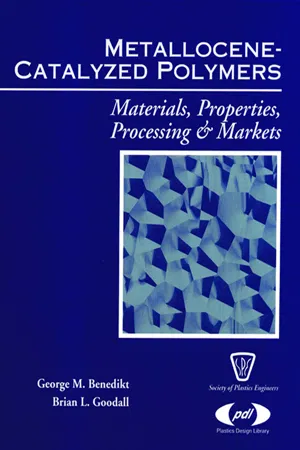
Metallocene Catalyzed Polymers
Materials, Processing and Markets
- 394 pages
- English
- ePUB (mobile friendly)
- Available on iOS & Android
eBook - ePub
About this book
It has been estimated that within just ten years, over half of all polyolefins will be made by using metallocene catalysts. This ground-breaking volume from PDL brings togetherùfor the first timeùwork from dozens of world-renowned experts on the subject. Fifty chapters of peer-reviewed content offer insights into applications in automotive components, food packaging, insulating films, non-woven fabrics and medical markets, among others.
Tools to learn more effectively

Saving Books

Keyword Search

Annotating Text

Listen to it instead
Information
Economic Factors for the Production of Metallocene and Perfluorinated Boron Cocatalysts
Jeffrey M. Sullivan, Boulder Scientific Company, P.O. Box 548 Mead, Colorado 80542, USA
ABSTRACT
Metallocene production costs are evaluated for a wide range of molecules currently under development for polyolefin catalyst systems, including bridged and unbridged ligands prepared from cyclopentadienes, indenes, and fluorenes. Production costs are evaluated on a life cycle basis and on a functional basis. Lifecycle costs are useful for budgeting and planning, and functional costs are useful for comparisons between competing alternatives. Examples from Boulder Scientific’s production experience are given for each category of metallocenes and for perfluorinated boron cocatalysts.
INTRODUCTION
Metallocenes were developed in the 1950’s, beginning with the discovery of ferrocene4 followed shortly thereafter by the synthesis of titanocene dichloride and zirconocene dichloride.9 By 1960, hundreds of metallocene molecules had been synthesized and characterized. Extensive reviews3,9 described the state of the art at that time. Interest in metallocenes continued to grow gradually during the past 30 years until their recent application to polyolefin catalysis.
Within the past 3 years, commercial interest in metallocene production for catalyst applications has increased dramatically. While some of the more common metallocenes (ferrocene and zirconocene, for example) have been commercially available in large quantities for a number of years, most of the metallocenes and cocatalysts currently under development for polyolefin production were either unknown or produced only for laboratory research. The sudden surge in demand for kilogram and megagram quantities of complex metallocene molecules has exerted pressure to get into production rapidly and drive costs down as soon as possible.
The Boulder Scientific Company, located in Mead, Colorado, has been producing metallocenes commercially for over 15 years. Recent interest in substituted cyclopentadienyl metallocenes, indenyl metallocenes, silyl-bridged metallocenes, and boron-based cocatalysts has spawned extensive laboratory development and commercial-scale production at the Mead facility. In response to the rapidly changing polyolefin market, Boulder Scientific now offers over 30 metallocene products, many of which are produced in kilogram to 100-kilogram quantities.
Boulder Scientific has scaled approximately 20 metallocene production processes from 10 grams to batch sizes as large as 100 kg. As these production processes have matured, many lessons have been learned and trends in production costs have been identified. This paper summarizes production economics for a variety of metallocenes and boron cocatalysts, so that polyolefin producers may have a guide to the relative cost of candidate catalyst molecules. Just as new drug molecules are screened for effectiveness and production costs, new metallocene molecules can be evaluated on a similar basis. The costs in this paper represent production costs of bulk metallocenes and boron cocatalysts but do not include the costs of producing the finished supported catalyst.
COST METHODOLOGY
Metallocene production costs can be evaluated on a product life-cycle basis and on a functional basis. Product life-cycle evaluation is chronologically oriented and includes development, initial scale-up (or pilot plant), early commercial production, and mature commercial production. Production costs are (in general) inversely related to quantity. It is not uncommon to experience a 4 to 10-fold reduction in cost from early kilogram-scale production to mature commercial production. Functional evaluation is dependent on the molecular structure and synthetic building blocks and can be conducted at any point in the product life cycle. Factors such as raw-material cost, air and moisture sensitivity, number of synthetic steps, purification requirements (in process and final), and yield are all factored into a functional cost analysis. Table 1 summarizes various cost contributions and whether they contribute to a functional analysis, life-cycle analysis, or both.
Table 1
Functional and Life-Cycle Cost Contributions
| Economic Factor | Functional | Life Cycle |
| Raw materials | 1 | 3 |
| Labor | 3 | 1 |
| Number of steps | 1 | 3 |
| Air or moisture sensitivity | 1 | 3 |
| Yield | 1 | 3 |
| Production scale | 2 | 1 |
| Purification requirements | 1 | 2 |
| Final delivery form | 2 | 2 |
Key: 1-significant impact; 2-moderate impact; 3-minimal impact
The two cost approaches in Table 1 serve different purposes. Functional analysis provides relative cost between two or more alternatives, but life-cycle cost analysis provides actual production costs for budgets, planning, or accounting.
Functional analysis is very useful early in the development cycle, particularly for comparing between competing alternatives. If, for example, 5 metallocenes were under evaluation for use in polyolefin production, a functional cost analysis could rank the products by production cost. Functional cost analysis is also useful in comparing competing metallocenes under development by different polyolefin producers. Although the catalytic activity (which is not always available in the public domain) is required for a complete analysis, the relative metallocene cost can be easily determined using a functional cost analysis. Life-cycle cost analysis is more useful once a production commitment has been made, and ultimate cost projections are required for long-term planning. Since the cost of the metallocene is often a significant portion of the overall catalyst cost, economic viability of polyolefin production may depend on the ultimate price of the bulk metallocene....
Table of contents
- Cover image
- Title page
- Table of Contents
- Copyright
- FOREWORD
- Materials
- Properties
- Processing
- Markets
- INDEX
Frequently asked questions
Yes, you can cancel anytime from the Subscription tab in your account settings on the Perlego website. Your subscription will stay active until the end of your current billing period. Learn how to cancel your subscription
No, books cannot be downloaded as external files, such as PDFs, for use outside of Perlego. However, you can download books within the Perlego app for offline reading on mobile or tablet. Learn how to download books offline
Perlego offers two plans: Essential and Complete
- Essential is ideal for learners and professionals who enjoy exploring a wide range of subjects. Access the Essential Library with 800,000+ trusted titles and best-sellers across business, personal growth, and the humanities. Includes unlimited reading time and Standard Read Aloud voice.
- Complete: Perfect for advanced learners and researchers needing full, unrestricted access. Unlock 1.4M+ books across hundreds of subjects, including academic and specialized titles. The Complete Plan also includes advanced features like Premium Read Aloud and Research Assistant.
We are an online textbook subscription service, where you can get access to an entire online library for less than the price of a single book per month. With over 1 million books across 990+ topics, we’ve got you covered! Learn about our mission
Look out for the read-aloud symbol on your next book to see if you can listen to it. The read-aloud tool reads text aloud for you, highlighting the text as it is being read. You can pause it, speed it up and slow it down. Learn more about Read Aloud
Yes! You can use the Perlego app on both iOS and Android devices to read anytime, anywhere — even offline. Perfect for commutes or when you’re on the go.
Please note we cannot support devices running on iOS 13 and Android 7 or earlier. Learn more about using the app
Please note we cannot support devices running on iOS 13 and Android 7 or earlier. Learn more about using the app
Yes, you can access Metallocene Catalyzed Polymers by George M. Benedikt,Brian L. Goodall in PDF and/or ePUB format, as well as other popular books in Technology & Engineering & Physical & Theoretical Chemistry. We have over one million books available in our catalogue for you to explore.