eBook - ePub
Stratigraphic Reservoir Characterization for Petroleum Geologists, Geophysicists, and Engineers
- 688 pages
- English
- ePUB (mobile friendly)
- Available on iOS & Android
eBook - ePub
Stratigraphic Reservoir Characterization for Petroleum Geologists, Geophysicists, and Engineers
About this book
Reservoir characterization as a discipline grew out of the recognition that more oil and gas could be extracted from reservoirs if the geology of the reservoir was understood. Prior to that awakening, reservoir development and production were the realm of the petroleum engineer. In fact, geologists of that time would have felt slighted if asked by corporate management to move from an exciting exploration assignment to a more mundane assignment working with an engineer to improve a reservoir's performance.
Slowly, reservoir characterization came into its own as a quantitative, multidisciplinary endeavor requiring a vast array of skills and knowledge sets. Perhaps the biggest attractor to becoming a reservoir geologist was the advent of fast computing, followed by visualization programs and theaters, all of which allow young geoscientists to practice their computing skills in a highly technical work environment. Also, the discipline grew in parallel with the evolution of data integration and the advent of asset teams in the petroleum industry. Finally, reservoir characterization flourished with the quantum improvements that have occurred in geophysical acquisition and processing techniques and that allow geophysicists to image internal reservoir complexities.
- Practical resource describing different types of sandstone and shale reservoirs
- Case histories of reservoir studies for easy comparison
- Applications of standard, new, and emerging technologies
Information
Topic
Physical SciencesSubtopic
Geology & Earth SciencesChapter 1
Basic Principles and Applications of Reservoir Characterization
Roger M. Slatt
Keywords
Compartmentalization; Energy consumption; Gas hydrates (Clathrates); Geologic reservoir heterogeneity; Global energy resource; Oil and gas; Reservoir characterization; Shale Gale
1.1 General Introduction
The volume of information that is being generated and made publicly available about oil and gas reservoirs is increasing at an exponential rate, as is most “knowledge.” The “information age” applies equally to oil and gas exploration and development as to other global issues, as evidenced by the almost unlimited amount of information that can be gathered from the Internet on both general and specific aspects of basic and applied geoscience and engineering.
In addition to the Internet revolution, specific technology advances over the past few years include improved seismic processing and imaging for 3D and 4D seismic surveys, drilling in deeper offshore waters and onshore horizontal drilling and completions, and continued understanding of the physiochemical makeup of reservoirs at finer-and-finer detail.
Since publication of the first edition of this book, exploration for and extraction of oil and gas from shales and tight sands has revolutionized the global energy balance and the petroleum industry's response to that revolution. Although it has long been recognized that there is an abundance of oil and gas in shales, they were generally considered to be hydrocarbon source rocks and seals. Advances in horizontal drilling, artificial fracturing (required of almost all shales to make them productive), and passive seismic monitoring provided the capability to economically extract oil and gas from these ultratight rocks. It has been suggested that there currently is a 100+-year supply of natural gas from North American shale (at current consumption rates), thus reducing the dependence on international sources of energy. In the early stages of development of shale gas, principally from the Barnett Shale, so much gas was produced that market price declined substantially. At the same time, oil prices were rising. As a result, the development of gas declined substantially, gas-rich shale plays were abandoned or sold off, and petroleum industry exploration moved toward liquid-rich intervals in the shales. An example is the Eagle Ford play of South Texas, which has a downdip dry gas window, an updip oil window, and an intermediate wet gas/condensate window (Fig. 1.1).
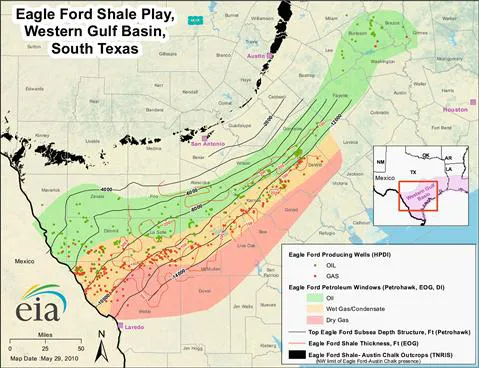
Figure 1.1 Distribution of oil, wet gas, and dry gas in the Eagle Ford Shale Play of South Texas. Figure provided by EIA.
Although new engineering and geophysical technologies were the driving forces behind shale development, our understanding of the basic physiochemical and stratigraphic makeup of shales lags far behind that of sandstone and carbonate reservoirs. New measurement methodologies and workflows are just being developed for characterizing shale reservoirs (Slatt et al., 2012). Chapter 12 in this second edition is devoted to characterization of shale and tight sand reservoirs.
Engineering and geophysical advancements, coupled with higher-resolution computing capabilities, have led to steady improvements in our capacity to build quantitative 3D geologic models for reservoir performance simulation and volumetric calculations. All of these advances have come about in large part because of the greater emphasis being placed upon enhanced hydrocarbon recovery from existing, mature fields (“brownfields”) and shale/tight sand reservoirs. As AAPG President Ted Beaumont stated, “The shale/tight sand reservoir play changed the concept of a hydrocarbon reservoir forever and the key to the evolution of our knowledge and understanding of this incredible play is reservoir characterization, the collaboration of geology, geophysics, and engineering.”
1.2 Integrating Expertise for Reservoir Characterization
Today, the field of reservoir characterization routinely involves disciplines of geology, geophysics, petrophysics, petroleum engineering, geochemistry, biostratigraphy, geostatistics, and computer science. Even behavioral science must be included in this list, because people in the different disciplines do not think or act similarly and sometimes must be encouraged to work together in a team setting. A popular quote (of unknown origin) is very appropriate to the oil and gas industry: Two stonecutters were asked what they were doing. The first said, “I'm cutting this stone into blocks.” The second replied, “I'm on a team that's building a cathedral.” The concept behind this latter statement is now fully ingrained within the petroleum industry, as evidenced by the organizational subdivision of exploration and development personnel into “asset teams.”
Different disciplines even use their own technical language, so that effective communication is sometimes lacking, leading to costly mistakes such as the Macondo blowout in April 2010 (http://en.wikipedia.org/wiki/Macondo_Prospect). A more mundane example is the term “deep water,” which is used by a geologist to indicate deposition of sediments in water depths beneath storm wave base (slope and basinal depths) and by an offshore drilling engineer to indicate present-day water depths > 500 m (1500 ft.) above the mudline (seafloor).
Visualization technologies and instrumentation introduced in earnest in the mid-1990s (Slatt et al., 1996) and now routinely used in all large and midsize companies have provided an effective means of breaking down some of the communication barriers among the disciplines. In part, this is due to the greater willingness of young entrants into the petroleum industry—geoscientists who were raised with home and school computers and sophisticated video games—to seek out, be comfortable with, and use computers for most tasks. Although we all acknowledge the advances that have been made in oil and gas exploration and development as a result of computers, there are a number of occasions of computer overuse (i.e., using the computer instead of knowledge to attempt to solve a problem). University professors are sometimes chided for producing “Nintendo geologists” (a term first introduced to me by W. Camp, a long-time petroleum industry geologist).
Thus, the field of reservoir characterization is quite comprehensive and challenging. In fact, definitions of reservoir characterization now vary according to the technologies available for characterization and the skills of the technologists. A rather vague definition that I like (perhaps because it is vague) has been provided by Halderson and Damsleth (1993): “The principal goal of reservoir characterization is to outsmart nature to obtain higher recoveries with fewer wells in better positions at minimum cost through optimization.”
1.3 Oil and Gas: The Main Sources of Global Energy
1.3.1 Resources and Reserves
The volume of oil and gas that is present beneath the Earth's surface can be classified in several ways. Figure 1.2 illustrates one classification, from the resource (undiscovered, total estimated) to the reserves (either proven or probable at a given price). Determining the resource and reserves at any one time is a difficult task, and the values will change over time. As shown in Fig. 1.2, undoubtedly, the total anticipated resource is not accessible to exploration, for geographic, political, and economic reasons and technological challenges.
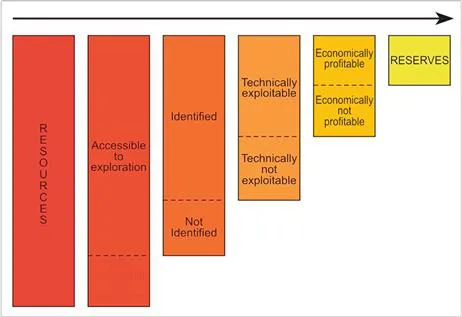
Figure 1.2 A visual definition of resources and reserves. Modified from Favennec (2002). Reprinted with permission of Institut Francais du Petrole.
Also, what is not accessible today may become accessible in the future, so that the total resource can change with time. Then, once the resource is identified and discovered, only a percentage of it may be technically recoverable. However, future technologies (some of which will focus on improved reservoir characterization) will modify this percentage from time to time. Finally, although the resource might be technically recoverable, economics will dictate how much is produced at a given time and price. Because global and local economics change more or less continually, the amount of resource that is actually extracted or extractable will also vary with time. It is this amount of the resource that can be considered the reserves, both proven and probable. A good example of the economic effect of supply and demand on exploration and production is the recent revelation and development of vast quantities of technically recoverable gas and liquids from shales (see Chapter 12 and as discussed earlier).
1.3.2 Predicting the Remaining Resource
Over the years, many estimates and calculations have been made regarding when the global supply of oil and gas will be exhausted. Perhaps, the most widely cited set of predictions are those of M. K. Hubbert. The “Hubbert curve,” which attracted significant attention, was published in 1957, when Hubbert predicted that annual U.S. oil production would peak as early as 1965 and no l...
Table of contents
- Cover image
- Title page
- Table of Contents
- Copyright
- Dedication
- Preface
- Series Editor's Preface
- Chapter 1. Basic Principles and Applications of Reservoir Characterization
- Chapter 2. Basic Sedimentary Rock Properties
- Chapter 3. Geologic Time and Stratigraphy
- Chapter 4. Tools and Techniques for Characterizing Oil and Gas Reservoirs
- Chapter 5. Basics of Sequence Stratigraphy for Reservoir Characterization
- Chapter 6. Geologic Controls on Reservoir Quality
- Chapter 7. Fluvial Deposits and Reservoirs
- Chapter 8. Eolian (Windblown) Deposits and Reservoirs
- Chapter 9. Deltaic Deposits and Reservoirs
- Chapter 10. Nondeltaic, Shallow Marine Deposits and Reservoirs
- Chapter 11. Deepwater Deposits and Reservoirs
- Chapter 12. Unconventional Resource Shales
- Chapter 13. Geologic and Engineering Modeling
- Index
Trusted by 375,005 students
Access to over 1.5 million titles for a fair monthly price.
Study more efficiently using our study tools.
Frequently asked questions
Yes, you can cancel anytime from the Subscription tab in your account settings on the Perlego website. Your subscription will stay active until the end of your current billing period. Learn how to cancel your subscription
No, books cannot be downloaded as external files, such as PDFs, for use outside of Perlego. However, you can download books within the Perlego app for offline reading on mobile or tablet. Learn how to download books offline
Perlego offers two plans: Essential and Complete
- Essential is ideal for learners and professionals who enjoy exploring a wide range of subjects. Access the Essential Library with 800,000+ trusted titles and best-sellers across business, personal growth, and the humanities. Includes unlimited reading time and Standard Read Aloud voice.
- Complete: Perfect for advanced learners and researchers needing full, unrestricted access. Unlock 1.5M+ books across hundreds of subjects, including academic and specialized titles. The Complete Plan also includes advanced features like Premium Read Aloud and Research Assistant.
We are an online textbook subscription service, where you can get access to an entire online library for less than the price of a single book per month. With over 1.5 million books across 990+ topics, we’ve got you covered! Learn about our mission
Look out for the read-aloud symbol on your next book to see if you can listen to it. The read-aloud tool reads text aloud for you, highlighting the text as it is being read. You can pause it, speed it up and slow it down. Learn more about Read Aloud
Yes! You can use the Perlego app on both iOS and Android devices to read anytime, anywhere — even offline. Perfect for commutes or when you’re on the go.
Please note we cannot support devices running on iOS 13 and Android 7 or earlier. Learn more about using the app
Please note we cannot support devices running on iOS 13 and Android 7 or earlier. Learn more about using the app
Yes, you can access Stratigraphic Reservoir Characterization for Petroleum Geologists, Geophysicists, and Engineers by Roger M. Slatt in PDF and/or ePUB format, as well as other popular books in Physical Sciences & Geology & Earth Sciences. We have over 1.5 million books available in our catalogue for you to explore.