eBook - ePub
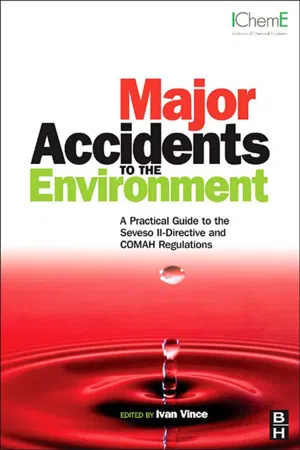
Major Accidents to the Environment
A Practical Guide to the Seveso II-Directive and COMAH Regulations
- 320 pages
- English
- ePUB (mobile friendly)
- Available on iOS & Android
eBook - ePub
Major Accidents to the Environment
A Practical Guide to the Seveso II-Directive and COMAH Regulations
About this book
- If our plant catches fire, when should it be allowed to burn down to prevent pollution?
- When does enforcement turn into prosecution, following an environmental accident?
- Will our environmental insurance cover the costs of remediation?
This book provides a thorough and practical guide to the environmental aspects of compliance with the Seveso II Directive and COMAH regulations and surrounding issues.It guides readers through the technical, legal and insurance related complexities unique to the environmental aspects of Seveso II/COMAH. Individual chapters and sections written by relevant experts explain the implications of the Directive/Regulations and other laws that relate to major accident hazards. Valuable case studies underpin and illuminate the arguments presented.The comprehensive appendices contain a wealth of further case studies as well as focused supporting information on environmental design, assessment and management of major hazard installations, for safety, prevention and environmental professionals, risk assessors, insurers, managers and their legal advisors.Dr Ivan Vince is Director of ASK Consultants and co-founder of one of the first industrial risk consultancies in Eastern Europe. He has investigated several environmental accidents.Related titles:Introduction to Emergency Management, 2e Haddow and Bullock 978-0-7506-7961-9Introduction to International Disaster Management, Coppola 978-0-7506-7982-4Learning from Accidents, 3e, Kletz 978-0-7506-4883-7
- This is the only guide to working with and implementing the Seveso II-Directive and COMAH regulations
- Written by leading risk management, scientific, legal, and engineering experts, this book provides all of the key elements an organization must manage in order to comply
- Accompanied by a comprehensive data handbook that enables managers and health & safety professionals to assess and apply the approaches required in the Directives
Information
Subtopic
InsurancePart 1
Major Accidents to the Environment
1
Technical aspects
Ivan Vince, Bob Sargent, Niall Ramsden and Tony Moore
INTRODUCTION
As discussed below, Major Accident To The Environment (MATTE) is a defined, if somewhat diffuse, concept under the COMAH (Control of Major Accident Hazards regulations, SI 1999 No.743) regime. As regards the latter, there is a large volume of documentation, much of it freely available on the Health and Safety Executive (HSE) web site, providing very clear and detailed guidance on all aspects relevant to human health and safety. For several reasons, corresponding publications on the environmental aspects of the COMAH are both fewer and less detailed.
Therefore, the purpose of this chapter is not to give an overview (for which see CA, 1999), but to focus in some depth on certain problem areas peculiar to MATTEs, in risk assessment, accident prevention and mitigation, and emergency response. Key sections of COMAH relevant to MATTEs are reproduced in Appendix 1.
While this book concentrates on the impact of chemical accidents on the natural environment (i.e. ecosystems), it should be recognised that environmental impact can also affect people, e.g. through the contamination of farm land and water supplies, overloading of sewage treatment works, damage to amenities, etc. For a detailed discussion of conflicts between safety and environmental considerations (not all major hazard related), see Crawley et al., 2000 and Beale, 2000.
The variety of circumstances surrounding MATTEs (chemicals, processes, immediate causes, outcomes) can best be appreciated by perusing collections of incident reports. Over one hundred records in the EU/OECD Major Accident Reporting System (MARS) database refer to major accidents that have caused environmental harm (not necessarily MATTEs). The records, in the form of short reports, are freely available (MAHB, 2007); full reports have been prepared by the national competent authorities for some incidents. A thoughtful selection of case studies appears in Christou, 2000 (see Appendix 2). A twice monthly roundup of industrial accidents, available at www.saunalahti.fi/ility/HInt1.htm, has a section devoted to the environment. Appendix 3 lists brief details of environmental accidents in the last twenty years extracted from the MHIDAS database, maintained by AEA Technology on behalf of HSE (AEA, 2007); owing to space constraints, the extract excludes hydrocarbon spills. There are many other sources of incident data.
RISK ASSESSMENT
Loss prevention begins with risk assessment. Operators of hazardous installations need to have some understanding of the hazards and associated risks created by their activities to decide rationally what, if any, additional control measures to implement, to prioritise any remedial actions and, specifically under COMAH, to demonstrate that they are adequately controlling the risks.
To judge whether a given degree of control is sufficient, it is necessary to consider both the severity and the likelihood/frequency of events (‘scenarios’) that might result from the hazards being realised. The final step in a COMAH risk assessment is to subject the so-called ‘residual risks’ (i.e. the risks remaining after taking into account the effects of all prevention), protection and mitigation measures in place or planned, to a triage: risks are compared against two threshold criteria and assigned into three categories, often shown diagrammatically as zones. A risk in the highest category, labelled ‘intolerable’, cannot be justified whatever the economic benefits of the activity giving rise to it and, in the last resort, the activity can be summarily prohibited by the authorities until the risk is lowered. Risks in the lowest, ‘broadly acceptable’, category, may need no further attention, beyond monitoring (unless several such risks converge/overlap so as to exceed the ‘broadly acceptable’ criterion, see e.g. HSE, 2003). Intermediate risks must be reduced to ALARP (As Low As Reasonably Practicable), based on some form of cost-benefit comparison. Approaching the upper extreme of ALARP, the operator would be expected to act to reduce risks unless the costs of doing so were shown to be wholly disproportionate to the reduction achievable; conversely, risks marginally above the lower extreme would be acceptable unless a large improvement were feasible for a relatively small investment.
What is an appropriate depth of analysis will depend on the size of the risk, the complexity of the operation and, especially in the case of environmental risks, the availability of data on the vulnerability of ‘receptors’. In practice, however, even on complex, ‘top-tier’ COMAH sites where certain risks may demand the most detailed analysis, it is always possible to simplify the analysis overall, beginning with a preliminary screening-out of risks of palpably low consequence and/or low frequency/probability of occurrence.
Screening can take various forms. In a sense, the COMAH designation is itself a form of pre-screening, based as it is on the presence of threshold quantities of dangerous substances. Scenario selection is also a form of screening, since only physically credible scenarios should be considered; in particular, there must be an unbroken pathway from source to environmental receptor, there must be the potential for sufficient harmful material to reach the receptor to cause a major accident to the environment (MATTE), etc. The reverse approach has also proved useful, whereby crude modelling is used to delineate a set of events of minimum severity that might give rise to a MATTE, allowing the assessor to ignore (for purposes of COMAH compliance) events falling below the minimum set. Similarly, scenarios can be screened out on the basis of likelihood/frequency; the threshold for catastrophic events generally being taken as 10–6 per year [NB the value applies to the MATTE itself, not to the release that might cause it if all protection and mitigation measures fail; thus, depending on the circumstances, it may be justifiable to screen out catastrophic releases of harmful substances at considerably higher frequencies than 10–6 per year].
The safety report required for a ‘top-tier’ COMAH installation must include a risk assessment focused on major accidents, as specified in Schedule 4 of COMAH (see Appendix 1):
Part 1 (purpose of safety reports)
The purposes referred to in regulation 7 [Safety report] are as follows-
… . 2. demonstrating that major accident hazards have been identified… .
Part 2 (minimum information to be included in safety report)
… . 4. Identification and accidental risks analysis… .
(a) detailed description of the possible major accident scenarios and their probability or the conditions under which they occur including a summary of the events which may play a role in triggering each of these scenarios, the causes being internal or external to the installation;
(b) assessment of the extent and severity of the consequences of identified major accidents;
However, even ‘lower-tier’ sites are required to develop a Safety Management System (SMS), which addresses, among other issues,
identification and evaluation of major hazards – adoption and implementation of procedures for systematically identifying major hazards arising from normal and abnormal operation and the assessment of their likelihood and severity (Schedule 2, para 4b).
Thus, a role ...
Table of contents
- Cover
- Title page
- Table of Contents
- Dedication
- Copyright
- Foreword
- Preface
- Author biographies
- Part 1: Major Accidents to the Environment
- Part 2: Appendices
Trusted by 375,005 students
Access to over 1.5 million titles for a fair monthly price.
Study more efficiently using our study tools.
Frequently asked questions
Yes, you can cancel anytime from the Subscription tab in your account settings on the Perlego website. Your subscription will stay active until the end of your current billing period. Learn how to cancel your subscription
No, books cannot be downloaded as external files, such as PDFs, for use outside of Perlego. However, you can download books within the Perlego app for offline reading on mobile or tablet. Learn how to download books offline
Perlego offers two plans: Essential and Complete
- Essential is ideal for learners and professionals who enjoy exploring a wide range of subjects. Access the Essential Library with 800,000+ trusted titles and best-sellers across business, personal growth, and the humanities. Includes unlimited reading time and Standard Read Aloud voice.
- Complete: Perfect for advanced learners and researchers needing full, unrestricted access. Unlock 1.5M+ books across hundreds of subjects, including academic and specialized titles. The Complete Plan also includes advanced features like Premium Read Aloud and Research Assistant.
We are an online textbook subscription service, where you can get access to an entire online library for less than the price of a single book per month. With over 1.5 million books across 990+ topics, we’ve got you covered! Learn about our mission
Look out for the read-aloud symbol on your next book to see if you can listen to it. The read-aloud tool reads text aloud for you, highlighting the text as it is being read. You can pause it, speed it up and slow it down. Learn more about Read Aloud
Yes! You can use the Perlego app on both iOS and Android devices to read anytime, anywhere — even offline. Perfect for commutes or when you’re on the go.
Please note we cannot support devices running on iOS 13 and Android 7 or earlier. Learn more about using the app
Please note we cannot support devices running on iOS 13 and Android 7 or earlier. Learn more about using the app
Yes, you can access Major Accidents to the Environment by Ivan Vince in PDF and/or ePUB format, as well as other popular books in Technology & Engineering & Insurance. We have over 1.5 million books available in our catalogue for you to explore.