eBook - ePub
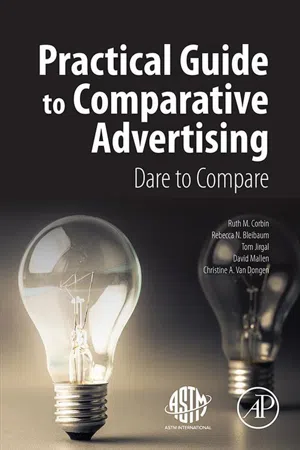
Practical Guide to Comparative Advertising
Dare to Compare
- 192 pages
- English
- ePUB (mobile friendly)
- Available on iOS & Android
eBook - ePub
Practical Guide to Comparative Advertising
Dare to Compare
About this book
Practical Guide to Comparative Advertising: Dare to Compare is an authoritative, engaging handbook on comparative advertising for food and non-food consumer products. Claim substantiation is a common stakeholder interest among management, advertisers, lawyers and researchers. This handbook covers the corporate culture and strategic goals that encourage comparative advertising, laws and regulations, standards for research evidence, and examples that bring the concepts to life. Of particular value to corporate brand managers, the book includes a checklist of process steps and quality controls that allow managers to orchestrate comparative ad campaigns and manage the risk of complaints from indignant competitors.
- Alerts research, development and marketing professionals to potential competition issues and legal concerns
- Provides a reference source for courts of law with respect to accepted industry standards and practices
- Presents an authoritative perspective, in plain language, on laws and regulations governing comparative advertising, and on worldwide standards governing research evidence in support of advertising claims
- Covers food and beverage, nutritional supplements, cosmetics and other consumer advertised products
Information
Chapter 1
Comparative Advertising—Look Before You Leap
Abstract
Comparative advertising promotes an organization’s products or services by reference to the products or services of others. By its very design, it encourages people to make comparisons. It can explicitly name a competitor or merely imply superiority or comparisons through its language, like “better-tasting,” “#1 recommended,” or “lowest price.” Memorable comparative advertising campaigns pervade the popular culture. The Pepsi Challenge (vis-à-vis archrival Coca-Cola) has been bubbling along for about 40 years, revitalized every so often with new technology and promotional ideas.
Keywords
Language; price; ideas; slogan; customer perception; market monitoring
Comparative advertising promotes an organization’s products or services by reference to the products or services of others. By its very design, it encourages people to make comparisons. It can explicitly name a competitor or merely imply superiority or comparisons through its language, like “better-tasting,” “#1 recommended,” or “lowest price.” Memorable comparative advertising campaigns pervade the popular culture. The Pepsi Challenge (vis-à-vis archrival Coca-Cola) has been bubbling along for about 40 years, revitalized every so often with new technology and promotional ideas.

A new-age cyber version of a similar competitive dare has appeared in the form of Microsoft’s “Bing it On Challenge,” inviting Internet users to compare the value of Bing versus Google search results.a Although there is no single measure of the success of Microsoft’s initial campaign, the campaign slogan “Bing it on” has powerfully endured, headlining reputable reports of Bing’s growth at the expense of Googleb
Commercials featuring the cool Mac dude versus the stodgy PC guy attracted such audience affection, that more and more advertisement scenarios were produced. How many ads in the series in all? 66!

In 2011, the National Australia Bank (NAB) won Cannes’ prestigious Grand Prix as that year’s “best campaign in the world” for its series of advertisements announcing a breakup between it and the four largest banks in the country. The tongue-in-cheek campaign featured “breakup” letters, conversations, and messages that people might use to escape a bad relationship. The media success motivated NAB to launch a website dedicated to the campaign, at http://breakup.nab.com.au/, bearing the headline “We’re not popular with the other banks anymore. We must be doing something right.” News in 2012 conveyed that NAB had attracted its millionth new customer since the campaign commenced.1

Does comparative advertising “work?” It apparently does work, at least sometimes, according to the examples above. The fun, the glamour, or the bravado of comparative advertising offer further temptation to consider it for one’s next big advertisement campaign. But the decision to launch a comparative advertisement is a commitment to something more than just communicating a message. It is a commitment to a style of communicating and to taking on risk. The decision has so many possible consequences for an organization that it would be unwise to proceed on the path of comparative advertising without the endorsement of the chief executive. A chief executive sets the tone and culture of an organization, more pervasively than some may realize.2 Compatibility with the organization’s tone and culture reflects ultimately on the clarity of its entire brand positioning (Box 1.1).
It’s a War Out There
Comparative advertising conveys a boldness of style. Consider how frequently it has been described with battleground analogies. “Let the wiener wars begin,” said Judge Morton Denlow as he opened the 2011 US trial about the comparative advertising of Ball Park Franks and Oscar Meyer Wieners. CBC News ran the story in Canada,3 observing that the “the battle pits…Sara Lee Corp, which makes Ball Park Franks, against Kraft Foods Inc., which makes Oscar Mayer,” and further described how Sara Lee had “fired the first volley.”
Consider a further illustration, in the following effusive paragraph from an articlef by advertising expert, author, and film-maker Herschell Gordon Lewis:
Headlines such as “Attack ads,” “cola wars,” “battle of the brands,” “marketing warfare,” “battle of the burgers” for books and news articles depict comparative advertising as an act of “confronting the enemy.” It’s a style that needs to sit well with your company, as a matter of strategic positioning and corporate culture.
Factors to Consider
The choice to be a “comparative advertiser” has implications much beyond the marketing department. Customer perception, employee morale, industry relationships, legal position, and financial risk/reward are all implicated in the choice. Each is considered in the following sections:
Customers Notice
Consumers are seldom passive accepters of “facts.” Encountering a comparative advertisement, they form views about its usefulness and truthfulness, and about the company behind it. They filter what they hear or see through the lens of their own experience and values.
Diverse published researchg on how customers view comparative advertising yields the following general purpose conclusions, subject of course to case-by-case exceptions:
- • Customers appreciate receiving factual comparative information about product features that help them find the product that is personally right for them. They like to feel “smarter,” and more in control of making good decisions.
- • Comparative advertisements are more effective than noncomparative advertisements in attracting attention, facilitating recall, increasing the likeability of the advertised brand, and increasing purchase intentions.
- • Based on the surveys of how much consumers “like” different advertisements, reported likeability is lower for comparative advertisements. The believability of the source is also generally rated lower. Advertisers should note, however, that likeability of advertisements, as reported in surveys, is not a consistent predictor of what consumers actually buy.
- • Advertisements that go beyond factual comparisons to comment negatively on a competitive brand or to devalue a competitive brand by innuendo, frequently meet with customer disapproval.
- • In extreme cases, a comparative advertisement may backfire by engendering public sympathy for a maligned brand.
The trade-off decision left to the advertiser, then, is whether to seek the reward of more business from customers, at the expense of being possibly viewed as a negative or mean-spirited advertiser. The risk of the latter can be mitigated by the use of demonstrably factual information, humor, and respectful tone.
Employees Love a Winner
Employee engagement is enhanced by corporate culture and corporate values with which employees can identify.h These seem particularly important today to younger professionals in the workforce. Although employees are therefore likely to enjoy advertisements which convey their company’s competitive superiority, advertisements that are embarrassing, disrespectful, or mean-spirited will insert a negative element into the company–employee relationship. Previewing comparative advertisements to employees, prior to their launch, with an explanation of the advertising objectives, will help to engage them in informed, even enthusiastic, dialog. It also prepares employees for comments by their friends and acquaintances.
Legal Standards Differ Around the World
It is no coincidence that “comparative advertising” has been explicitly defined in the laws, directives, or regulations of several countries. That is warning in itself...
Table of contents
- Cover image
- Title page
- Table of Contents
- Copyright
- Preface
- Chapter 1. Comparative Advertising—Look Before You Leap
- Chapter 2. Governing Laws, Network Standards, and Industry Self-Regulation
- Chapter 3. What’s the Name of the Claim
- Chapter 4. Foundations of Test Design
- Chapter 5. Statistical Support—How Much Is Enough?
- Chapter 6. Know Your Limits: Claims Have Boundaries
- Chapter 7. An Ounce of Prevention: Troubleshoot Your Claim Before Launch
- Chapter 8. Into the Fray: Playing Defense
- Chapter 9. Into the Fray: Playing Offense
- Chapter 10. Vive la Difference—Adapting Comparative Advertising to Different Countries
- Chapter 11. Advertising Claims in Social Media
- Chapter 12. Summary and Handy Checklist
- Chapter 13. Twenty-First Century Resources
- Index
Trusted by 375,005 students
Access to over 1.5 million titles for a fair monthly price.
Study more efficiently using our study tools.
Frequently asked questions
Yes, you can cancel anytime from the Subscription tab in your account settings on the Perlego website. Your subscription will stay active until the end of your current billing period. Learn how to cancel your subscription
No, books cannot be downloaded as external files, such as PDFs, for use outside of Perlego. However, you can download books within the Perlego app for offline reading on mobile or tablet. Learn how to download books offline
We are an online textbook subscription service, where you can get access to an entire online library for less than the price of a single book per month. With over 1.5 million books across 990+ topics, we’ve got you covered! Learn about our mission
Look out for the read-aloud symbol on your next book to see if you can listen to it. The read-aloud tool reads text aloud for you, highlighting the text as it is being read. You can pause it, speed it up and slow it down. Learn more about Read Aloud
Yes! You can use the Perlego app on both iOS and Android devices to read anytime, anywhere — even offline. Perfect for commutes or when you’re on the go.
Please note we cannot support devices running on iOS 13 and Android 7 or earlier. Learn more about using the app
Please note we cannot support devices running on iOS 13 and Android 7 or earlier. Learn more about using the app
Yes, you can access Practical Guide to Comparative Advertising by Ruth M. Corbin,Rebecca N. Bleibaum,Tom Jirgal,David Mallen,Christine A. Van Dongen in PDF and/or ePUB format, as well as other popular books in Technology & Engineering & Materials Science. We have over 1.5 million books available in our catalogue for you to explore.