- 152 pages
- English
- ePUB (mobile friendly)
- Available on iOS & Android
eBook - ePub
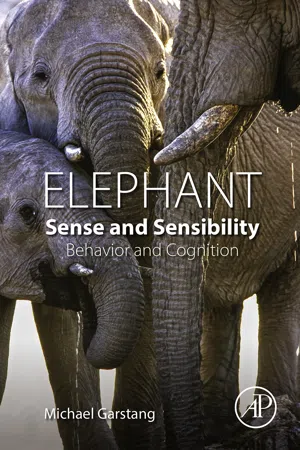
Elephant Sense and Sensibility
About this book
Elephant Sense and Sensibility is a comprehensive treatment of the full range of elephant behavior. Beginning with chapters on evolution and the elephant's brain, this book is an integrated presentation of the elephant's capacity for memory, morality, emotion, empathy, altruism, language, intelligence, learning and teaching. Grounded primarily in scientific research, the book also draws upon anecdotal and visual evidence showing elephants thinking, acting, feeling and behaving in ways that we, as humans, recognize. This complete treatment of elephant behavior supported by the extensive literature, along with anecdotal and photographic material, provides an overview not available in any other text.
- Covers a variety of aspects that relate to behavior, ranging from brain function and sensory input to communication, learning, and intelligence
- Features a comprehensive treatment of elephant behavior supported by the extensive literature, anecdotal information, and striking photographic material, providing an overview not available in any other text
- Features an interdisciplinary approach to behavior, with vital information included and integrated from several key disciplines
Information
Topic
Scienze biologicheSubtopic
BiologiaChapter 1
Introduction
Abstract
The book opens with an account of how Namibian elephants, impacted and disrupted by civil wars, were able to return to desert habitats, finding favored watering places deep in the trackless sands of the Namib Desert. Such feats of navigation, as well as detection and recognition of unnatural dangers such as land mines, speak to both the memory and neural capacity of elephants.
A brief overview of the content of the book is described for the chapters that follow, beginning with the evolution of the elephant, its brain, and the elephant’s capacity for memory, morality, emotion, empathy, altruism, language, learning, and teaching.
Emphasis is placed upon the integration across disciplines and the incorporation of anecdotal and visual evidence typically avoided in scientific treatments. Finally, we ask whether our findings cast light upon the relationship between ourselves and our fellow beings who occupy this planet with us.
Keywords
Elephant memory
Elephant navigation
Elephant neural capacity
Elephant–human relationships
Elephant capacity for emotions
The Namib Desert, stretching inland along the west coast of southern Africa, contains the largest dune fields of all the world’s deserts. Fixed dunes rising to over 100 m (320 ft) form formidable barriers between the interior of Namibia and the Skeleton Coast. Despite this, desert elephants (Figure 1.1), tallest of the African savanna elephants (Loxodonta africana), cross these dunes to reach isolated oases to drink and feed on preferred vegetation.

Figure 1.1 Desert elephant, Loxodonta africana, adapted to the sands of the Namib and Kalahari. Taller and more slender than its fellow elephants on the wetter savannas, the tallest on record is 4.5 m (14 ft, 4 in.) at the shoulder.
The Angolan civil war (1975–2002) decimated and dislocated wildlife in this region. It is estimated that 100,000 elephants were exterminated in Angola alone. Wildlife in Namibia was also disrupted by military operations and by poaching. A north–south road, built for military purposes in Namibia, cut off migrations from the east (Etosha National Park) to the coastal deserts of northwestern Namibia.
With independence in Namibia and a fragile peace in Angola (Figure 1.2), the blocking road was closed. Elephants could once again penetrate the desert. Reaching the nearest oasis meant a 24-h walk, across shifting desert sands, climbing up and over 100-m (300-ft) dunes in a featureless terrain devoid of landmarks. Elephants who had not made this journey for more than two generations unerringly crossed these sands to revisit favored isolated sites. Whether or not the elephants that made this amazing journey had done so before still leaves the questions: How did they navigate across such hostile and featureless terrain to find a precise and isolated location? And, how and why did they remember these remote clusters of green in a vast sea of undulating sand?

Figure 1.2 Points of interest in Southern Africa that appear throughout the text: (1) Namib Desert and Skeleton Coast; (2) Etosha National Park; (3) Okavango Delta; (4) Luiana Partial Reserve; (5) Caprivi Strip; (6) Luangwa National Park; (7) Sengwa National Park (formerly Wanki); (8) Kruger National Park; (9) Pilanesberg National Park; (10) Hluhlwe Game Reserve; (11) Addo Elephant National Park; (12) Knysna Forest; (13) Kalahari; and (14) Parque National do Limpopo.
Similar journeys have been recorded covering some 180 km (112 mile) from the Caprivi Strip and Botswana by elephants returning to Angola’s Luiana Partial Reserve (Leon Marshall, January 2008, Sunday Independent [South Africa]). This reserve in Cuando Cubango Province was occupied by Jonas Savimbi’s National Union for the Total Independence of Angola (UNITA). Savimbi’s rebels distributed unknown numbers of landmines in the region. Michael Chase of Elephants Without Borders (Chase, 2007; Chase and Griffin, 2011) knows of the location of some 45 minefields near Jamba Camp, Savimbi’s old headquarters. After the end of the civil war in 2002 when elephants began returning to the Luiana Partial Reserve, many were fatally injured by these land mines. Chase, however, reports that within 2 years no incidents of injury or loss of elephants in the region were reported. By using overlapping tracking of five GPS-collared elephants, Chase demonstrated that these elephants (both collared and herd mates) were moving through minefields without injury. It would be difficult not to conclude that the elephants had learned to detect the presence of mines, knew that the mines represented danger, and were able to avoid them. It is equally likely that these elephants used their highly refined sense of smell to detect the mines.
Responding to the changing circumstances described above, elephants demonstrate cognitive abilities and adaptability that are remarkable. The ability to find remote locations in trackless landscapes, to deal with threats to their survival, and to formulate solutions that can be followed by the group as a whole draw upon advanced mental processes. Elephants depend on memory, making the origins of memory fundamental to elephant neural processes. Memory is thus a central theme of this book. We as humans are what memory makes us. Without memory we cease to exist as sentient beings. This is no less true for elephants than it is for humans.
In Chapter 2 we trace the evolution of elephants with particular attention to aspects of the elephant’s brain that reflect this evolution. Elephants deviated from the primates some 35 million years ago. Yet elephants, proceeding in parallel, evolved brains that are functionally more similar to those of humans than they are different. With large bodies and complex systems such as the trunk and an opposable thumb in the form of a highly tactile and sensitive tip (Figure 1.3), elephants exhibit cognitive abilities that may in some instances exceed those of humans. Because human brains have been studied much more extensively than those of elephants, in Chapter 4 we make some comparisons between these two brains.

Figure 1.3 The versatility of the trunk is enhanced by the two fingers or the equivalent of an opposable thumb at the tip of the African elephant’s trunk. The sensitivity and control of this prehensile feature allows the detection of minute surface features or the picking-up of objects as small as an unshelled peanut.
In Chapter 3 we examine physiological aspects of the elephant’s brain but in concert with current neurological research (Bryne and Bates, 2006); we are more concerned with how the brain as a whole functions rather than the role played by the component parts of the brain. In particular, we attempt the difficult task of entering the mind of the elephant, despite the constraint of the imbalance of our knowledge of the elephant versus the human brain (Gould, 2004).
We take a Darwinian approach, arguing that evolution favors behavior that promotes survival of the species (Darwin, 1897). This will lead us to explore in elephants the existence and the origin of memory (Chapter 5), morality (Chapter 6), emotions (Chapter 7), empathy and altruism (Chapter 8), communication (Chapter 9), language (Chapter 10), intelligence (Chapter 11), learning and teaching (Chapter 12), the sensory environment (Chapter 13), and the relationship between humans and elephants (Chapter 14). Each of these characteristics is embedded in the cognitive processes of the elephant’s brain and is thus uniquely elephantine.
We draw upon the growing body of scientific evidence that examines these areas and while we are able to consider significant findings, these will not be without contention, nor in many cases fully supported by definitive scientific evidence. Few animals can be subjected to rigorous and controlled experimen...
Table of contents
- Cover image
- Title page
- Table of Contents
- Copyright
- Foreword
- Preface
- About the Author
- Acknowledgments
- Chapter 1: Introduction
- Chapter 2: Elephant Evolution
- Chapter 3: An Elephant’s Brain
- Chapter 4: Functioning of the Brain
- Chapter 5: Memory
- Chapter 6: Morality
- Chapter 7: Emotions
- Chapter 8: Empathy and Altruism
- Chapter 9: Communication
- Chapter 10: Language
- Chapter 11: Intelligence
- Chapter 12: Learning and Teaching
- Chapter 13: The Sensory Environment of Elephants
- Chapter 14: Them and Us
- References
- Supplemental Bibliography
- Index
Trusted by 375,005 students
Access to over 1.5 million titles for a fair monthly price.
Study more efficiently using our study tools.
Frequently asked questions
Yes, you can cancel anytime from the Subscription tab in your account settings on the Perlego website. Your subscription will stay active until the end of your current billing period. Learn how to cancel your subscription
No, books cannot be downloaded as external files, such as PDFs, for use outside of Perlego. However, you can download books within the Perlego app for offline reading on mobile or tablet. Learn how to download books offline
Perlego offers two plans: Essential and Complete
- Essential is ideal for learners and professionals who enjoy exploring a wide range of subjects. Access the Essential Library with 800,000+ trusted titles and best-sellers across business, personal growth, and the humanities. Includes unlimited reading time and Standard Read Aloud voice.
- Complete: Perfect for advanced learners and researchers needing full, unrestricted access. Unlock 1.5M+ books across hundreds of subjects, including academic and specialized titles. The Complete Plan also includes advanced features like Premium Read Aloud and Research Assistant.
We are an online textbook subscription service, where you can get access to an entire online library for less than the price of a single book per month. With over 1.5 million books across 990+ topics, we’ve got you covered! Learn about our mission
Look out for the read-aloud symbol on your next book to see if you can listen to it. The read-aloud tool reads text aloud for you, highlighting the text as it is being read. You can pause it, speed it up and slow it down. Learn more about Read Aloud
Yes! You can use the Perlego app on both iOS and Android devices to read anytime, anywhere — even offline. Perfect for commutes or when you’re on the go.
Please note we cannot support devices running on iOS 13 and Android 7 or earlier. Learn more about using the app
Please note we cannot support devices running on iOS 13 and Android 7 or earlier. Learn more about using the app
Yes, you can access Elephant Sense and Sensibility by Michael Garstang in PDF and/or ePUB format, as well as other popular books in Scienze biologiche & Biologia. We have over 1.5 million books available in our catalogue for you to explore.