eBook - ePub
Creative Design Engineering
Introduction to an Interdisciplinary Approach
- 194 pages
- English
- ePUB (mobile friendly)
- Available on iOS & Android
eBook - ePub
About this book
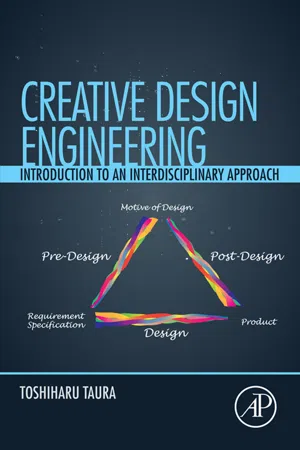
Creative Design Engineering: Introduction to an Interdisciplinary Approach presents the latest information on a field that has traditionally been primarily concerned with how to make things. However, as technology has advanced, and we have no shortage of things, a new challenge for today's engineers is what to make. In tackling this, our approaches to engineering design have come under the spotlight.
This book presents solutions to this topic in different sections that highlight the basic concerns associated with innovation. First, design is considered a kind of universal human act. Second, it is an interdisciplinary approach that brings together perspectives from fields such as cognitive science and science of knowledge is adopted. Third, the scope of the discussion also includes the process of creating an initial idea for a new product (called the pre-design phase), as well as the use of the product in society (the post-design phase).
Design engineers and researchers in engineering design will find this a user-friendly route to understanding the importance of creativity to engineering and how to implement new techniques to improve design outcomes. The book has been translated from the original Japanese book titled Sozo Dezain Kogaku [Creative Design Engineering] (published by the University of Tokyo Press 2014).
- Draws on research in industrial design, art, and cognitive science to present a concept of creativity which breaks free of traditional engineering thinking
- Deconstructs design as a human activity to increase our understanding, helping us create outstanding engineering projects and systems
- Includes discussion points to help the reader not only explore the concepts in the book, but also apply them to their own design contexts
Information
Chapter 1
Purpose of Creative Design Engineering
Abstract
This chapter sets out the main purpose of this book. First, the chapter looks at how products are closely related to science and technology, and society. Next, the analytical method, which focuses on analyzing a problem, and the synthetic method, which involves an existing analysis as well as a new creation, are explained as perspectives for understanding design. Design is then defined as the process of composing what is desirable toward the future. Finally, the main questions that this book seeks to answer are set out, Why do we design? and Why are we able to design? The design cycle model, composed of the pre-design phase, the design phase, and the post-design phase, is proposed as a framework for discussing these questions.
Keywords
science and technology
society
analysis
synthesis
pre-design phase
design phase
post-design phase
design cycle
1.1. Science and technology, products, and society
The word “design” is used a lot these days. You will hear it in terms such as industrial design and mechanical design, but also in terms such as corporate design or career design. This is probably because it contains something that is both essential and attractive for society. We place high value on people with synthetic and creative abilities—perhaps because we hope that they will help society overcome its pervasive sense of stagnation. This phenomenon is particularly evident in the monozukuri (manufacturing) sector. Until recently, its main role was to consider how to make things. However, now that we have no shortage of things, and technology has reached fruition, what to make has become the new task. Meanwhile, environmental problems have escalated, and there is a growing awareness of the need to restructure the very systems that society is founded on. These issues are large scale and complex. Design seems to have been identified as a keyword in addressing them. Accordingly, there is an increasing need to understand design from a general and meta level, as well as from a practical perspective.
Engineering design and industrial design are closely related to science and technology,1 with the goods produced in these areas of design often incorporating the most cutting-edge technology. Examples include airplanes, cars, and computers. A discussion of present and future design is not possible without addressing science and technology.
Goods, on the other hand, are more closely related to society.2 They are used and disposed of within society, and this is where new needs are also generated. We could rephrase this as follows: goods that nobody uses are meaningless. Their value is directly dependent on whether they are accepted by society. Along with goods such as cars and consumer electronics, this book also includes power stations and other industrial plants under the category of objects of design. From here onward, we will therefore refer to all objects of design as products.
The relation among science and technology, products, and society is summarized in Fig. 1.1.

Figure 1.1 The relationship among science and technology, products, and society.
Science and technology enables the development of products, the desired function of which can be obtained with fundamental knowledge about physical phenomena. At the same time, products also require science and technology to discover new principles and improve on existing ones. For example, internal combustion engines are designed based on knowledge of thermodynamics and strength of materials. Science and technology is then called upon, for example, to develop more innovative ways of powering a car, such as fuel cells.
Products, in turn, provide society with a service (utility or a sense of satisfaction), and they also receive from society an evaluation of these services and feedback on new needs. For example, gasoline-powered cars provide users with the convenience of transportation, while they receive demands from users for new functions, such as high fuel efficiency.
The relations shown in Fig. 1.1 also help us to understand the difference between engineering design and industrial design. Whereas engineering design is closer to science and technology, in the sense that it relies on a fundamental knowledge of physical phenomena, industrial design is closer to society, in the sense that the focus is on relations with consumers (Fig. 1.2).

Figure 1.2 Engineering design and industrial design.
1.2. Perspectives on design: analytical and synthetic methods
This book uses the term “design” in the broad sense, encompassing engineering design and industrial design. The word “design” can be used in different ways. For example, “I like the design of that chair,” “This event is well designed,” or “Let’s design a vision for the company.” In each of these sentences, “design” expresses a different meaning. In the first, it refers to an esthetic appreciation, in the sense of giving color and shape to products. In the second, it refers to structure and order, in the sense of orchestrating a plan to achieve a goal. In the third, it refers to drawing a vision for the future, in the sense of pursuing an ideal image. In this book, we will focus on the second and third meanings.
Design methods can largely be classified into two types.
The first method is primarily used when there is an explicit problem. A problem usually refers to the gap between an existing situation and a goal. In this book, we use it to refer to such a gap in relation to a specific product or how it is used. The key here lies in analyzing the goal and the existing situation. In this book, the term analysis means understanding the nature of something that already exists by breaking it down into several parts or constituent characteristics. Accordingly, we refer to the design method that focuses on analyzing a problem as the analytical method. Here, the purpose of design is to solve a problem. In this case, the reason for the design (this will be called the motive of design—discussed in further detail in Chapters 2 and 3) lies in the problematic product or situation that creates a need for it. For example, the motive for designing the washing machine was to make it easier to do the laundry, which until then had been a laborious manual task. Subsequent improvements have since been made in response to demands for better machines. Here then, the reason why the washing machine was designed (the motive) lies in the laundry situation (the task of laundry being arduous), and later, the washing machine itself (defects in the machine and scope for improvement). Similarly, the motive for designing the bridge arose out of the need to cross rivers. Accordingly, the washing machine and the bridge were both designed to solve problems: the laborious task of hand-washing and imperfect washing machines in the case of the washing machine, and difficulty crossing rivers and imperfect bridges in the case of the bridge.
The second method is primarily used when there is no explicit problem. Products are still designed even if no problem has been defined. This is where designers pursue their inherent ideals. With this kind of design, the resulting product and how it will be used are of course not specified since there is no explicit problem. The focus of the design, therefore, is shifting from an analysis of existing things to a new creation (synthesis). Synthesis, as a notion, is the opposite of analysis. Conventionally, it is used in the sense of combining various things that already exist into something that does not yet exist. Still, synthesis alone is not enough to constitute the kind of design that pursues an ideal. This is because combining things that already exist also requires that they are analyzed. The method that encompasses both analysis and conventional synthesis is referred to in this book as the synthetic method. In this method, the direction of the design is not uniquely determined. This means that the design is often developed based on the feelings and criteria that exist within the designer’s mind. This goes beyond gut or irrational feelings; rather, it involves the designer carefully considering what would be ideal at that particular ti...
Table of contents
- Cover
- Title page
- Table of Contents
- Copyright
- Preface
- Chapter 1: Purpose of Creative Design Engineering
- Part 1: Motive of design and the design cycle model
- Part 2: Theory and methodology of concept generation
- Part 3: Theory and methodology of conceptual design
- Part 4: Design capability and sociality
- Epilogue
- Subject Index
Trusted by 375,005 students
Access to over 1.5 million titles for a fair monthly price.
Study more efficiently using our study tools.
Frequently asked questions
Yes, you can cancel anytime from the Subscription tab in your account settings on the Perlego website. Your subscription will stay active until the end of your current billing period. Learn how to cancel your subscription
No, books cannot be downloaded as external files, such as PDFs, for use outside of Perlego. However, you can download books within the Perlego app for offline reading on mobile or tablet. Learn how to download books offline
Perlego offers two plans: Essential and Complete
- Essential is ideal for learners and professionals who enjoy exploring a wide range of subjects. Access the Essential Library with 800,000+ trusted titles and best-sellers across business, personal growth, and the humanities. Includes unlimited reading time and Standard Read Aloud voice.
- Complete: Perfect for advanced learners and researchers needing full, unrestricted access. Unlock 1.5M+ books across hundreds of subjects, including academic and specialized titles. The Complete Plan also includes advanced features like Premium Read Aloud and Research Assistant.
We are an online textbook subscription service, where you can get access to an entire online library for less than the price of a single book per month. With over 1.5 million books across 990+ topics, we’ve got you covered! Learn about our mission
Look out for the read-aloud symbol on your next book to see if you can listen to it. The read-aloud tool reads text aloud for you, highlighting the text as it is being read. You can pause it, speed it up and slow it down. Learn more about Read Aloud
Yes! You can use the Perlego app on both iOS and Android devices to read anytime, anywhere — even offline. Perfect for commutes or when you’re on the go.
Please note we cannot support devices running on iOS 13 and Android 7 or earlier. Learn more about using the app
Please note we cannot support devices running on iOS 13 and Android 7 or earlier. Learn more about using the app
Yes, you can access Creative Design Engineering by Toshiharu Taura in PDF and/or ePUB format, as well as other popular books in Technology & Engineering & Industrial Engineering. We have over 1.5 million books available in our catalogue for you to explore.