
- 360 pages
- English
- ePUB (mobile friendly)
- Available on iOS & Android
eBook - ePub
Raising Entrepreneurial Capital
About this book
Raising Entrepreneurial Capital guides the reader through the stages of successfully financing a business. The book proceeds from a basic level of business knowledge, assuming that the reader understands simple financial statements, has selected a specific business, and knows how to write a business plan. It provides a broad summary of the subjects that people typically research, such as "How should your company position itself to attract private equity investment?" and "What steps can you take to improve your company's marketability?"
Much has changed since the book was first published, and this second edition places effects of the global recession in the context of entrepreneurship, including the debt vs. equity decision, the options available to smaller businesses, and the considerations that lead to rapid growth, including venture capital, IPOs, angels, and incubators. Unlike other books of the genre, Raising Entrepreneurial Capital includes several chapters on worldwide variations in forms and availability of pre-seed capital, incubators, and the business plans they create, with case studies from Europe, Latin America, and the Pacific Rim.
- Combines solid theory with a practitioner's experience and insights
- Case studies illustrate theory throughout the book
- Updated to reflect the realities of the global economic recession
1
Introduction
John Vinturella and Suzanne Erickson
This chapter introduces many of the concepts that will be further developed in later chapters. We describe the environment of small and start-up businesses. We explain the difference between the so-called small business and entrepreneurial ventures, as well as the importance of those businesses to the economy. We discuss characteristics of small and start-up businesses and their owners. We provide data on success rates for new businesses and the opportunities offered by fractional entrepreneurship. We discuss various forms of business organization and the impact those forms may have on later decisions and options. Finally, we begin the discussion of the various sources of financing that start-ups can and should use, including bootstrapping and new options made available by social networks. The chapter ends with a brief but necessary look at the reasons for business failure.
Keywords
Entrepreneur, C-corporation, sole proprietorship, capitalization, partnership, bootstrapping, fractional entrepreneurship
Getting Started
This book is about financing the entrepreneurial venture. Why devote a whole book just to financing? Financial choices, especially ones made early on, can affect future growth opportunities and strategic options. To avoid precluding desirable strategic actions later on, the entrepreneur needs to carefully structure the business from day 1. Many potential entrepreneurs have a great idea for a business, but without a sound financial road map to execute it, the idea will remain simply an idea.
In this book, we consider financing issues at all stages of the venture’s life, from the birth of the company through its growth, the sale of the business or its shutdown. We consider internal financial management and risk management as strategies to garner or conserve resources internally. We look at franchising as an entree to entrepreneurship that involves somewhat less risk than the traditional method of start-up.
This book is intended to be a guide that will increase the odds of success for the potential entrepreneur. To that end, the book is detailed and more experiential than theoretical. It is based on standard financial theories, but it also benefits from the experiences of many entrepreneurs and from lessons learned the hard way. Our hope is that the book will provide useful, practical advice to aspiring entrepreneurs in the all-important task of funding their new businesses.
It is important at the outset to distinguish between entrepreneurial ventures and other types of small business. Broadly speaking, new and/or privately held businesses can be divided into entrepreneurial ventures and the so-called lifestyle businesses.
Entrepreneurial ventures can be defined as new business start-ups with high growth aspirations. Typically, the entrepreneur is passionate about an idea or product, is willing to bear substantial risk to see his or her vision brought to market, and is willing to work incredibly long hours to realize the vision.
Entrepreneurship can be defined as the pursuit of opportunity without regard to resources currently controlled.1 In other words, the idea is key, and the entrepreneur will figure out a way to bring the idea to fruition. In corporate finance, the firm is managed for absentee owners, the stockholders, and wealth maximization; in any privately held business, the goals of the business and the entrepreneur are intertwined.
Many successful entrepreneurs insist that they are motivated not by the money, but by the challenge, or “the game.” These are called serial entrepreneurs. Once the start-up reaches some sort of equilibrium or steady state, the thrill is gone for these entrepreneurs, and the next start-up beckons them to a fresh challenge.
Contrast this vision with that of the much more prevalent lifestyle business. Lifestyle businesses can vary from a hobby turned into an income-producing sideline to the many sole proprietorships and family-owned businesses, all with very different growth aspirations and goals. For these businesses, a good living or independence is the goal and driving force behind the business. There is no plan to take the business public or sell it to a larger company. Significantly for the purposes of this book, there is no plan to grow the business faster than the internal resources will allow. If all growth is funded internally, financing the business becomes much simpler, and financial management is the primary strategy for financial success. Financing the lifestyle business would lead to a very short book, and most of the topics would be covered in a standard working capital text. For that reason, our focus in this book is on the faster growing entrepreneurial firm. However, many of the lessons in the chapters on internal financial management and risk management apply to the lifestyle business as well.
To increase their probability of success, entrepreneurs must understand what actions they can take to increase the odds and what hurdles may prevent a venture from succeeding. In this chapter, we will focus on the faster growth entrepreneurial venture and discuss how the choice of organizational form is related to growth and to the firm’s need for capital. We will also discuss bootstrapping, i.e., creative sources of funding to get the venture through the early times and beyond. The chapter will close with a look at the rest of the chapters.
The Typical American Business
A good starting point for understanding small businesses is to consider a profile of the average American business. Prof. Scott Shane summarized data from the Census Bureau’s 2007 Survey of Business Owners (SBO) for Small Business Trends (January 3, 2011). Here are some of his findings2:
The vast majority (78.8%) of U.S. businesses have no employees. The only sector of the economy where the majority of businesses has employees is accommodation and food services, in which 61.5% of businesses have employees. The average business generates over $1.1 million in sales, has more than four employees, and pays an average compensation of over $41,000.
Requirements for Being Considered a Small Business
Previously, the Small Business Administration (SBA) had defined a small business as one with fewer than 500 employees. Now the requirement is based on North American Industry Classification System (NAICS) codes, which classify businesses as to type, in considerable detail.3 The criteria for each type may be based on either annual sales or number of employees. Where number of employees is specified, 500 is still the most frequently used definition.
Examples are:
| NAICS Number Code | Sales Maximum ($ million) | Employee Number Maximum | |
| 111992 | Peanut farming | 0.75 | |
| 112310 | Chicken egg production | 12.5 | |
| 493110 | Warehousing | 25.5 | |
| Food manufacturing | |||
| 311230 | Breakfast cereals | 1000 | |
| 311821 | Cookies and crackers | 750 | |
| 311830 | Tortillas | 500 | |

SBA adds that “[a] small business is not dominant in its field of operations….”
Small Businesses’ Role in the U.S. Economy
Over 99% of employing organizations are small businesses, and more than 95% of these businesses have fewer than 10 employees. “The reality is that most Americans are employed by a very small business that has little in common with the tiny sliver of the business demographic represented by corporate America”4 (Figure 1.1).
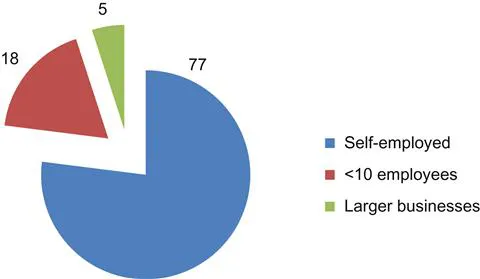
Table of contents
- Cover image
- Title page
- Table of Contents
- Copyright
- Dedication
- Preface
- Acknowledgments
- 1. Introduction
- 2. Alternatives in Venture Financing: Debt Capital
- 3. Alternatives in Venture Financing: Early-Stage Equity Capital
- 4. Determining the Amount Needed: The Business Plan
- 5. Valuation: Survey of Methods
- 6. Venture Capital
- 7. Exit Strategies
- 8. Anatomy of a Venture Funding
- 9. Franchising
- 10. Internal Financial Management
- 11. Essentials of Risk Management
- 12. Opportunities to Do Business and Raise Capital Globally
Trusted by 375,005 students
Access to over 1.5 million titles for a fair monthly price.
Study more efficiently using our study tools.
Frequently asked questions
Yes, you can cancel anytime from the Subscription tab in your account settings on the Perlego website. Your subscription will stay active until the end of your current billing period. Learn how to cancel your subscription
No, books cannot be downloaded as external files, such as PDFs, for use outside of Perlego. However, you can download books within the Perlego app for offline reading on mobile or tablet. Learn how to download books offline
Perlego offers two plans: Essential and Complete
- Essential is ideal for learners and professionals who enjoy exploring a wide range of subjects. Access the Essential Library with 800,000+ trusted titles and best-sellers across business, personal growth, and the humanities. Includes unlimited reading time and Standard Read Aloud voice.
- Complete: Perfect for advanced learners and researchers needing full, unrestricted access. Unlock 1.5M+ books across hundreds of subjects, including academic and specialized titles. The Complete Plan also includes advanced features like Premium Read Aloud and Research Assistant.
We are an online textbook subscription service, where you can get access to an entire online library for less than the price of a single book per month. With over 1.5 million books across 990+ topics, we’ve got you covered! Learn about our mission
Look out for the read-aloud symbol on your next book to see if you can listen to it. The read-aloud tool reads text aloud for you, highlighting the text as it is being read. You can pause it, speed it up and slow it down. Learn more about Read Aloud
Yes! You can use the Perlego app on both iOS and Android devices to read anytime, anywhere — even offline. Perfect for commutes or when you’re on the go.
Please note we cannot support devices running on iOS 13 and Android 7 or earlier. Learn more about using the app
Please note we cannot support devices running on iOS 13 and Android 7 or earlier. Learn more about using the app
Yes, you can access Raising Entrepreneurial Capital by John B. Vinturella,Suzanne M. Erickson in PDF and/or ePUB format, as well as other popular books in Business & Corporate Finance. We have over 1.5 million books available in our catalogue for you to explore.