eBook - ePub
Parkinson's Disease
Molecular and Therapeutic Insights From Model Systems
- 686 pages
- English
- ePUB (mobile friendly)
- Available on iOS & Android
eBook - ePub
Parkinson's Disease
Molecular and Therapeutic Insights From Model Systems
About this book
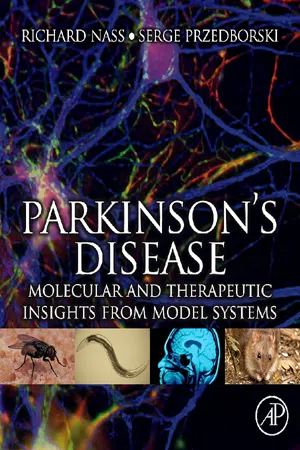
Parkinson's disease is the second most prevalent neurodegenerative disease and is characterized by the irreversible loss of dopamine neurons. Despite its high prevalence in society and many decades of research, the origin of the pathogenesis and the molecular determinants involved in the disorder has remained elusive. Confounding this issue is the lack of experimental models that completely recapitulate the disease state. The identification of a number of genes thought to play a role in the cell death, and development of both toxin and genetic models to explore the function of the genes both in unaffected and diseased cells are now providing new insights into the molecular basis of the neurodegeneration, as well as therapeutic approaches. In this reference, we will describe the advances and the advantages that various invertebrates, cell culture, rodents, and mammals provide in the identification of the molecular components and mechanisms involved in the cell death, and outline the opportunities that these systems provide in drug discovery.
- Comprehensive and critical assessment of the utility of various model systems to identify the molecular components and pathways involved in Parkinson's disease
- Describes the power of toxin and genetic models to identify novel therapeutic targets and compounds that can be used in PD
- Current overviews of current status of PD research and discovery from bench-to-bedside
- Provides novel insights and views on where the future of PD research may lead
- Provides a powerful teaching tool and template to explore the utility of model systems to identify molecular pathways, molecular targets, and therapeutics that are applicable to a variety of neurological diseases
Information
Part I. Clinical Overview
Chapter 1. Clinical Aspects of Parkinson Disease
Clinical Features of Parkinson Disease
Parkinsonism is defined as any combination of six specific, independent motoric features: tremor-at-rest, bradykinesia, rigidity, loss of postural reflexes, flexed posture, and the freezing phenomenon (where the feet are transiently “glued” to the ground) (Table 1.1). Not all six of these cardinal features need be present, but at least two should be before the diagnosis of parkinsonism is made, with at least one of them being tremor-at-rest or bradykinesia. Parkinson disease (PD) is the type of parkinsonism that is most commonly encountered by the general clinician; it is also the one on which much research has been expended and the one we know the most about. The great majority of cases of PD are sporadic, without any other family members being affected. One of the great advances in the last decade is that several gene mutations have been discovered to cause PD. But these monogenetic causes do not explain the great majority of sporadic cases. Environmental factors of an unknown nature and the combination of genetic and environmental risk factors are considered to play a role in the etiology of PD.
TABLE 1.1. Cardinal motor features of parkinsonism
| Tremor-at-rest |
| Bradykinesia/hypokinesia/akinesia |
| Rigidity |
| Flexed posture of neck, trunk, and limbs |
| Loss of postural reflexes |
| Freezing of gait |
The symptoms of PD begin insidiously and worsen gradually over time. They typically begin on one side of the body, rather than bilaterally, before eventually spreading to involve the other side. The most common initial symptom recognized by the patient is tremor of a hand or foot when that limb is at rest, called tremor-at-rest or resting tremor with a frequency of about 4 Hz.The hand is the more common site. The tremor can be intermittent at the beginning, being present only in stressful situations. Later, tremor tends to be more constant. Tremor is not present in everyone with PD. When absent, the initial symptom is a reduced arm swing or a decreased stride length and speed when walking.
Although PD can develop at any age, it is most common in older adults, with a peak age at onset around 60 years. The prevalence and incidence increases with age, with a lifetime risk of about 2%. A positive family history doubles the risk of developing PD to 4%. Twin studies indicate that PD with an onset under the age of 50 years is more likely to have a genetic relationship than for patients with an older age at onset.
Of the six cardinal motor symptoms, three occur early in the course of the illness, and three occur later. The early symptoms and signs are rest tremor, bradykinesia, and rigidity. Bradykinesia is slowness and reduced amplitude of movement. Features of limb bradykinesia are a smaller and slower of handwriting, difficulty shaving, brushing teeth, and putting on make-up. Walking becomes slow, with decreased arm swing and with a tendency to shuffle feet. Difficulty arising from a deep chair, getting out of automobiles, and turning in bed are symptoms of truncal bradykinesia. Rigidity of muscles is detected by the examiner when he/she moves the patient's limbs, neck or shoulders and experiences increased resistance. There is often a ratchet-like feel to the muscles, so-called cogwheel rigidity.
PD is a neurodegenerative disease, and these early motoric symptoms appear to be related to striatal dopamine deficiency due to loss of dopaminergic neurons in the substantia nigra pars compacts, which sends axons to the striatum. Whereas these early features of PD usually respond to medication that activate striatal dopamine receptors (such as levodopa and dopamine agonists), the three later motoric symptoms of flexed posture, loss of postural reflexes a...
Table of contents
- Brief Table of Contents
- Table of Contents
- List of Figures
- List of Tables
- List of Contributors
- Preface
- Foreword
- Part I. Clinical Overview
- Part II. Non-Human Primate Models
- Part III. Rodent Toxin Models
- Part IV. Rodent And Other Vertebrate Genetic Models
- Part V. Multicellular Invertebrate Models
- Part VI. Cell-Based Models
- Part VII. Cell-Free Models
Trusted by 375,005 students
Access to over 1.5 million titles for a fair monthly price.
Study more efficiently using our study tools.
Frequently asked questions
Yes, you can cancel anytime from the Subscription tab in your account settings on the Perlego website. Your subscription will stay active until the end of your current billing period. Learn how to cancel your subscription
No, books cannot be downloaded as external files, such as PDFs, for use outside of Perlego. However, you can download books within the Perlego app for offline reading on mobile or tablet. Learn how to download books offline
Perlego offers two plans: Essential and Complete
- Essential is ideal for learners and professionals who enjoy exploring a wide range of subjects. Access the Essential Library with 800,000+ trusted titles and best-sellers across business, personal growth, and the humanities. Includes unlimited reading time and Standard Read Aloud voice.
- Complete: Perfect for advanced learners and researchers needing full, unrestricted access. Unlock 1.5M+ books across hundreds of subjects, including academic and specialized titles. The Complete Plan also includes advanced features like Premium Read Aloud and Research Assistant.
We are an online textbook subscription service, where you can get access to an entire online library for less than the price of a single book per month. With over 1.5 million books across 990+ topics, we’ve got you covered! Learn about our mission
Look out for the read-aloud symbol on your next book to see if you can listen to it. The read-aloud tool reads text aloud for you, highlighting the text as it is being read. You can pause it, speed it up and slow it down. Learn more about Read Aloud
Yes! You can use the Perlego app on both iOS and Android devices to read anytime, anywhere — even offline. Perfect for commutes or when you’re on the go.
Please note we cannot support devices running on iOS 13 and Android 7 or earlier. Learn more about using the app
Please note we cannot support devices running on iOS 13 and Android 7 or earlier. Learn more about using the app
Yes, you can access Parkinson's Disease by Richard Nass,Serge Przedborski in PDF and/or ePUB format, as well as other popular books in Medicine & Neurology. We have over 1.5 million books available in our catalogue for you to explore.