- 384 pages
- English
- ePUB (mobile friendly)
- Available on iOS & Android
eBook - ePub
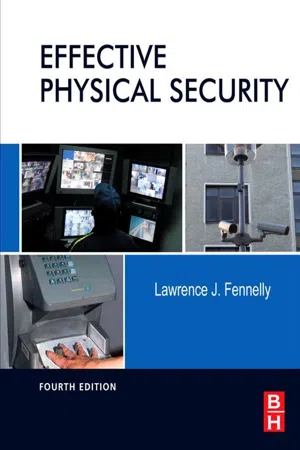
Effective Physical Security
About this book
Effective Physical Security, Fourth Edition is a best-practices compendium that details the essential elements to physical security protection. The book contains completely updated sections that have been carefully selected from the authors' work that set the standard: Handbook of Loss Prevention and Crime Prevention, Fifth Edition.
Designed for easy reference, Effective Physical Security contains important coverage of environmental design, security surveys, locks, lighting, and CCTV as well as new chapters covering the latest in the ISO standards for Risk Assessment and Risk Management, physical security planning, network systems infrastructure, and environmental design. This new edition continues to serve as a valuable reference for experienced security practitioners as well as students in undergraduate and graduate security programs.
- Required reading for the ASIS Physical Security Professional Certification (PSP) and recommended reading for the CPP certification
- Provides detailed coverage of Physical Security in an easily accessible reference format with content divided into three major parts: Design, Equipment, and Operations
- Each chapter is written by a recognized expert security specialist
Information
Chapter 1
Influence of Physical Design
Introduction
The relationship between physical design and informal social control of crime is a new idea only in the sense of its systematic application to the modern urban scene. Prior to the development of the modern city, most societies took some precautions to relate security in the physical environment to a responsibility for security actions by the inhabitants themselves.
In the rush of modern urban development, however, economic and political priorities seem to far outweigh security priorities, with the result that many urban settings now seem deliberately designed to discourage informal social control. No colonial community would have done so, even when stockades were no longer needed for defense. New England towns continued to be constructed so that homes and stores formed a hollow square around a central common area where social activities could take place and where livestock could be kept in relative security. In this kind of environment, everyone knew everyone else’s business. While this meant less personal privacy than the modern city-dweller may enjoy, it also meant a high degree of shared responsibility for controlling undesirable behavior and unwanted intrusion.
Only recently have students of modern urban society begun again to take serious note of the relationship between physical design and informal social control. Jane Jacobs first applied the concept to modern cities in 1961. In her book The Death and Life of Great American Cities [1], she theorized that multiple land uses along residential streets provided an interaction between the physical design and the users (pedestrians and residents), which promoted natural and informal surveillance and, therefore, increased the safety of the streets.
Lee Rainwater, in an evaluation of a public housing project in St. Louis in 1966, discussed the effect of physical design on the attitudes of public housing residents, pointing out that inappropriate architectural design was directly related to antisocial behavior [2].
Elizabeth Wood, writing in 1961, suggested that current design patterns in public housing projects appeared to discourage informal social relationships and gatherings, thereby preventing the development of social interactions through which residents could create informal social controls and self-policing[3].
Schlomo Angel, in 1968, found that variations in the level of pedestrian and vehicular traffic could either encourage or discourage crimes[4]. Too few users provided enough potential victims, but not enough potential witnesses.
Gerald Leudtke and E. Lystad found, as the result of studies in Detroit, that
many of the features of urban form and structure…could tend to facilitate or decrease the4 probability of crime. Such physical features include the condition and maintenance of buildings, streets, and alleys; evidence of recent construction; mixtures of land use; rates of pedestrian traffic and pedestrian accumulation within various land uses; location of structures on an urban grid pattern; and distance to adjacent structures. Other examples are types of parking facilities; visibility into structures from roads, sidewalks and adjoining buildings; concealment by trees, shrubs, parked automobiles, fences, signs, and advertising; the visibility of entrance points; building setbacks; and, the number and arrangement of entrance points in a building[5].
In 1969, Oscar Newman and George Rand[6] developed a theory of territoriality (now referred to as defensible space) that held that proper physical design of housing encourages residents to extend their social control from their homes and apartments out into the surrounding common areas. In this way, they change what previously had been perceived as semi-public or public territory into private territory. Upgrading the common areas in this way results in increased social control and an interaction between physical environment and its users that reduces crime.
As Newman himself defines it,
Defensible space is a surrogate term for the range of mechanisms—real and symbolic barriers, strongly defined areas of influence, improved opportunities for surveillance—that combine to bring an environment under the control of its residents. A defensible space is a living residential environment that can be employed by inhabitants for the enhancement of their lives, while providing security for their families, neighbors, and friends. The public areas of a multifamily residential environment devoid of defensible space can make the act of going from street to apartment equivalent to running the gauntlet. The fear and uncertainty generated by living in such an environment can slowly eat away and eventually destroy the security and sanctity of the apartment unit itself. On the other hand, by grouping dwelling units to reinforce association of mutual benefit, by delineating paths of movement, by defining areas of activity for particular users through their juxtaposition with internal living areas, and by providing for natural opportunities for visual surveillance, architects can create a clear understanding of the function of a space, who its users are and ought to be. This, in turn, can lead residents of all income levels to adopt extremely potent territorial attitudes and policing measures, which act as a strong deterrent to potential criminals[7].
A study by Reppetto[8] in Boston indicated the need to expand the crime prevention through environmental design process to include whole neighborhoods and provide for comprehensive data collection efforts, which would both define the nature of crime patterns and suggest appropriate countermeasures.
Reppetto was also able to show that closely knit communities do tend to protect their members through informal social controls. This finding was further emphasized by John Conklin in The Impact of Crime:
A tightly knit community can minimize the problem of street crime. However, informal social control also poses a threat to the diversity of behavior that exists in a pluralistic society, even though it may curb violent crime. Still, street crime would decline if interaction among the residents of a community were more frequent, and if social bonds were stronger. A sense of responsibility for other citizens and for the community as a whole would increase individuals’ willingness to report crime to the police and the likelihood of their intervention in a crime in progress. Greater willingness of community residents to report crime to the police might also obviate the need for civilian police patrols. More interaction in public places and human traffic on the sidewalks would increase surveillance of the places where people now fear to go. More intense social ties would reinforce surveillance with a willingness to take action against offenders[9].
C. Ray Jeffrey, in his classic theoretical work Crime Prevention Through Environmental Design (1971)[10], written before Jeffrey became aware of the works of Newman and others, proposed a three-fold strategy involving not only physical design, but also increased citizen participation and the more effective use of police forces. He contended that the way to prevent crime is to design the total environment in such a manner that the opportunity for crime is reduced or eliminated.
Jeffrey contends that both the physical and social characteristics of an urban area affect crime patterns. Better physical planning is a key to unlocking the potential for improved physical security and the potential for development of informal social control. He also argues for high levels of precision in the analytical stages that precede physical planning for crime reduction:
One of the major methodological defects in ecological studies of crime rates has been the use of large units and census tract data as a basis for analysis. The usual units are rural–urban, intricacy, intercity, regional, and national differences.…Such an approach is much too gross for finding the physical features associated with different types of crimes.
We must look at the physical environment in terms of each building, or each room of the building, or each floor of the building. Fine-grain resolution is required in place of the usual large-scale photographs.…Whenever crime rates are surveyed at a micro level of analysis, it is revealed that a small area of the city is responsible for a majority of the crimes. This fact is glossed over by gross statistical correlation analysis of census tract data, which ignore house-by-house or block-by-block variations in crime rates. For purposes of crime prevention we need data that will tell us what aspects of the urban environment are responsible for crime, such as the concentration of homicide or robbery in a very small section of the city[11].
Defensible Space
Oscar Newman and others have explored and further defined the defensible space concept in recent years through design studies and experiments involving existing and new public housing projects. The following summary of defensible space techniques will give the practitioner an initial understanding of this important application of physical design to the urban residential environment.
Design for defensible space involves attempts to strengthen two basic kinds of social behavior called territoriality and natural surveillance.
Territoriality
The classic example of territoriality is the “a man’s home is his castle” tradition of the American single-family home and its surroundings. In this tradition, the family lays claim to its own territory and acts to protect it. This image of the home as a castle reinforces itself “by the very act of its position on an integral piece of land buffered from neighbors and the public street by intervening grounds”[12].
As the urban setting has grown, the single-family home has become, to developers, an economic liability. Family housing has moved into the row house (townhouse), apartment complex, high-rise apartment structure, and massive public housing project. Whatever the benefits of this transition, the idea of territoriality has been largely lost in the process. The result is that “most families living in an apartment building experience the space outside their apartment unit as distinctly public; in effect, they relegate responsibility for all activity outside the immediate confines of their apartment to the public authorities”[13].
As residents are forced by the physical design of their surroundings to abandon claim to any part of the outside world, the hallways, stairways, lobbies, grounds, parking lots, and streets become a kind of no-man’s land in which criminals can operate almost at will. Public and private law enforcement agencies (formal controls) attempt to take up the slack, but without the essential informal social control that a well-developed social sense of territoriality brings, law enforcement can do little to reduce crime.
Natural Surveillance
The increased presence of human observers, which territoriality brings, can lead to higher levels of natural surveillance in all areas of residential space. However, the simple presence of increased numbers of potential observers is not enough, because natural surveillance, to be effective, must include an action component. The probab...
Table of contents
- Cover image
- Title page
- Table of Contents
- Copyright
- Dedication
- Acknowledgments
- Foreword
- Chapter 1. Influence of Physical Design
- Chapter 2. Introduction to Vulnerability Assessments*
- Chapter 3. Security Surveys and the Audit
- Chapter 4. Approaches to Physical Security*
- Chapter 5. Protective Barriers
- Chapter 6. Physical Barriers*
- Chapter 7. Use of Locks in Physical Crime Prevention*
- Chapter 8. Safes, Vaults, and Accessories
- Chapter 9. Security Lighting
- Chapter 10. Alarms: Intrusion Detection Systems*
- Chapter 11. Video Technology Overview*
- Chapter 12. Biometrics Characteristics
- Chapter 13. Access Control and Badges
- Chapter 14. Fence Standards
- Chapter 15. Stages of Fire
- Chapter 16. Standards, Regulations, and Guidelines: Compliance and Your Security Program, Including Global Resources
- Chapter 17. Information Technology Systems Infrastructure*
- Chapter 18. Security Officers and Equipment Monitoring
- Chapter 19. Glass and Windows
- Chapter 20. Doors
- Chapter 21. Physical Security*
- Chapter 22. Fiber Optics and Robots
- Index
Trusted by 375,005 students
Access to over 1.5 million titles for a fair monthly price.
Study more efficiently using our study tools.
Frequently asked questions
Yes, you can cancel anytime from the Subscription tab in your account settings on the Perlego website. Your subscription will stay active until the end of your current billing period. Learn how to cancel your subscription
No, books cannot be downloaded as external files, such as PDFs, for use outside of Perlego. However, you can download books within the Perlego app for offline reading on mobile or tablet. Learn how to download books offline
Perlego offers two plans: Essential and Complete
- Essential is ideal for learners and professionals who enjoy exploring a wide range of subjects. Access the Essential Library with 800,000+ trusted titles and best-sellers across business, personal growth, and the humanities. Includes unlimited reading time and Standard Read Aloud voice.
- Complete: Perfect for advanced learners and researchers needing full, unrestricted access. Unlock 1.5M+ books across hundreds of subjects, including academic and specialized titles. The Complete Plan also includes advanced features like Premium Read Aloud and Research Assistant.
We are an online textbook subscription service, where you can get access to an entire online library for less than the price of a single book per month. With over 1.5 million books across 990+ topics, we’ve got you covered! Learn about our mission
Look out for the read-aloud symbol on your next book to see if you can listen to it. The read-aloud tool reads text aloud for you, highlighting the text as it is being read. You can pause it, speed it up and slow it down. Learn more about Read Aloud
Yes! You can use the Perlego app on both iOS and Android devices to read anytime, anywhere — even offline. Perfect for commutes or when you’re on the go.
Please note we cannot support devices running on iOS 13 and Android 7 or earlier. Learn more about using the app
Please note we cannot support devices running on iOS 13 and Android 7 or earlier. Learn more about using the app
Yes, you can access Effective Physical Security by Lawrence J. Fennelly in PDF and/or ePUB format, as well as other popular books in Social Sciences & Criminology. We have over 1.5 million books available in our catalogue for you to explore.