eBook - ePub
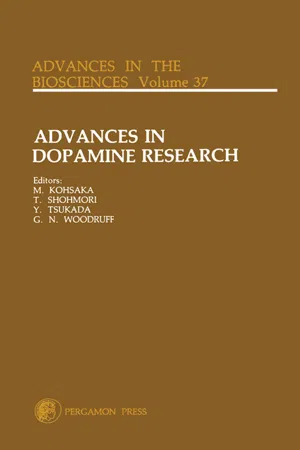
Advances in Dopamine Research
Proceeding of a Satellite Symposium to the 8th International Congress of Pharmacology, Okayama, Japan, July 1981
- 438 pages
- English
- ePUB (mobile friendly)
- Available on iOS & Android
eBook - ePub
Advances in Dopamine Research
Proceeding of a Satellite Symposium to the 8th International Congress of Pharmacology, Okayama, Japan, July 1981
About this book
Advances in Dopamine Research documents the proceedings of a satellite symposium to the 8th International Congress of Pharmacology held in Okayama, Japan, July 1981. The importance of dopamine in brain function is reflected in this volume book by the chapters on the neurochemical, behavioral, neuroanatomical, and electrophysiological aspects of dopamine in the central nervous system. Dopamine receptor agonists and antagonists enjoy widespread use in the treatment of various brain disorders. A comprehensive account of research on the actions and mechanisms of action of drugs which affect central dopaminergic pathways is included in this volume. Also presented are accounts of the importance of dopamine and dopamine receptors in the periphery. It is hoped that this volume will be of interest to neuroscientists and pharmacologists, and indeed to all who are interested in clinical and scientific aspects of dopamine and other neurotransmitters.
Information
Topic
MedicineSubtopic
Diseases & AllergiesPlenary Lecture on Dopamine Receptors
G.N. Woodruff, Department of Physiology and Pharmacology, University of Southampton, Southhampton, UK
ABSTRACT
An account is given of some early functional tests that were used in the evaluation of dopamine receptor agonists and antagonists. Using pharmacological, biochemical and electrophysiological studies, ADTN and certain ergot alkaloids have been shown to be potent dopamine receptor agonists. ADTN is considerably more active than iso-ADTN in all tests so far studied. This suggests that the receptor-preferring conformation of dopamine is the extended form, β rotamer. Ergot alkaloids differ from catechol type agonists in their effects on the dopamine sensitive adenylate cyclase in homogenates of rat striatum or nucleus accumbens. The benzamide derivative sulpiride which has neuroleptic properties in a number of tests, differs from classical neuroleptics in that it does not block effects of dopamine on the dopamine sensitive adenylate cyclase. This had led to the concept of D1 and D2 receptors. Our results, however, are not in accordance with the current concept of D1 and D2 receptors. Receptor binding studies have shown that sulpiride is a very useful ligand for dopamine receptor binding studies. It is more selective than spiroperidol but similar to the latter ligand in terms of regional distribution of binding and susceptibility to displacement by agonists and antagonists. It differs from conventional neuroleptics, however, in that there is a unique requirement for sodium ions in sulpiride binding. Our results using N-ethylmaleimide suggest that a sulphydryl group is associated with the sulpiride binding component of the dopamine receptor.
KEYWORDS
Dopamine receptors
ADTN
sulpiride
receptor binding
adenylate cyclase
conformation of dopamine
INTRODUCTION
Dopamine was first synthesised by Barger and Ewins (1910) and by Mannich and Jacobsohn (1910). Some of its actions were described in the same year in a paper by Barger and Dale (1910) in which they described its weak peripheral sympathomimetic activity. In addition to its activity on α and β adrenoceptors, dopamine causes changes in the cardiovascular system that are quite distinct from those produced by adrenaline or noradrenaline. In 1942, Holtz and Credner showed that in the guinea-pig and rabbit dopamine causes a fall in the arterial blood pressure, although the significance of this finding was not realised for many years to come. Indeed, it was not possible to further characterize the cardiovascular action of dopamine until the much later discovery of specific β blockers which could eliminate the possibility of dopamine mediating its effects via β receptors. Fifteen years later a proposal that ‘dopamine has some regulating functions of its own which are not yet known’ in a paper by Blaschko (1957) coincided with the beginnings of a vast amount of research on the physiological and pharmacological implications of dopamine, first in the CNS, and later in the periphery. The presence of dopamine in the brain was first demonstrated biochemically by Carlsson and others (1958), Montagu (1957) and Weil-Malherbe and Bone (1957). Using histochemical techniques, Carlsson, Falck and Hillarp (1962) showed that brain dopamine was localized intra-neuronally. Since this time numerous histochemical studies have been carried out in combination with mechanical or chemical lesioning. These studies have revealed a detailed knowledge of the organization and projection of central dopaminergic neuronal systems (review by Lindvall and Bjorklund, 1978).
The finding by Ehringer and Hornykiewicz (1960) that the dopamine content of the corpus striatum is drastically depleted in patients with Parkinson’s Disease led eventually to the successful use of Dopa in the treatment of this disorder (Cotzias, Van Woert and Schiffer, 1967). A considerable amount of research has subsequently been directed towards the discovery of potent and selective dopamine receptor agonists which can be used as anti-Parkinson drugs. The first dopamine receptor agonist, apart from dopamine itself, was apomorphine. Ernst, in 1965, proposed that the behavioural actions of apomorphine were due to the ability of the drug to stimulate central dopamine receptors. Although this proposal was based on the scantiest of evidence, apomorphine was soon firmly established as a potent and selective dopamine receptor agonist. Fortunately, subsequent work has confirmed the agonist activity of apomorphine at dopamine receptors. Neuroleptic drugs have been used in the treatment of schizophrenic states since the early 1950s. It is now generally accepted that these compounds act by blocking CNS dopamine receptors, although, again, the earlier suggestions for the mode of actions of these drugs were mainly hypothetical (Van Rossum, 1965; 1966).
METHODS OF INVESTIGATING DOPAMINE RECEPTORS
One of the difficulties encountered in dopamine receptor research has been the lack of convenient model test systems on which to evaluate the activities of dopamine receptor agonists and antagonists. The ultimate consequence of dopamine receptor activation should be the eliciting of a biological response. In the CNS, this would be expected to be either a change in neuronal firing or a change in transmitter release or perhaps some long-term metabolic change. Unfortunately, the tests available for measuring CNS dopamine receptor activity are often indirect and not based on a sound pharmacological characterization of the responses being measured. This is particularly important in attempts to classify or characterize multiple dopamine receptors.
Multiple receptors for neurotransmitters seems to be the rule rather than the exception. By analagy with the muscarinic and nicotinic acetylcholine receptors, the α1 and α2 and β1 and β2 adrenoceptors and the H1 and H2 histamine receptors, one would expect there to be multiple dopamine receptors, which we could call D1 and D2. These have been looked for and apparently found (Kebabian and Calne, 1979). Furthermore, D3 and D4 dopamine receptors have also been claimed (Sokoloff, Martres and Schwartz, 1980; Seeman, 1980). Dopamine receptor classification has however been carried out without a proper knowledge of selective agonists and antagonists. Let us take as an example of a successful area of receptor classification, the field of histamine H1 and H2 receptors. Histamine is known to have a number of pharmacological actions in the periphery. The traditional antihistamines, such as mepyramine and diphenhydramine, were shown to competitively inhibit the effects of histamine in causing contractions of smooth muscle. The inhibitory effect of histamine on the rat uterus and the stimulatory effect of histamine on gastric secretion were, however, unaffected by mepyramine or diphenhydramine. Ash and Schild (1966) defined the pharmacological receptors involved in the mepyramine-sensitive histamine responses as H1 receptors. They also suggest a common receptor-mediating mepyramine-insensitive histamine responses in gastric secretion and rat uterus inhibition. However, they were unable to comment further on this presumed second type of histamine receptor because there were no available antagonists. In 1972 it was shown that burimimide competitively inhibits the stimulatory effects of histamine on gastric acid secretion whilst also blocking the inhibitory effect of histamine on the rat uterus (Black and others, 1972). This allowed the definition and characterization of this second receptor which became known as the H2 receptor. Many important developments have since taken place in this field and there are now available a considerable number of selective agonists and antagonists for both H1 and H2 receptors. Using these selective compounds, and utilising receptor binding techniques and adenylate cyclase assays, the histamine receptors in the brain have been successfully characterized as H1 and H2 (Schwartz, Garbarg and Quach, 1981). Attempts to classify multiple dopamine receptors on the other hand, have been seriously hindered by the lack of specific agonists and antagonists, by the lack of knowledge on order of potencies of agonists and antagonists and, as previously mentioned, by the lack of suitable test systems. Some of the test systems which have been used are outlined below.
Invertebrate Neurones
Nearly fifteen years ago we investigated the possibility of using the isolated brain of the snail, Helix aspersa, as a model system on which to study dopamine receptor agonists and antagonists. Individual neurones can be recorded with intracellular microelectrodes and dopamine induced hyperpolarizations (or depolarizati...
Table of contents
- Cover image
- Title page
- Table of Contents
- ADVANCES IN THE BIOSCIENCES
- Copyright
- Preface
- Chapter 1: Plenary Lecture on Dopamine Receptors
- Chapter 2: The Pharmacological Distinction between Central Pre- and Post-synaptic Dopamine Receptors: Implications for the Pathology and Therapy of Schizophrenia
- Chapter 3: Peripheral Post-synaptic Dopamine (DA1) Receptors
- Chapter 4: Two Dopamine Receptors in the Rabbit Sympathetic Ganglia
- Chapter 5: Multiple Receptors for Dopamine (D2, D3, D4)
- Chapter 6: Brain Dopamine Receptor: Multiple Binding Sites or Physiological Receptor Site
- Chapter 7: Diurnal Changes and Aging Effects on Central Monoamine Metabolisms
- Chapter 8: Effects of Isolation Induced Behavioral Abnormalities and Haloperidol on Homovanillic Acid Levels in Individual Dopaminergic Neuron Systems of Rat Brain
- Chapter 9: Studies on Tyrosine Hydroxylase in Dopaminergic Nerve Terminals including Mesolimbic and Mesocortical Areas
- Chapter 10: Effects of Antipsychotic Drugs on Regional Cyclic AMP Levels in the Rat Brain
- Chapter 11: Stimulatory Effect of Dopamine on Na,K-ATPase in the Central Nervous System
- Chapter 12: Functional Heterogeneity of Multiple Dopamine Receptors during Six Months’ Treatment with Distinct Classes of Neuroleptic Drugs
- Chapter 13: Preferential Labelling of Adenylate Cyclase Coupled Dopamine Receptors with Thioxanthene Neuroleptics
- Chapter 14: Synthesis of Phenothiazine Derivatives with Photoaffinity Label and Interaction with Dopamine Binding Sites
- Chapter 15: Characteristics of Vascular Dopamine Receptors in Isolated Rabbit Arteries
- Chapter 16: Dopamine and Dopamine Receptors in the Gut: Their Possible Role in Duodenal Ulceration
- Chapter 17: The Possible Role of Central Adrenaline Containing Neurons in the Action of Dopaminergic Drugs
- Chapter 18: Stereochemistry of Dopamine Receptor Agonists
- Chapter 19: Indole-derived Fragments of Ergot Alkaloids as Dopamine Congeners
- Chapter 20: The Involvement of the Superior Colliculus and Midbrain Reticular Formation in the Expression of Circling Behaviour
- Chapter 21: Dopamine Synaptic Mechanisms Reflected in Studies Combining Behavioural Recordings and Brain Dialysis
- Chapter 22: The Role of Dopamine in the Kidney
- Chapter 23: Dopamine Release from Left and Right Caudate of the Rat Measured by in vivo Electrochemical Electrodes
- Chapter 24: Dopamine in the Rat Locus Coeruleus: Why?
- Chapter 25: Acute and Chronic Effects of Haloperidol on Dopamine Fluorescence in the Median Eminence and on Plasma Prolactin Prolactin Levels in Rát
- Chapter 26: Localization of Dopamine in the Rat Prolactin Cell — a Fluorescence and Immunoelectron Microscopical Study
- Chapter 27: Identification of the Recognition Binding Subunit of the Dopamine Receptor in Human Brain
- Chapter 28: Modulation of the Stimulation-Evoked Release of 3H-Dopamine Through Activation of Dopamine Autoreceptors of the D-2 Subtype in the Isolated Rabbit Retina
- Chapter 29: Dopaminergic Cells and their Possible Role in the Fish Retina
- Chapter 30: The Regulation of Tyrosine Hydroxylase Activity by Phosphorylation
- Chapter 31: (−)2,10,11-Trihydroxy-N-n-Propylnoraporphine (TNPA) — a Novel Dopaminergic Aporphine Alkaloid with Anticonvulsant Activity
- Chapter 32: Neuroanatomy of Central Dopamine Pathways: Review of Recent Progress
- Chapter 33: Neuroendocrinology of Dopamine and Noradrenaline Systems in Early Development
- Chapter 34: The Dopamine Receptor in the Intermediate Lobe of the Rat Pituitary Gland
- Chapter 35: Dopamine and Neuron Activity in the Meso-telencephalic System — An Electrophysiological Study
- Chapter 36: Inhibition of R-(−)-Apomorphine-induced Stereotypic Cage-climbing Behavior in Mice by S-(+)-Apomorphine
- Chapter 37: Influence of Some Dopaminoceptor Agonists on Pentobarbitone Sleep in Young Chicks
- Chapter 38: Two Dopamine Binding Sites in the Canine Caudate Nucleus and their Biochemical and Pharmacological Role
- Chapter 39: Evidence for the Existence of a Dopaminergic Innervation of the Rat and Human Hippocampal Formation
- Chapter 40: Autoregulation of Dopamine Synthesis in Striatal Nerve Endings
- Chapter 41: On the Role of Mesencephalic Reticular Formation and Superior Colliculus in the Expression of Dopaminergic Behavioural Syndromes
- Chapter 42: Reduction in Spontaneous Locomotor Activity by Purported Dopamine Agonists: an Analysis of the Site and Mechanism of Action
- SUBJECT INDEX
Trusted by 375,005 students
Access to over 1.5 million titles for a fair monthly price.
Study more efficiently using our study tools.
Frequently asked questions
Yes, you can cancel anytime from the Subscription tab in your account settings on the Perlego website. Your subscription will stay active until the end of your current billing period. Learn how to cancel your subscription
No, books cannot be downloaded as external files, such as PDFs, for use outside of Perlego. However, you can download books within the Perlego app for offline reading on mobile or tablet. Learn how to download books offline
Perlego offers two plans: Essential and Complete
- Essential is ideal for learners and professionals who enjoy exploring a wide range of subjects. Access the Essential Library with 800,000+ trusted titles and best-sellers across business, personal growth, and the humanities. Includes unlimited reading time and Standard Read Aloud voice.
- Complete: Perfect for advanced learners and researchers needing full, unrestricted access. Unlock 1.5M+ books across hundreds of subjects, including academic and specialized titles. The Complete Plan also includes advanced features like Premium Read Aloud and Research Assistant.
We are an online textbook subscription service, where you can get access to an entire online library for less than the price of a single book per month. With over 1.5 million books across 990+ topics, we’ve got you covered! Learn about our mission
Look out for the read-aloud symbol on your next book to see if you can listen to it. The read-aloud tool reads text aloud for you, highlighting the text as it is being read. You can pause it, speed it up and slow it down. Learn more about Read Aloud
Yes! You can use the Perlego app on both iOS and Android devices to read anytime, anywhere — even offline. Perfect for commutes or when you’re on the go.
Please note we cannot support devices running on iOS 13 and Android 7 or earlier. Learn more about using the app
Please note we cannot support devices running on iOS 13 and Android 7 or earlier. Learn more about using the app
Yes, you can access Advances in Dopamine Research by M. Kohsaka,T. Shohmori,Y. Tsukada in PDF and/or ePUB format, as well as other popular books in Medicine & Diseases & Allergies. We have over 1.5 million books available in our catalogue for you to explore.