eBook - ePub
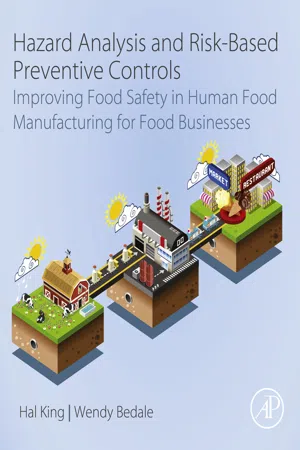
Hazard Analysis and Risk-Based Preventive Controls
Improving Food Safety in Human Food Manufacturing for Food Businesses
- 248 pages
- English
- ePUB (mobile friendly)
- Available on iOS & Android
eBook - ePub
Hazard Analysis and Risk-Based Preventive Controls
Improving Food Safety in Human Food Manufacturing for Food Businesses
About this book
Hazard Analysis and Risk-Based Preventive Controls: Improving Food Safety in Human Food Manufacturing for Food Businesses is a comprehensive, first of its kind resource for the retail food industry on the Hazard Analysis and Risk-based Preventive Controls (PCHF) regulations of the Food Safety Modernization Act (FSMA). This book covers all aspects of PCHF, including the legislation's intent, applications to ensure safe food production, and resources to keep up-to-date on new food safety hazards and regulatory guidance. Written for food safety professionals and food business leaders, its emphasis on what the retail food industry needs to know about PCHF make it an indispensable resource for organizations buying food from companies required to demonstrate compliance with PCHF.
PCHF implementation is (or soon will be) required for human food companies along the supply chain in the United States, as well as all food companies that import ingredients and products for human consumption into the U.S.
- Explains what retail food industry professionals need to know about PCHF and how they can leverage PCHF when working with suppliers
- Provides the most current "how to" information on implementing PCHF to prepare for new FDA regulations in the food industry
- Identifies the right resources to perform hazard analysis and develop effective preventive controls
- Demonstrates step-by-step examples for continuous improvement in sustaining PCHF responsibilities and keeping abreast of new food safety information
Information
Chapter 1
Introduction
Abstract
This chapter builds the case for the use of hazard analysis and risk-based preventive controls to significantly reduce the risk of foodborne diseases, allergic reactions, and injuries caused by manufactured human foods. By placing a focus on food safety management of human food products that are sold at retail food businesses, the retail food business can participate in the hazard analysis and risk-based preventive controls of its own products and obtain even greater value from these important new food safety tools' use in their supply chain. FDA's ongoing efforts in the science of food safety (e.g., identifying “high-risk foods”) and regulating food safety in human food manufacturing are critical to the success of the new rules of the Food Safety Modernization Act. However, continued due diligence of both the food manufacturing and food retail businesses in identifying and preventing known food safety hazards within food manufacturing facilities is key. Hazard analysis and risk-based preventive controls represent invaluable tools to the retail food businesses to ensure food safety in their supply chain.
Keywords
CDC; FDA; Food safety hazards; Foodborne disease outbreaks; Foodborne injury; High-risk foods; Illness and disease; Recalls; Reportable food registry; Risk prevention
Knowing is not enough; we must apply.
Willing is not enough; we must do.
Johann Wolfgang von Goethe
1.1. Making the Case
A candy manufacturer was solicited by a quick service restaurant (QSR) chain to manufacture a new milk chocolate candy for the restaurants to blend into a frozen dairy dessert. The candy manufacturer could offer the restaurant chain a lower price for the candy if it could be manufactured in its current facility, which also produced milk chocolate–covered peanuts and used peanut flour in other products. The restaurant chain desired the lower cost candy supply to boost its margin on the frozen dessert but also wanted to ensure that the frozen dessert would be free from peanut allergen.
To further reduce costs, the restaurant chain planned to sell the frozen dairy desert in single-use beverage cups that the chain currently used for other types of beverages. Since these cups were used for many different products, they were not labeled with any ingredient or product information, and the company did not want to include avoidance messaging, such as “may contain peanuts,” on the cups.
The restaurant chain’s quality department was responsible for ensuring the safety of the products manufactured by other companies for the chain. The quality department prescribed food safety specifications to the candy manufacturer that required undeclared allergen management controls and cleaning and sanitation cross-contact preventive control standard operating procedures (SOPs).
The candy manufacturer had a clean room with segregated production areas, detailed cleaning and sanitation schedules, and excellent production equipment maintenance, all of which should prevent allergen cross-contact between products. Verification that equipment was free of peanut allergen was performed following cleaning and sanitation by conducting on-site rapid peanut protein testing before the candy was run on a predetermined production line. The food safety specifications also required additional peanut protein testing on every lot of finished product. A hold and release protocol was in place so that product lots could not be released for distribution until a negative test result for peanut protein for that lot was obtained.
However, after numerous product test runs, product testing continued to show detectable peanut protein. The QSR chain food safety leader decided to do a walk-through of the candy manufacturing facility to try to identify the problem. All food safety specifications seemed to be in place. When asked for the source of the airflow that came into the candy production clean room, the QA manager reminded the food safety leader that the clean room used filtered air, the standard for such a production area. Because the facility was several years old, the food safety leader asked if changes had been made to the facility or the clean room since its original construction. The food safety leader and the QA manager followed the flow of air via the air ducts from the clean room back to its source. To their surprise, they found the air originated in the allergen storage room. During their investigation, they also found that key air filters were missing. Even more importantly, they actually observed an employee scooping peanu...
Table of contents
- Cover image
- Title page
- Table of Contents
- Copyright
- Foreword
- Preface
- Chapter 1. Introduction
- Chapter 2. The Era of the Food Safety Modernization Act and Hazard Analysis and Risk-Based Preventive Controls
- Chapter 3. What Potential Food Ingredient Hazards Occur in Human Food Manufacturing?
- Chapter 4. What and Where Are Potential Process and Facility-Related Hazards Introduced Into Foods During Human Food Manufacturing?
- Chapter 5. Hazard Analysis in a Human Food Manufacturing Facility
- Chapter 6. Preventive Controls
- Chapter 7. Validation of Preventive Controls
- Chapter 8. Implementation and Management of Preventive Controls: Monitoring, Verification, Corrective Actions, and Associated Records
- Chapter 9. Environmental Monitoring to Prevent Facility-Related Hazards
- Chapter 10. Regulatory Knowledge and Interactions for Retail Buyers in the FSMA Era
- Appendix A: Example of an FDA Warning Letter
- Appendix B: Unexpected Allergens in Food Ingredients
- Appendix C: Case Study
- Appendix D: Supplier Approval Checklist for Retail Businesses
- Glossary
- Index
Trusted by 375,005 students
Access to over 1.5 million titles for a fair monthly price.
Study more efficiently using our study tools.
Frequently asked questions
Yes, you can cancel anytime from the Subscription tab in your account settings on the Perlego website. Your subscription will stay active until the end of your current billing period. Learn how to cancel your subscription
No, books cannot be downloaded as external files, such as PDFs, for use outside of Perlego. However, you can download books within the Perlego app for offline reading on mobile or tablet. Learn how to download books offline
Perlego offers two plans: Essential and Complete
- Essential is ideal for learners and professionals who enjoy exploring a wide range of subjects. Access the Essential Library with 800,000+ trusted titles and best-sellers across business, personal growth, and the humanities. Includes unlimited reading time and Standard Read Aloud voice.
- Complete: Perfect for advanced learners and researchers needing full, unrestricted access. Unlock 1.5M+ books across hundreds of subjects, including academic and specialized titles. The Complete Plan also includes advanced features like Premium Read Aloud and Research Assistant.
We are an online textbook subscription service, where you can get access to an entire online library for less than the price of a single book per month. With over 1.5 million books across 990+ topics, we’ve got you covered! Learn about our mission
Look out for the read-aloud symbol on your next book to see if you can listen to it. The read-aloud tool reads text aloud for you, highlighting the text as it is being read. You can pause it, speed it up and slow it down. Learn more about Read Aloud
Yes! You can use the Perlego app on both iOS and Android devices to read anytime, anywhere — even offline. Perfect for commutes or when you’re on the go.
Please note we cannot support devices running on iOS 13 and Android 7 or earlier. Learn more about using the app
Please note we cannot support devices running on iOS 13 and Android 7 or earlier. Learn more about using the app
Yes, you can access Hazard Analysis and Risk-Based Preventive Controls by Hal King,Wendy Bedale in PDF and/or ePUB format, as well as other popular books in Biological Sciences & Medical Microbiology & Parasitology. We have over 1.5 million books available in our catalogue for you to explore.