eBook - ePub
Recent Progress in Hormone Research
Proceedings of the 1979 Laurentian Hormone Conference
- 648 pages
- English
- ePUB (mobile friendly)
- Available on iOS & Android
eBook - ePub
Recent Progress in Hormone Research
Proceedings of the 1979 Laurentian Hormone Conference
About this book
Recent Progress in Hormone Research, Volume 36 presents the proceedings of the 1979 Laurentian Hormone Conference. The book discusses seasonal breeding as nature's contraceptive; the neuroendocrine control of the menstrual cycle; and the heterogeneity of estrogen binding sites. The text also describes steroid hormone receptors in breast cancer treatment strategy; the multihormonal regulation of casein gene expression at the transcriptional and posttranscriptional levels in the mammary gland; and the hormonal domains of response. The organization and evolution of cloned globin genes; the synthesis, cloning, and expression of hormone genes in Escherichia coli; and ACTH, beta-lipotropin, and related peptides in the brain, pituitary, and blood are also considered. The book further tackles cortoic acids; hormones controlling insect metamorphosis; and the early events in the biosynthesis of secretory and membrane proteins. The text also looks into autoimmunity in endocrine disease and the regulation of peptide hormone receptors and gonadal steroidogenesis. Endocrinologists, reproductive biologists, physiologists, and biochemists will find the book invaluable.
Information
Seasonal Breeding: Nature’s Contraceptive1
G.A. LINCOLN and R.V. SHORT, Medical Research Council Reproductive Biology Unit, Centre for Reproductive Biology, Edinburgh, Scotland
Publisher Summary
This chapter focuses on the seasonal control of fertility. It discusses two aspects in detail—the way in which changes in the secretion of luteinizing hormone-releasing hormone by the hypothalamus controls the activity of the pituitary and testis, and the way changes in day length influence the activity of the hypothalamus. The downstream events evoked by the hypothalamus are relatively easy to understand, whereas the mechanisms involved in the photoperiodic control are very complex and largely unresolved. While seasonal changes in temperature, rainfall, and food availability are the factors of the environment that dictate survival of adults and young—and are thus ultimately responsible for dictating the timing of the birth season—these are not necessarily the factors used as cues by the animals to regulate their reproductive endocrinology. This is because it is necessary to anticipate the timing of birth by dictating the timing of conception, as the duration of gestation in mammals is usually fixed. As accurate timing of conception is important, animals tend to become reliant on cues from the environment, which are the best predictors of the time of year. The seasonal cycle highlights the seasonal changes in daylight length, rutting behavior, testicular diameter, sexual skin flush, and concentrations of plasma follicle-stimulating hormone, prolactin, and testosterone in a group of rams throughout the year.
I Introduction
That you should ask two foreigners to deliver the Gregory Pincus Memorial Lecture in an intellectual setting that was very much Pincus’ own creation is honor indeed, although it is also an intimidating assignment. We would like to think that a tenuous thread of circumstance links Pincus with the topic of this lecture, for it was in 1930 and again in 1937 that he spent sabbatical years in the School of Agriculture at Cambridge, working with the late F. H. A. Marshall. Unfortunately there is little record of what took place between them, although we know that Pincus was working on the induction of parthenogenesis in rabbit eggs, and the two men must often have discussed their respective research interests.
Marshall was Reader in Agricultural Physiology and was beginning to develop an interest in seasonal breeding. His first paper on this subject, entitled “Light as a factor in sexual periodicity,” was published in 1932, although his major accounts, “Sexual periodicity and the causes which determine it,” “Extroceptive factors in sexual periodicity,” and “On the incidence of the breeding season in mammals after transference to a new latitude,” written in conjunction with the Duke of Bedford, were not published until 1936 to 1942 (Marshall, 1932, 1936, 1942; Marshall and Bedford, 1942).
On the face of it, it might seem that this transient meeting between Pincus and Marshall was their sole point of contact. It is common knowledge how Pincus’ own research changed direction when he realized the significance of the simple observation of Makepeace et al. (1937) that progesterone injections would inhibit ovulation in the rabbit, and how Pincus and Chang confirmed and extended this work in 1953, using an oral progestin, and published their results in an obscure South American journal so as not to excite too much attention. Today, few people can fail to have heard of “the Pill,” and some 80 million women can attest to its contraceptive efficacy.
In contrast to this spectacular practical application of basic research, studies of seasonal breeding have so far produced few rewards. Since the phenomenon is confined to only some of the common laboratory animals, including the hamster, ferret, and rhesus monkey, and is pronounced in only a few domestic animals, such as the sheep, goat, and horse, it has generally been regarded as of rather peripheral interest to mainstream endocrinology. And any suggestion that the mechanisms underlying seasonal breeding might be of relevance for the regulation of human reproduction has been treated with scepticism, since the human species can reproduce at all times of year, regardless of latitude.
In a previous presentation we attempted to dispel this prejudice indicating that, far from being a rare exception, seasonal breeding is the general rule for the majority of mammals (Lincoln, 1980). Natural selection has the effect of maximizing the efficiency of reproduction, and for many species this means curtailing breeding for some part of the year. For this, natural methods of fertility control have evolved—Nature’s Contraceptive. We believe that a better understanding of how seasonal reproductive quiescence is brought about can lead to insights into the neurohormonal regulation of reproduction, may suggest new ways of boosting the fertility of our farm livestock, and in the course of time could even lead to new developments in human contraception. These were some of the reasons why we decided to take up this area of research when the Medical Research Council established our new Reproductive Biology Unit in Edinburgh in 1972. Edinburgh was a happy choice for two reasons. Not only was it in Edinburgh that Marshall began his own research career in the year 1900, but, more important, Edinburgh lies at a northerly latitude (56°N), comparable to the middle of Hudson Bay, in which seasonal breeding is essential for the survival of all the indigenous mammals. Every cold winter is a reminder to us of the selective forces that have operated to produce animals with their own methods of fertility control.
While seasonal changes in temperature, rainfall, and food availability are the factors of the environment that dictate survival of adults and young, and are thus ultimately responsible for dictating the timing of the birth season, these are not necessarily the factors used as cues by the animals to regulate their reproductive endocrinology. This is because it is necessary to anticipate the timing of birth by dictating the timing of conception, the duration of gestation in mammals usually being fixed. Since accurate timing of conception is important, animals have tended to become reliant on cues from the environment, which are the best predictors of the time of year. The cyclic events in our solar system provide such precise cues, and it is of interest that the majority of species that have evolved in temperate and cold climates show changes in reproductive activity in response to seasonal changes in daylight length. It is the tilted axis of the earth that confers the annual rhythms in daylight length, which are so pronounced well away from the equator. These changes therefore, provide the proximate cues from the environment that allow for the timing of the mating season. It is the tilted axis of the earth that also provides the ultimate cause of breeding seasons, since this dictates the seasonal changes in temperature and thus availability of food (Baker, 1938).
II Choice of Experimental Animal
Our initial interest in seasonal breeding was aroused by studies of wild red deer (Cervus elaphus) living on the Isle of Rhum, off the northwest coast of Scotland (Fig. 1). We established the nature and extent of the seasonal changes in testicular activity of the stag, which shows complete testicular regression and spermatogenic arrest in the spring and summer, with a return to maximal androgen secretion and spermatogenesis in time for the autumn rut in September–October (Lincoln et al., 1970; Lincoln, 1971a,b). Similar studies on the hind showed that estrus and ovulation commence in early October, some time after the stags have started to rut, and that the peak of conception occurs in mid-October, to give a peak of calvings in early June (Guinness et al., 1971; Lincoln and Guinness, 1973; Mitchell and Lincoln, 1973). However, if the hinds are prevented from mating, they continue to undergo regular 18-day estrous cycles from October to February or March. They are also capable of conceiving on any of these occasions, although late conception with calving in the autumn is associated with a high incidence of lactational failure, and in the wild such late calves would never survive the winter. Thus the red deer stag and hind are seasonal to the extent that their fertility is restricted to 6 months of the year, but the behavioral phenomenon of the rut means that in practice almost all the matings are confined to a few hectic weeks in the autumn, to give a synchronized calving in early summer when the grass is beginning to grow and calf survival is optimal.
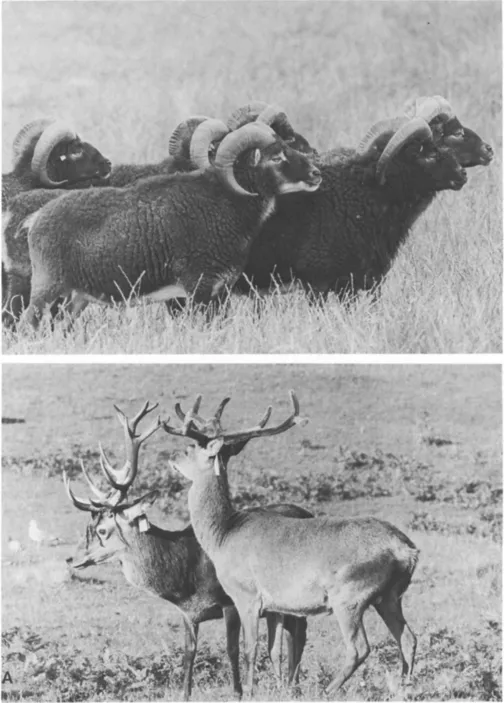
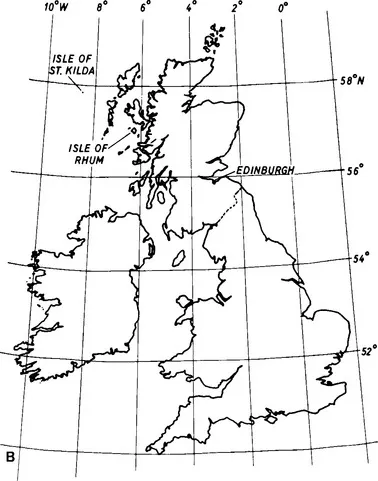
FIG. 1 (A) Above: A group of adult Soay rams. Below: Two adult red deer stags. Both the Soay sheep and red deer show marked seasonal changes in their reproductive physiology, with a rutting season in the autumn and a sexually quiescent period in spring and summer. (B) Map showing the location of the island of St. Kilda, home of the Soay sheep, and the island of Rhum, home of the red deer involved in this study.
Marshall and the Duke of Bedford (1942) had already indicated that these seasonal changes in red deer were controlled by photoperiod, since, when deer were first exported from Scotland to New Zealand, and subsequently reimported from New Zealand to England, the stags rapidly readjusted their cycles so that they were in synchrony with the indigenous stock. However, the hinds appeared to require a year or more for complete readjustment. Jaczewski (1954) subsequently demonstrated the effect of photoperiod on red deer stags in an experimental situation, and Goss has carried out a most thorough and painstaking investigation of the effect...
Table of contents
- Cover image
- Title page
- Table of Contents
- Copyright
- LIST OF CONTRIBUTORS AND DISCUSSANTS
- PREFACE
- Inside Front Cover
- Lewis Libman Engel 1909–1978
- Chapter 1: Seasonal Breeding: Nature’s Contraceptive
- Chapter 2: The Neuroendocrine Control of the Menstrual Cycle
- Chapter 3: Heterogeneity of Estrogen Binding Sites: Relationship to Estrogen Receptors and Estrogen Responses
- Chapter 4: Steroid Hormone Receptors in Breast Cancer Treatment Strategy
- Chapter 5: Multihormonal Regulation of Casein Gene Expression at the Transcriptional and Posttranscriptional Levels in the Mammary Gland
- Chapter 6: Hormonal Domains of Response: Actions of Glucocorticoid and Thyroid Hormones in Regulating Pleiotropic Responses in Cultured Cells
- Chapter 7: The Organization and Evolution of Cloned Globin Genes
- Chapter 8: Synthesis, Cloning, and Expression of Hormone Genes in Escherichia coli
- Chapter 9: ACTH, β-Lipotropin, and Related Peptides in Brain, Pituitary, and Blood
- Chapter 10: Cortoic Acids: Explorations at the Frontier of Corticosteroid Metabolism
- Chapter 11: Hormones Controlling Insect Metamorphosis
- Chapter 12: Early Events in the Biosynthesis of Secretory and Membrane Proteins: The Signal Hypothesis
- Chapter 13: Human Growth Hormone: A Complex of Proteins
- Chapter 14: Autoimmunity in Endocrine Disease
- Chapter 15: Regulation of Peptide Hormone Receptors and Gonadal Steroidogenesis
- SUBJECT INDEX
Trusted by 375,005 students
Access to over 1.5 million titles for a fair monthly price.
Study more efficiently using our study tools.
Frequently asked questions
Yes, you can cancel anytime from the Subscription tab in your account settings on the Perlego website. Your subscription will stay active until the end of your current billing period. Learn how to cancel your subscription
No, books cannot be downloaded as external files, such as PDFs, for use outside of Perlego. However, you can download books within the Perlego app for offline reading on mobile or tablet. Learn how to download books offline
Perlego offers two plans: Essential and Complete
- Essential is ideal for learners and professionals who enjoy exploring a wide range of subjects. Access the Essential Library with 800,000+ trusted titles and best-sellers across business, personal growth, and the humanities. Includes unlimited reading time and Standard Read Aloud voice.
- Complete: Perfect for advanced learners and researchers needing full, unrestricted access. Unlock 1.5M+ books across hundreds of subjects, including academic and specialized titles. The Complete Plan also includes advanced features like Premium Read Aloud and Research Assistant.
We are an online textbook subscription service, where you can get access to an entire online library for less than the price of a single book per month. With over 1.5 million books across 990+ topics, we’ve got you covered! Learn about our mission
Look out for the read-aloud symbol on your next book to see if you can listen to it. The read-aloud tool reads text aloud for you, highlighting the text as it is being read. You can pause it, speed it up and slow it down. Learn more about Read Aloud
Yes! You can use the Perlego app on both iOS and Android devices to read anytime, anywhere — even offline. Perfect for commutes or when you’re on the go.
Please note we cannot support devices running on iOS 13 and Android 7 or earlier. Learn more about using the app
Please note we cannot support devices running on iOS 13 and Android 7 or earlier. Learn more about using the app
Yes, you can access Recent Progress in Hormone Research by Roy O. Greep in PDF and/or ePUB format, as well as other popular books in Biological Sciences & Zoology. We have over 1.5 million books available in our catalogue for you to explore.