Fire and combustion presents a significant engineering challenge to mechanical, civil and dedicated fire engineers, as well as specialists in the process and chemical, safety, buildings and structural fields. We are reminded of the tragic outcomes of 'untenable' fire disasters such as at King's Cross underground station or Switzerland's St Gotthard tunnel. In these and many other cases, computational fluid dynamics (CFD) is at the forefront of active research into unravelling the probable causes of fires and helping to design structures and systems to ensure that they are less likely in the future. Computational fluid dynamics (CFD) is routinely used as an analysis tool in fire and combustion engineering as it possesses the ability to handle the complex geometries and characteristics of combustion and fire. This book shows engineering students and professionals how to understand and use this powerful tool in the study of combustion processes, and in the engineering of safer or more fire resistant (or conversely, more fire-efficient) structures.No other book is dedicated to computer-based fire dynamics tools and systems. It is supported by a rigorous pedagogy, including worked examples to illustrate the capabilities of different models, an introduction to the essential aspects of fire physics, examination and self-test exercises, fully worked solutions and a suite of accompanying software for use in industry standard modeling systems.
- Computational Fluid Dynamics (CFD) is widely used in engineering analysis; this is the only book dedicated to CFD modeling analysis in fire and combustion engineering
- Strong pedagogic features mean this book can be used as a text for graduate level mechanical, civil, structural and fire engineering courses, while its coverage of the latest techniques and industry standard software make it an important reference for researchers and professional engineers in the mechanical and structural sectors, and by fire engineers, safety consultants and regulators
- Strong author team (CUHK is a recognized centre of excellence in fire eng) deliver an expert package for students and professionals, showing both theory and applications. Accompanied by CFD modeling code and ready to use simulations to run in industry-standard ANSYS-CFX and Fluent software
Modeling of fires has contributed significantly to the modern development of fire safety science and the emergence of the discipline of fire engineering. Suitable numerical simulation tools have effectively taken center stage for practicing fire engineers to exploit the freedoms offered under the performance-based, fire safety engineering approach. The core of all fire modeling activities remains essentially on the proper treatment of the gas phenomena of the fire itself for any subsequent assessment of impact on structures, people, or environment. In this chapter, the deterministic model based on the field model or computational fluid dynamics in fire modeling is introduced by examining its historical development, impact in reviewing major fire disasters, utilization in research, and application in practice. At the end of this chapter, the scope of the book foreshadows the many important aspects of fire modeling that will be covered in later chapters.
1.1. Historical Development of Fire Modeling
Amongst the many incidents of uncontrollable fires, unwanted fires in enclosures are the most frequently encountered. Significant examples of some major fire disasters recorded in history are the Kings Cross Fire in the London Underground, which occurred on 18 November 1987, and the collapse of the World Trade Center Towers in New York on 11 September 2001. The hazard that these fires represent is usually associated with the uncontrolled nature of the exothermic chemical reactions, especially between organic or combustible materials and air and their interaction with the structural components. What follows from the analysis of this fire hazard is that it cannot, in general, be totally eliminated, but it can be reduced to an acceptably low level via appropriate design considerations and procedures.
Fire dynamics embraces numerous complicated physical and chemical interactions, which include fluid dynamics, thermodynamics, combustion, radiation, or even multi-phase effects. During the early investigations of enclosure fire development, a great deal of attention has been focused on better understanding the fire behaviors using experimental techniques and theoretical approaches. Experiments provide useful observations and measurements of the flaming process, while theoretical models employ a mathematical description of the physical phenomena through the input of experimental data. There are, however, limitations in fully applying experimental techniques and theoretical approaches to a range of fire problems. Conducting full-scale experiments can be rather expensive due to the high costs of construction of a fire facility and the instrumentation and hardware required for data collection. On the other hand, in spite of the low computational costs associated with the use of theoretical approaches, these models are still highly dependent on the experimental data from which they are correlated and the specific geometrical configuration where the fire experiments are carried out.
With the advent of digital computers, the use of numerical methodologies in fire modeling offers fire modelers the flexibility of aptly simulating the fire behaviors in different enclosure configurations, hence overcoming the constraints in experimental techniques and theoretical approaches. There are essentially two major categories of computer models for analyzing enclosure fire development. The first category is the stochastic or probabilistic models, which treat the fire growth as a series of sequential events or states. Here, mathematical rules are established to govern the transition from one event to another—for example, from ignition to established burning—and probabilities are assigned to each transfer point based on the analysis of relevant experimental data, historical fire incident data, and computer model results. The second category, which is the primary focus of this book, is the deterministic models. Through these models, the processes encountered in a compartment fire are represented by interrelated mathematical expressions based on physics and chemistry. Generally speaking, these models—normally known as room fire, computer fire, or mathematical fire models—can provide an accurate estimate of the impact of fire and, more importantly, suggested measures for fire prevention or control.
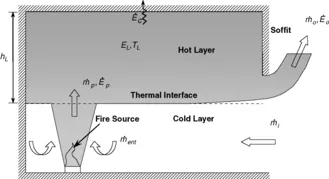
In fire modeling, the most widely used physically based fire model is the “zone” or “control volume” model. Zone modeling has proven to be a practical methodology in providing estimates to the fire processes in enclosure. Essentially, it solves the conservations equations for distinct and relatively large control volumes. On the basis of the “Two Layers Assumption,” the dominant characteristic of this type of model is exemplified in Figure 1.1. The zone model assumes that the burn room is divided into two layers (i.e., the upper layer of hot gases and the bottom layer of cold gases). Within the enclosure, the hot layer contains all the combustion products, which are taken to be well mixed and homogenous in temperature, while the cold layer is filled with the entrained ambient air. The transient layer height and temperature change (i.e., hL and TL) are calculated by considering the global conservation of mass and energy. Invoking the mass conservation, the mass accumulated in the hot layer
is given by
(1.1.1)
where
is the mass flow rate of the combustion products from the plume entering the hot layer and
is the mass flow rate of the exhausting hot gases. Similarly, the net energy gain in the hot layer
through applying the energy conservation is calculated according to
(1.1.2)
where
is the energy gain due to the exothermic chemical reaction between the fuel and air,
is the energy loss to the surroundings, and
is the energy loss due to the convective heat transfer to the boundaries of enclosure.
Figure 1.1
Schematic representation of “Two Layers Assumption” taken in zone modeling.
The beginnings of zone modeling can be traced back to the mid-1970s with the description of the fundamental equations in Quintiere (1977). Based on these equations, the very first zone model published was RFIRES by Pape et al. (1981). This was followed by the Harvard series of models developed by Emmons, Mitler, and co-workers (Mitler and Emmons, 1981, Mitler and Rockett, 1987), ASET model and ASET-B model in Walton (1985), FPETOOL, a descendant of the FIREFORM model, by Nelson (1986, 1990), CFAST model from the National Institute of Standards and Technology (NIST) as reported in Peacock et al. (1993), and a variety of other different models (Babrauskas, 1979, Davis and Cooper, 1991). The development of these zone models has been facilitated by advancements both in the understanding of the basic physics of fire growth in a compartment and in the computational technology. While most of the zone models are based on the same fundamental principals, significant variation in features exists among these models—single-room or multi-room enclosure, sprinkler/detector activation, smoke filling through openings, and many others. As aforementioned, typical model outputs of the zone models are the prediction of the evolution of the gas temperatures (TL) and the thickness of the upper smoke layer (hL). Comprehensive investigations on the use of zone models to specific fire problems can be found in Friedman (1991), Cox (1995), Walton (1995), and Novozhilov (2001).
Although zone models have been widely adopted and have demonstrated considerable success, they still remain a prescriptive approach to fire modeling. These models generally require the necessity of a priori knowledge of the flow pattern and the vanishing of the local effect within the two zones. In spite of their ease of usage, they are very likely to be imprecise in predicting fire scenarios where the empirical correlations are breached—for example, fires that have restricted entrainment areas or irregular geometrical structures. Owing to global averaging that is performed on the variables of interest over the two zones within the computational domain, these models are generally unable to predict the local physical quantities as required. The field model, an alternative to deterministic modeling, improves the spatial resolution of the zone model by further dividing the computational domain into a three-dimensional mesh comprised of many tiny cells. Field modeling of fires calculates changes in each cell by using the fundamental equations of fluid dynamics. They consist generally of a set of three-dimensional, time-dependent equations, non-linear partial differential equations expressing the conservation of mass, momentum, and energy. This process of solving the fundamental dynamics with digital computers is commonly referred as Computational Fluid Dynamics (CFD). Field model calculates the physical conditions in each cell, which results from changes in adjacent cells. In hindsight, the ability to simulate a range of fire scenarios without the limitations associated with empirical correlations and the feasibility of accommodating complex geometries represent some of the many advantages that the field model has over the zone model. Owing to the evolution of computer technology, there have been intensifying activities toward the concerted development of CFD-based fire models. The enormous contribution of CFD in fire modeling is reviewed in the next section.
1.2. Overview of Current Trends in Fire Modeling
Fire modeling, which emphasizes the application of CFD techniques in fire engineering, first appeared in the late 1970s by the development of the computer code UNDSAFE-I (Yang and Chang, 1977) and subsequently in the late 1980s and early 1990s by the application of JASMINE (developed by Fire Research Station, UK) and FLOW-3D (developed by Atomic Energy Authority, Harwell, UK) to unravel the cause of fatalities suffered in the Kings Cross Fire in the London Underground station (Cox et al., 1989, Simcox et al., 1992). Within reasonable limits of computer usage and cost, early field modeling approaches have assumed the fire to be adequately represented by a volumetric heat source, thus removing the need o...
Table of contents
Cover Image
Table of Contents
Copyright
Preface
Chapter 1. Introduction
2. Field Modeling Approach
Chapter 3. Additional Considerations in Field Modeling
Chapter 4. Further Considerations in Field Modeling
Chapter 5. Advance Technique in Field Modeling
Chapter 6. Other Challenges in Fire Safety Engineering
Appendix A. Higher-Order Differencing Schemes and Time-Marching Methods
Appendix B. Algebraic Equation System and CFD-Based Fire Model
Appendix C. Advanced Combustion Modeling
Appendix D. Relevant Tables for Combustion and Radiation Modeling
References
Index
Trusted by 375,005 students
Access to over 1.5 million titles for a fair monthly price.
Study more efficiently using our study tools.
Frequently asked questions
Yes, you can cancel anytime from the Subscription tab in your account settings on the Perlego website. Your subscription will stay active until the end of your current billing period. Learn how to cancel your subscription
No, books cannot be downloaded as external files, such as PDFs, for use outside of Perlego. However, you can download books within the Perlego app for offline reading on mobile or tablet. Learn how to download books offline
Perlego offers two plans: Essential and Complete
Essential is ideal for learners and professionals who enjoy exploring a wide range of subjects. Access the Essential Library with 800,000+ trusted titles and best-sellers across business, personal growth, and the humanities. Includes unlimited reading time and Standard Read Aloud voice.
Complete: Perfect for advanced learners and researchers needing full, unrestricted access. Unlock 1.5M+ books across hundreds of subjects, including academic and specialized titles. The Complete Plan also includes advanced features like Premium Read Aloud and Research Assistant.
Both plans are available with monthly, semester, or annual billing cycles.
We are an online textbook subscription service, where you can get access to an entire online library for less than the price of a single book per month. With over 1.5 million books across 990+ topics, we’ve got you covered! Learn about our mission
Look out for the read-aloud symbol on your next book to see if you can listen to it. The read-aloud tool reads text aloud for you, highlighting the text as it is being read. You can pause it, speed it up and slow it down. Learn more about Read Aloud
Yes! You can use the Perlego app on both iOS and Android devices to read anytime, anywhere — even offline. Perfect for commutes or when you’re on the go. Please note we cannot support devices running on iOS 13 and Android 7 or earlier. Learn more about using the app
Yes, you can access Computational Fluid Dynamics in Fire Engineering by Guan Heng Yeoh,Kwok Kit Yuen in PDF and/or ePUB format, as well as other popular books in Technology & Engineering & Civil Engineering. We have over 1.5 million books available in our catalogue for you to explore.