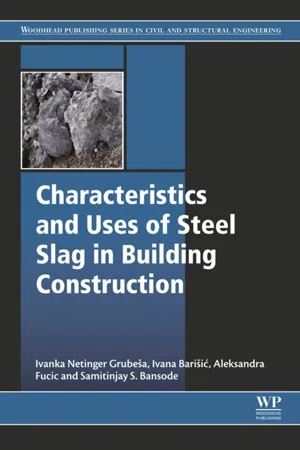
eBook - ePub
Characteristics and Uses of Steel Slag in Building Construction
- 194 pages
- English
- ePUB (mobile friendly)
- Available on iOS & Android
eBook - ePub
Characteristics and Uses of Steel Slag in Building Construction
About this book
Characteristics and Uses of Steel Slag in Building Construction focuses predominantly on the utilization of ferrous slag (blast furnace and steel slag) in building construction.
This extensive literature review discusses the worldwide utilization of ferrous slag and applications in all sectors of civil engineering, including structural engineering, road construction, and hydro-technical structures.
It presents cutting-edge research on the characteristics and properties of ferrous slag, and its overall impact on the environment.
- Comprehensively reviews the literature on the use of blast furnace and steel slag in civil engineering
- Examines the environmental impact of slag production and its effect on human health
- Presents cutting-edge research from worldwide studies on the use of blast furnace and steel slag
Information
1
Introduction
Abstract
One of the major challenges of society at present is the protection of the environment. Some of the important elements in this area are the reduction of the consumption of energy and natural raw materials. Therefore, the introduction of new, alternative materials in any process to replace traditionally used materials from natural sources is getting considerable attention by advocates of sustainable development. This chapter strives to describe the need for the introduction of alternative materials in building processes. Readers are introduced to some basic terms and legislation related to waste management in Europe, and the potential of using certain types of alternative materials in civil engineering process is given. However, emphasis is placed on slag as a by-product generated when purifying, casting, and alloying metals. The metal melting process is described here, and slag types regarding the melted metal type and the cooling method are discussed as well. In addition, a short history of slag utilisation in the civil engineering profession is given. In the concluding remarks, the authors explain their interest in a certain type of slag, steel slag, which is the main topic of this book.
Keywords
Waste management; alternative materials in civil engineering; legal framework; metal melting process; slag types; history of slag utilisationCivil engineering is an activity that essentially relies on exploiting natural resources. However, the ever-growing demand for materials by the building industry cannot be fully met by natural resources or traditional materials. Hence, there is a need to develop potential alternative materials and innovative techniques to solve the increasing demands of building construction. The response to this issue can be found in the reuse of waste materials. Furthermore, a large amount of waste results from the demolition caused during construction, and all of this has to be managed or disposed of somehow. The building material industry here comes to the fore as a domain of interest for reusing the waste material.
Even though waste materials are increasing today during the construction of new buildings and the rehabilitation of existing structures, civil engineering has left a very large ecological footprint throughout history. The influence is evident from the example of a 1-km-long, four-lane highway made of concrete pavement. This road requires about 1620 tons of cement, 7800 tons of coarse aggregate, and about 3240 tons of sand. If the same road were made of asphalt, it would require about 3600 tons of coarse aggregate, 2400 tons of fine aggregate, 540 tons of sand, and 300 tons of bitumen [1]. During aggregate preparation and other paving work, 1200 tons of CO2 is produced, which is almost equal to the total CO2 emissions produced by 210 passenger cars in a year [2]. Since the network of roads throughout the entire world is 15.99 million km long (for comparison, the distance between the Moon and the Earth is only 384,400 km), the implications of this statistic lead to alarming findings about the scale of the adverse environmental impact of road construction, as only one branch of civil engineering.
Water is the most consumed material in construction, but the runner-up is concrete. It is estimated that roughly 25 billion tons of concrete are manufactured globally each year, which amounts to more than 3.8 tons per person in the world [3]. It is mostly used in buildings, but it is also present in pavement. Besides the huge amount of used aggregate, due to the wide use of these materials, the cement and concrete industries are the biggest CO2 producers, with cement production contributing about 5% of annual anthropogenic global CO2 production [4]. Therefore, in recent years, researchers have focused on finding new methods of design, construction, and maintenance with the purpose of producing environmentally friendly buildings. Most of these studies are based on the use of waste materials, which solves the problem of waste disposal but also contributes to the savings and preservation of natural, nonrenewable materials. Therefore, the civil engineering community, aware of this negative trend, is turning to exploring the ecological principles of building, primarily through using lesser amounts of natural, nonrenewable resources. At the same time, we must face the pressing problem of disposing of the increasing amount of various wastes.
1.1. Legal framework for waste management
Today, waste is one of the key problems faced by the world in general, and civil engineering has been trying to address this issue by following the principles of sustainable development. As materials from natural resources are usually either already present on a construction site or are brought there from a nearby site, most of the standards for civil engineering materials are based on the assumption that natural materials are being used on a building project. In order to ensure the transfer of knowledge about waste materials obtained in research to practice in real life, a legal framework is needed.
One of the first legal documents pertaining to environmental preservation was the Basel Convention on the Control of Transboundary Movements of Hazardous Wastes and Their Disposal, passed in 1989. Another very important international document was the Kyoto Protocol, which was adopted in Kyoto, Japan, in 1997 and came into force in 2005. This document is a supplement to the already existing United Nations Framework Convention on Climate Change, and it was signed with the aim of reducing greenhouse gas emissions. The states that have ratified it create 61% of the world’s pollutants. Today, all European Union (EU) member states must adapt their laws to the current Waste Framework Directive (WFD), which provides a legislative framework for the collection, transport, recovery, and disposal of waste and includes a common definition of waste [5]. The revised WFD came into force in 2008, and its requirements are supplemented by other directives for specific waste streams. The directive also requires EU member states to take appropriate measures to encourage (i) the prevention or reduction of waste production and (ii) the recovery of waste by means of recycling, reuse, reclamation, or any other process, with a view to extracting secondary raw materials or using the waste as an energy source. Prior to this document, there was no definition of the term by-product in legislation in any European country. This document clearly defines “by-product as a substance or object, resulting from a production process, the primary aim of which is not the production of that item”. By-products, therefore, are production residue, not waste. Material can be considered as by-product if it meets all of the following criteria [6]:
• Further use of the substance or object is certain.
• The substance or object can be used directly, without any further processing other than normal industrial practice.
• The substance or object is produced as an integral part of a production process.
• Further use is lawful; i.e., the substance or object fulfils all relevant product, environmental, and health protection requirements for the specific use in question and will not lead to overall adverse environmental or human health impacts.
According to the directive, waste is defined as “any substance or object which the holder discards or intends or is required to discard”. Despite this given definition, many publications still use the term waste to refer to alternative materials that can be used in building rather than materials from natural resources.
1.2. Alternative materials in civil engineering
In civil engineering, the term alternative materials usually refers to solid wastes generated by industrial, mining, domestic, and agricultural activity. The type and nature of solid wastes and their recycling, as well as their utilisation potential in civil engineering, are listed in Table 1.1.
When solid waste is used in place of other conventional materials, natural resources and energy are preserved and expensive and potentially harmful waste disposal methods are avoided. Other advantages of using waste include reduced energy consumption using already existing materials, reduce...
Table of contents
- Cover image
- Title page
- Table of Contents
- Related titles
- Copyright
- Woodhead Publishing Series in Civil and Structural Engineering
- About the authors
- Foreword
- 1. Introduction
- 2. Ferrous slag: Characteristics and properties
- 3. Environmental impact of ferrous slag usage in civil engineering
- 4. Application of blast furnace slag in civil engineering: Worldwide studies
- 5. Applications of steel slag in civil engineering: Worldwide research
- 6. The Croatian experience of steel slag application in civil engineering
- 7. The Indian experience of steel slag application in civil engineering
- 8. Recommendations for future research
- Index
Trusted by 375,005 students
Access to over 1.5 million titles for a fair monthly price.
Study more efficiently using our study tools.
Frequently asked questions
Yes, you can cancel anytime from the Subscription tab in your account settings on the Perlego website. Your subscription will stay active until the end of your current billing period. Learn how to cancel your subscription
No, books cannot be downloaded as external files, such as PDFs, for use outside of Perlego. However, you can download books within the Perlego app for offline reading on mobile or tablet. Learn how to download books offline
Perlego offers two plans: Essential and Complete
- Essential is ideal for learners and professionals who enjoy exploring a wide range of subjects. Access the Essential Library with 800,000+ trusted titles and best-sellers across business, personal growth, and the humanities. Includes unlimited reading time and Standard Read Aloud voice.
- Complete: Perfect for advanced learners and researchers needing full, unrestricted access. Unlock 1.5M+ books across hundreds of subjects, including academic and specialized titles. The Complete Plan also includes advanced features like Premium Read Aloud and Research Assistant.
We are an online textbook subscription service, where you can get access to an entire online library for less than the price of a single book per month. With over 1.5 million books across 990+ topics, we’ve got you covered! Learn about our mission
Look out for the read-aloud symbol on your next book to see if you can listen to it. The read-aloud tool reads text aloud for you, highlighting the text as it is being read. You can pause it, speed it up and slow it down. Learn more about Read Aloud
Yes! You can use the Perlego app on both iOS and Android devices to read anytime, anywhere — even offline. Perfect for commutes or when you’re on the go.
Please note we cannot support devices running on iOS 13 and Android 7 or earlier. Learn more about using the app
Please note we cannot support devices running on iOS 13 and Android 7 or earlier. Learn more about using the app
Yes, you can access Characteristics and Uses of Steel Slag in Building Construction by Ivanka Netinger Grubeša,Ivana Barisic,Aleksandra Fucic,Samitinjay Sadashivrao Bansode in PDF and/or ePUB format, as well as other popular books in Technology & Engineering & Civil Engineering. We have over 1.5 million books available in our catalogue for you to explore.