eBook - ePub
Cyclura
Natural History, Husbandry, and Conservation of West Indian Rock Iguanas
- 240 pages
- English
- ePUB (mobile friendly)
- Available on iOS & Android
eBook - ePub
Cyclura
Natural History, Husbandry, and Conservation of West Indian Rock Iguanas
About this book
Rock iguanas of the West Indies are considered to be the most endangered group of lizards in the world. They are a flagship species in the Caribbean and on most islands are the largest native land animals. Unfortunately, human encroachment and introduced animals have brought this species to the brink of extinction. Cyclura: Natural History, Husbandry, and Conservation of the West Indian Iguanas is the first book to combine the natural history and captive husbandry of these remarkable reptiles, while at the same time outlining the problems researchers and conservationists are battling to save these beautiful, iconic animals of the Caribbean islands.
Authors Jeffrey Lemm and Allison Alberts have been studying West Indian iguanas for nearly 20 years in the wild and in captivity; their experiences with wild iguanas and their exquisite photos of these charismatic lizards in the wild make this book a must-have for reptile researchers, academics and enthusiasts, as well as anyone interested in nature and conservation.
- Includes chapters with contributions by leading experts on rock iguana taxonomy, nutrition, and diseases
- Features color photos of all taxa, including habitat and captive shots
- Provides easily understandable and usable information gleaned from experience and hands-on reptile research
Information
Chapter 1. Evolution and Biogeography
Catherine L. Stephen
Outline
Evolution on Islands3
Cyclura’s Wild Ride5
What’s in a Name?9
A Consequence of Island Evolution10
The geographic distribution of rock iguanas (Cyclura, Harlan, 1824) across the islands of the Caribbean shows an interesting pattern. Almost every species is relegated to a single island or island group. How did each species get to where it is today? Why are the species so morphologically distinct from one another? How old is each species? These and other questions can be addressed by combining available data on species relationships, distributions, geologic history of the Caribbean, and our knowledge of evolutionary processes.
It is helpful to understand a few of the fundamentals of island evolution when thinking about the evolutionary history of rock iguanas.
Evolution on Islands
Biologists have spent much time studying the processes that shape the variation between island taxa. There are famous examples of fantastic species diversity along island archipelagos: the Galapagos has the mockingbirds, finches, and tortoises; in Hawaii are the honeycreepers, fruit flies, and silverswords; the Greater Antilles in the Caribbean host the Anolis radiation, as well as curly tail lizards, hutias, and rock iguanas.
Often the first step in the process of diversification is isolation of individuals from their parent population. This can happen in myriad ways, two of which are quite common for island species: vicariance and dispersal. Vicariance occurs when a barrier arises that physically isolates a population from others of its species, such as tectonic plate separation. Diversification via dispersal begins when several organisms of a species share a rare event (e.g., rafting on a mat of vegetation to a new, distant location) leading to the establishment of a new population (Figure 1.1).
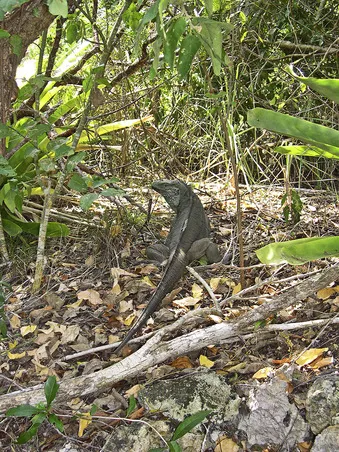 |
| FIGURE 1.1 Grand Cayman Blue iguanas are believed to be relatives of iguanas that rafted to the Cayman Islands from Cuba. |
By either means, the newly isolated population is now subject to a novel set of natural selection pressures, such as differences in the climate, animal and plant communities, food resources, substrate, etc. As land masses break up, what was once an inland prairie can become a coastal area, and be subject to a vastly different microclimate regime. When sea level rises, lowland areas become submerged and populations unable to disperse across water are isolated on higher ground. Changes in ocean circulation will change temperature and humidity, soil composition, and vegetation. Some members of the biological community will be able to thrive in the new conditions, while others will dwindle. Subsequent changes in community structure will affect species–species interactions and resource availability. In every generation, genetic mutations will arise in these isolated populations that can affect such traits as behavior, morphology, physiology, and communication. Such mutations might facilitate a better fit to the changed structural environment and community composition, and these become the drivers of evolution. Over many thousands of generations, without continued genetic connection to the ancestral population, increased differentiation will eventually lead to diversification and speciation.
Cyclura’s Wild Ride
The Greater Antilles island group originated on the edge of the Caribbean Plate in the Pacific Ocean and pushed its way eastward to its current position in the Atlantic Ocean. Current scientific data support the scenario that much of the Greater Antilles’ flora and fauna, potentially including the ancestor to Cyclura, colonized the islands when a connection with South America existed via the Aves Ridge during the Eocene–Oligocene transition 35–33 million years ago (mya) (Malone et al., 2000; Hedges, 2001; MacPhee et al., 2003; Iturralde-Vinent, 2006). Subsequently, the biological communities on these lands experienced land mass connections and disconnections, island emergences and submergences, sea level fluctuations, and literally millions of tropical storms. The combination of geologic, genetic, and evolutionary data allows us to reconstruct a likely sequence of events that led to the modern day diversity of the rock iguanas (FIGURE 1.2 and FIGURE 1.3). However, the evolutionary scenario presented here is just one of several hypotheses, and new information could alter our understanding of the evolution of Cyclura iguanas.
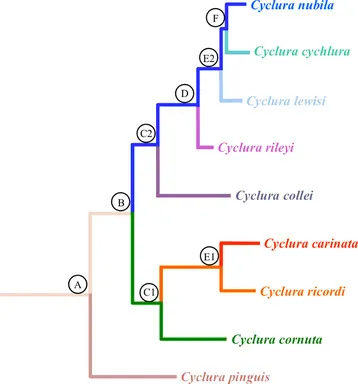 |
| FIGURE 1.2 Evolutionary relationships of the Cyclura species. Letters mark each divergence (node). Each species is color coded to match their distribution in Figure 1.3. |
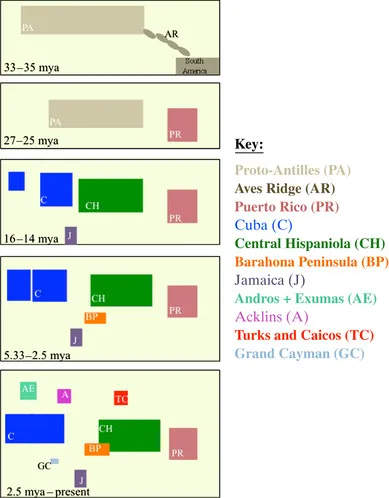 |
| FIGURE 1.3 A chronological series of some of the geologic changes in the Caribbean from the Oligocene–Eocene transition to the present (based on Iturralde-Vinent, 2006). Each island (or island group) is color coded to indicate the Cyclura species occurring there. |
In the earliest configuration of the “proto-Antillean” land mass, the three largest islands in this group were connected (Lewis and Draper, 1990; Iturralde-Vinent, 2006; Pindell et al., 2006), and the iguanid colonizer was apparently successful enough to disperse across this land mass. The initial divergences within Cyclura resulted when this land mass broke up due to tectonic activity and deep waterways formed, separating groups of animals. The earliest new species line to be isolated became C. pinguis on the Puerto Rican Bank (node A). This species, the most basal (oldest) of the genus, was once present throughout the Puerto Rican island bank, but is now restricted to a few small islands in the British Virgin Islands. The remaining island mass then separated into two parts (node B), eastern Cuba and central Hispaniola (excluding the southern peninsula), with the formation of the Windward Passage waterway between the two islands. Cuba’s successful Cyclura population gave rise to many descendent species as they dispersed onto other islands (see beyond), while the core Cuban population evolved into the species C. nubila. Originally, Hispaniola (today comprised of the countries of Dominican Republic and Haiti) had only the population whose modern descendents are C. cornuta.
Hispaniola has the distinction of being the only island to contain two species of rock iguanas today (Figure 1.4). C. cornuta is distributed throughout most of the island, whereas C. ricordii is restricted to the Barahona Peninsula in the arid Neiba Valley and coastal lowlands. The two species are sympatric (utilize the same habitat) throughout the limited range of C. ricordii. So, how did they diverge in the first place? Somewhere between 2 million years ago and 100,000 years ago, the Baharona Peninsula was joined with the rest of Hispaniola, forming the Neiba Valley. One hypothesis is that the ancestors of C. ricordii colonized this island-peninsula (node C1) at some point after it was no longer submerged and evolved differentiating traits prior to the island’s connection with Hispaniola (thereby forming the peninsula). This lineage also gave rise to the species ...
Table of contents
- Cover image
- Table of Contents
- Cyclura
- Copyright
- List of Contributors
- Dedication
- Preface
- Acknowledgments
- About the Authors
- Chapter 1. Evolution and Biogeography
- Chapter 2. Species Accounts
- Chapter 3. Natural History
- Chapter 4. Husbandry
- Chapter 5. Nutrition
- Chapter 6. Health and Medical Management
- Chapter 7. Conservation
- Bibliography
- Glossary
- Index
Trusted by 375,005 students
Access to over 1.5 million titles for a fair monthly price.
Study more efficiently using our study tools.
Frequently asked questions
Yes, you can cancel anytime from the Subscription tab in your account settings on the Perlego website. Your subscription will stay active until the end of your current billing period. Learn how to cancel your subscription
No, books cannot be downloaded as external files, such as PDFs, for use outside of Perlego. However, you can download books within the Perlego app for offline reading on mobile or tablet. Learn how to download books offline
Perlego offers two plans: Essential and Complete
- Essential is ideal for learners and professionals who enjoy exploring a wide range of subjects. Access the Essential Library with 800,000+ trusted titles and best-sellers across business, personal growth, and the humanities. Includes unlimited reading time and Standard Read Aloud voice.
- Complete: Perfect for advanced learners and researchers needing full, unrestricted access. Unlock 1.5M+ books across hundreds of subjects, including academic and specialized titles. The Complete Plan also includes advanced features like Premium Read Aloud and Research Assistant.
We are an online textbook subscription service, where you can get access to an entire online library for less than the price of a single book per month. With over 1.5 million books across 990+ topics, we’ve got you covered! Learn about our mission
Look out for the read-aloud symbol on your next book to see if you can listen to it. The read-aloud tool reads text aloud for you, highlighting the text as it is being read. You can pause it, speed it up and slow it down. Learn more about Read Aloud
Yes! You can use the Perlego app on both iOS and Android devices to read anytime, anywhere — even offline. Perfect for commutes or when you’re on the go.
Please note we cannot support devices running on iOS 13 and Android 7 or earlier. Learn more about using the app
Please note we cannot support devices running on iOS 13 and Android 7 or earlier. Learn more about using the app
Yes, you can access Cyclura by Jeffrey Lemm,Allison C. Alberts in PDF and/or ePUB format, as well as other popular books in Technology & Engineering & Animal Husbandry. We have over 1.5 million books available in our catalogue for you to explore.