- 622 pages
- English
- ePUB (mobile friendly)
- Available on iOS & Android
eBook - ePub
About this book
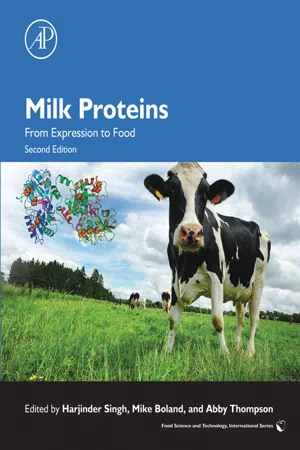
Understanding of the interactions of milk proteins in complex food systems continues to progress, resulting in specialized milk-protein based applications in functional foods, and in protein ingredients for specific health applications. Milk Proteins is the first and only presentation of the entire dairy food chain – from the source to the nutritional aspects affecting the consumer.
With focus on the molecular structures and interactions of milk proteins in various processing methods, Milk Proteins presents a comprehensive overview of the biology and chemistry of milk, as well as featuring the latest science and developments. Significant insight into the use of milk proteins from an industry viewpoint provides valuable application-based information. Those working with food and nutritional research and product development will find this book useful.
- 20% new chapter content — full revision throughout
- New chapters address: role of milk proteins in human health; aspects of digestion and absorption of milk proteins in the GIT; consumer demand and future trends in milk proteins; and world supply of proteins with a focus on dairy proteins
- Internationally recognized authors and editors bring academic and industrial insights to this important topic
Information
Chapter 1
The World Supply of Food and the Role of Dairy Protein
Srikanta Chatterjee*
Arnab Sarkar**
Mike J. Boland***
* Massey University, Palmerston North, New Zealand
** Synlait Milk Ltd., Rakaia, New Zealand
*** Riddet Institute, Palmerston North, New Zealand
Abstract
World hunger continues to be a major problem. The main focus of those concerned with world hunger is on the availability of adequate calories for all, but this overshadows another problem: the availability of enough protein and enough dietary essential amino acids. We estimate that about a quarter of the world's population is getting barely enough protein; a particular issue is that of the essential amino acid lysine, which is deficient in cereal proteins, the biggest source of protein nutrition. Milk protein is an important source of dietary protein and is particularly rich in lysine and branched-chain amino acids. It accounts for 10% of all the global protein supply and provides the third highest supply after cereals and meat, but it is more important than the amounts would suggest because of its rich supply of essential amino acids and high digestibility (in contrast to cereal protein) and because of its acceptability to vegetarians. Global trade in dairy is still small (about 8% of dairy production is traded) but growing. Supplementation of cereal protein with milk protein has a potentially important role to play in balancing world protein nutrition.
Keywords
Protein nutrition, milk protein, dairy trade, dairy production
Introduction
As one of the basic necessities of life, the availability, quality, and affordability of food are of concern to individuals and nations alike. The Green Revolution started in the late 1960s and involved the introduction of some new, high-yielding seed varieties, better use of irrigation facilities, and fertilizers. Following these innovations, the world enjoyed several decades of relative stability in the price of basic items of food, including food grains. The period from the early 1970s to 1990 saw world output of food grains and oilseeds rise steadily by an average of 2.2% a year, with periodic fluctuations. With the exception of parts of the African continent, the global rate of growth of food crops exceeded that of the world population, leading to an increase in their per capita availability and to relatively stable prices. Indeed, in 2000 world food prices in real terms were at their lowest for one hundred years (Trostle, 2008).
Since the early 1990s, however, the global rate of growth for grain and oilseed production has declined to 1.3% a year and is projected to decline further to around 1.2% over the next decade. This and a few other adverse factors have contributed to the rapid rise in the world market prices for major food products since early 2006, recording an increase of around 60% in just two years to early 2008. This upward trend has moderated somewhat since then, and the inflation-adjusted food price index stood at 140.3 in June 2013, having risen from its 2002–2004 base of 100.0. The most recent figures indicate that the Food and Agriculture Organization (FAO) food price index (FFPI) averaged 210 points in February 2013, remaining virtually stable since November 2012. The index of cereal prices, at 246 points, was 5.4% higher in June 2013 than it was a year earlier. The index of cereal prices was 5 points (2.07%) higher, and the index of dairy prices, after a sharp decline (22%) in the year to June 2012, rose 38% by June 2013 (FAO, 2013a). The general climate of rising retail prices of food items globally has raised the specter of another global food crisis, especially in the poorer countries, where the drive for food security has suffered a major jolt.
Side by side with this worsening situation w...
Table of contents
- Cover
- Title page
- Table of Contents
- Food Science and Technology International Series
- Copyright
- List of Contributors
- Preface to the Second Edition
- Preface to the First Edition
- Chapter 1: The World Supply of Food and the Role of Dairy Protein
- Chapter 2: Milk: An Overview
- Chapter 3: The Comparative Genomics of Monotremes, Marsupials, and Pinnipeds: Models to Examine the Functions of Milk Proteins
- Chapter 4: Significance, Origin, and Function of Bovine Milk Proteins: The Biological Implications of Manipulation or Modification
- Chapter 5: Post-translational Modifications of Caseins
- Chapter 6: Casein Micelle Structure and Stability
- Chapter 7: Structure and Stability of Whey Proteins
- Chapter 8: Effects of High-pressure Processing on Structure and Interactions of Milk Proteins
- Chapter 9: The Whey Proteins in Milk: Thermal Denaturation, Physical Interactions, and Effects on the Functional Properties of Milk
- Chapter 10: Effects of Drying on Milk Proteins
- Chapter 11: Changes in Milk Proteins during Storage of Dry Powders
- Chapter 12: Interactions and Functionality of Milk Proteins in Food Emulsions
- Chapter 13: Milk Protein–Polysaccharide Interactions
- Chapter 14: Interactions between Milk Proteins and Micronutrients
- Chapter 15: Model Food Systems and Protein Functionality
- Chapter 16: Sensory Properties of Dairy Proteins
- Chapter 17: Milk Protein Gels
- Chapter 18: Milk Proteins—A Cornucopia for Developing Functional Foods
- Chapter 19: Milk Proteins and Human Health
- Chapter 20: Milk Proteins: Digestion and Absorption in the Gastrointestinal Tract
- Chapter 21: Milk Proteins: The Future
- Index
- Food Science and Technology: International Series
Trusted by 375,005 students
Access to over 1.5 million titles for a fair monthly price.
Study more efficiently using our study tools.
Frequently asked questions
Yes, you can cancel anytime from the Subscription tab in your account settings on the Perlego website. Your subscription will stay active until the end of your current billing period. Learn how to cancel your subscription
No, books cannot be downloaded as external files, such as PDFs, for use outside of Perlego. However, you can download books within the Perlego app for offline reading on mobile or tablet. Learn how to download books offline
Perlego offers two plans: Essential and Complete
- Essential is ideal for learners and professionals who enjoy exploring a wide range of subjects. Access the Essential Library with 800,000+ trusted titles and best-sellers across business, personal growth, and the humanities. Includes unlimited reading time and Standard Read Aloud voice.
- Complete: Perfect for advanced learners and researchers needing full, unrestricted access. Unlock 1.5M+ books across hundreds of subjects, including academic and specialized titles. The Complete Plan also includes advanced features like Premium Read Aloud and Research Assistant.
We are an online textbook subscription service, where you can get access to an entire online library for less than the price of a single book per month. With over 1.5 million books across 990+ topics, we’ve got you covered! Learn about our mission
Look out for the read-aloud symbol on your next book to see if you can listen to it. The read-aloud tool reads text aloud for you, highlighting the text as it is being read. You can pause it, speed it up and slow it down. Learn more about Read Aloud
Yes! You can use the Perlego app on both iOS and Android devices to read anytime, anywhere — even offline. Perfect for commutes or when you’re on the go.
Please note we cannot support devices running on iOS 13 and Android 7 or earlier. Learn more about using the app
Please note we cannot support devices running on iOS 13 and Android 7 or earlier. Learn more about using the app
Yes, you can access Milk Proteins by Mike Boland,Harjinder Singh,Abby Thompson in PDF and/or ePUB format, as well as other popular books in Technology & Engineering & Nutrition, Dietics & Bariatrics. We have over 1.5 million books available in our catalogue for you to explore.