- 211 pages
- English
- ePUB (mobile friendly)
- Available on iOS & Android
eBook - ePub
Mechanics of Sheet Metal Forming
About this book
The basic theory of sheet metal forming in the automotive, appliance and aircraft industries is given. This fills a gap between the descriptive treatments in most manufacturing texts and the advanced numerical methods used in computer-aided-design systems.
The book may be used by lecturers in undergraduate courses in manufacturing; plentiful exercises and worked examples provide quantitative tutorial problems for students. A separate, but related simulation software package advertised on this page enables students to explore the limits of processes and understand the influence of different process and material variables.
Engineers in stamping plants and press shops find the book useful in understanding what happens during forming and why failures occur. The book is also used as a text for industrial short courses that have been given in many countries. Die designers and tooling engineers find the simple treatment of processes useful at the conceptual design stage and also in determining modifications needed to overcome problems indicated by detailed numerical analysis.
The original text, published 10 years ago, has been completely rewritten for this edition and newer topics such as hydroforming included. Simple equations governing plastic deformation, press forming, bending, punch stretching and deep drawing are derived and explained. The aim is to provide simple applicable methods rather than complex numerical techniques for practising engineers and for students interested in a quantitative and practical approach.
SIMPLIFIED STAMPING SIMULATION SOFTWARE "4S'
The analytical treatment in this book is used to develop simulation modules for simple cases of sheet forming such as stamping, deep drawing, bending and hydroforming. Students can investigate the influence of tooling dimensions, material properties and process variables such as friction on the outcome of operations and see from animated models how, for example, press loads develop during forming. Applications using this package greatly enhance interest in the development of theory in the book.
The website http://www.mssinternational.com provides further information and an opportunity to run some of the modules.
- Presents the fundamentals of sheet metal forming - bending, stretching, press forming, deep drawing and hydroforming
- Shows how deformation, loads and process limits can be calculated using simple equations
- Concentrates on simple, applicable methods rather than complex numerical techniques
- Contains many exercises, worked examples and solutions
- Used as a reference text in undergraduate manufacturing courses, as a required text in specialist graduate courses and as a course text for industrial short courses
- Is supported by a separate, but related simulation software package described below
Information
1
Material properties
The most important criteria in selecting a material are related to the function of the part – qualities such as strength, density, stiffness and corrosion resistance. For sheet material, the ability to be shaped in a given process, often called its formability, should also be considered. To assess formability, we must be able to describe the behaviour of the sheet in a precise way and express properties in a mathematical form; we also need to know how properties can be derived from mechanical tests. As far as possible, each property should be expressed in a fundamental form that is independent of the test used to measure it. The information can then be used in a more general way in the models of various metal forming processes that are introduced in subsequent chapters.
In sheet metal forming, there are two regimes of interest – elastic and plastic deformation. Forming a sheet to some shape obviously involves permanent ‘plastic’ flow and the strains in the sheet could be quite large. Whenever there is a stress on a sheet element, there will also be some elastic strain. This will be small, typically less than one part in one thousand. It is often neglected, but it can have an important effect, for example when a panel is removed from a die and the forming forces are unloaded giving rise to elastic shape changes, or ‘springback’.
1.1 Tensile test
For historical reasons and because the test is easy to perform, many familiar material properties are based on measurements made in the tensile test. Some are specific to the test and cannot be used mathematically in the study of forming processes, while others are fundamental properties of more general application. As many of the specific, or nonfundamental tensile test properties are widely used, they will be described at this stage and some description given of their effect on processes, even though this can only be done in a qualitative fashion.
A tensile test-piece is shown in Figure 1.1. This is typical of a number of standard test-pieces having a parallel, reduced section for a length that is at least four times the width, w0. The initial thickness is t0 and the load on the specimen at any instant, P, is measured by a load cell in the testing machine. In the middle of the specimen, a gauge length l0 is monitored by an extensometer and at any instant the current gauge length is l and the extension is Δl = l – l0. In some tests, a transverse extensometer may also be used to measure the change in width, i.e. Δw = w – w0. During the test, load and extension will be recorded in a data acquisition system and a file created; this is then analysed and various material property diagrams can be created. Some of these are described below.
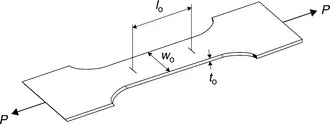
Figure 1.1 Typical tensile test strip.
1.1.1 The load–extension diagram
Figure 1.2 shows a typical load–extension diagram for a test on a sample of drawing quality steel. The elastic extension is so small that it cannot be seen. The diagram does not represent basic material behaviour as it describes the response of the material to a particular process, namely the extension of a tensile strip of given width and thickness. Nevertheless it does give important information. One feature is the initial yielding load, Py, at which plastic deformation commences. Initial yielding is followed by a region in which the deformation in the strip is uniform and the load increases. The increase is due to strain-hardening, which is a phenomenon exhibited by most metals and alloys in the soft condition whereby the strength or hardness of the material increases with plastic deformation. During this part of the test, the cross-sectional area of the strip decreases while the length increases; a point is reached when the strain-hardening effect is just balanced by the rate of decrease in area and the load reaches a maximum Pmax.. Beyond this, deformation in the strip ceases to be uniform and a diffuse neck develops in the reduced section; non-uniform extension continues within the neck until the strip fails.
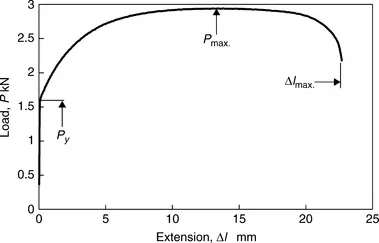
Figure 1.2 Load–extension diagram for a tensile test of a drawing quality sheet steel. The test-piece dimensions are l0 = 50, w0 = 12.5, t0 = 0.8 mm.
The extension at this instant is Δlmax., and a tensile test property known as the total elongation can be calculated; this is defined by

1.1.2 The engineering stress–strain curve
Prior to the development of modern data pr...
Table of contents
- Cover image
- Title page
- Table of Contents
- Copyright
- Preface to the second edition
- Preface to the first edition
- Disclaimer
- Introduction
- Chapter 1: Material properties
- Chapter 2: Sheet deformation processes
- Chapter 3: Deformation of sheet in plane stress
- Chapter 4: Simplified stamping analysis
- Chapter 5: Load instability and tearing
- Chapter 6: Bending of sheet
- Chapter 7: Simplified analysis of circular shells
- Chapter 8: Cylindrical deep drawing
- Chapter 9: Stretching circular shells
- Chapter 10: Combined bending and tension of sheet
- Chapter 11: Hydroforming
- Appendix A1: Yielding in three-dimensional stress state
- Appendix A2: Large strains: an alternative definition
- Solutions to exercises
- Index
Trusted by 375,005 students
Access to over 1.5 million titles for a fair monthly price.
Study more efficiently using our study tools.
Frequently asked questions
Yes, you can cancel anytime from the Subscription tab in your account settings on the Perlego website. Your subscription will stay active until the end of your current billing period. Learn how to cancel your subscription
No, books cannot be downloaded as external files, such as PDFs, for use outside of Perlego. However, you can download books within the Perlego app for offline reading on mobile or tablet. Learn how to download books offline
Perlego offers two plans: Essential and Complete
- Essential is ideal for learners and professionals who enjoy exploring a wide range of subjects. Access the Essential Library with 800,000+ trusted titles and best-sellers across business, personal growth, and the humanities. Includes unlimited reading time and Standard Read Aloud voice.
- Complete: Perfect for advanced learners and researchers needing full, unrestricted access. Unlock 1.5M+ books across hundreds of subjects, including academic and specialized titles. The Complete Plan also includes advanced features like Premium Read Aloud and Research Assistant.
We are an online textbook subscription service, where you can get access to an entire online library for less than the price of a single book per month. With over 1.5 million books across 990+ topics, we’ve got you covered! Learn about our mission
Look out for the read-aloud symbol on your next book to see if you can listen to it. The read-aloud tool reads text aloud for you, highlighting the text as it is being read. You can pause it, speed it up and slow it down. Learn more about Read Aloud
Yes! You can use the Perlego app on both iOS and Android devices to read anytime, anywhere — even offline. Perfect for commutes or when you’re on the go.
Please note we cannot support devices running on iOS 13 and Android 7 or earlier. Learn more about using the app
Please note we cannot support devices running on iOS 13 and Android 7 or earlier. Learn more about using the app
Yes, you can access Mechanics of Sheet Metal Forming by Jack Hu,Zdzislaw Marciniak,John Duncan in PDF and/or ePUB format, as well as other popular books in Technology & Engineering & Mechanical Engineering. We have over 1.5 million books available in our catalogue for you to explore.