- 288 pages
- English
- ePUB (mobile friendly)
- Available on iOS & Android
eBook - ePub
About this book
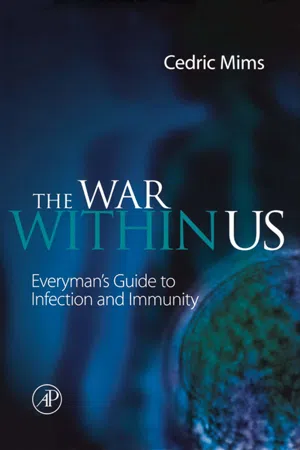
Infectious diseases are the leading cause of death worldwide. In The War Within Us, well-known author and infectious disease specialist Cedric Mims makes the intricacies of the immune system and infectious diseases less baffling for the general reader and answers the questions of how things work and why. The story is told in terms of the ancient conflict between the invader (the infectious disease) and the defender (the body's immune system) and the strategies and counter-strategies used by both sides, making it a book that is both informative and interesting to read. The War Within Us is an ideal introduction to the basics of immunity and infection for general readers and students. It also serves as a quick reference book for physicians, researchers, and other health workers.
- Parasite versus host
- The conflict: how we defend ourselves
- The microbe's response to our defence
- How microbes cause diseas
- Thumbnail sketches of seven selected diseases:
- The threat of new diseases
Information
Topic
MedicineSubtopic
ImmunologyPart 1
THE PARASITE VERSUS THE HOST
Chapter 1
THE PARASITE VERSUS THE HOST
PARASITISM AS A WAY OF LIFE
‘I keep six honest serving men
(They taught me all I knew);
Their names are What and Why and When
And How and Where and Who.’
Just So Stories (1902)
‘The Elephants Child’
Rudyard Kipling (1865–1936).
This book is about parasites. They live in or on their hosts, and while a few are quite large (tapeworm), most are microscopically small (microbes such as viruses and bacteria). There are good and there are bad parasites. They range from unobtrusive more or less harmless ones to virulent invaders that cause severe sickness or death. Let us consider some examples to show the spectrum of possibilities.
Stephanie’s skin worries
Stephanie, aged 15, lives in Bristol, England, and is worried about her skin. For some months there have been ugly red spots on her forehead and shoulders, and they aren’t made much better by the ointments and creams she buys from the chemist. And lately she has the feeling that her body has an unpleasant smell. What is going on?
The skin protects us from the outside world, and takes a regular buffeting. To cope with this, it constantly renews itself from below. In the bottommost layers the skin cells divide, pushing up their progeny towards the surface. As they move up they get thinner, flatter, eventually die and are shed from the body as tiny skin flakes. We lose more than a million each day, and a veritable shower is released when we undress. The fine layer of white dust that your finger picks up from the top of a shelf or cupboard consists mostly of dead skin cells. In this way your skin is completely replaced every week or so.
The dry outer layers have to be kept moist and supple, and a layer of oily material oozes out over the skin from tens of thousands of tiny sebaceous glands (Latin, sebum = grease) that open onto the surface. Stephanie’s problem is that she is undergoing the changes of adolescence. Sex hormones are transforming her into a woman but they are also causing overactivity of the sebaceous glands. The glands get blocked, and the resident bacteria on the skin, which are normally harmless parasites, grow in the blocked glands and form substances that give rise to inflammation and redness. She is convinced she looks terrible, and cannot understand why she has to suffer while her friend Joan has such clear unblemished skin. Finally the GP starts her on a long course of antibiotics to keep the bacteria out of the glands, and things get a bit better. But the acne spots may stay until she has ‘grown out of it’ in her early twenties.
The worry that she smells is part of the general feeling that she is unattractive, but once again the resident skin bacteria have something to answer for. When her sweat and the oily secretions from the sebaceous glands first arrive at the skin surface they do not smell unpleasant. Resident bacteria, however, use these secretions as food and form odoriferous products, especially in the armpits. Luckily, most deodorants act against these particular bacteria, and this problem is solved without difficulty.
Stephanie’s skin bacteria can be looked on as well-behaved parasites as long as they don’t harm her, but they overstepped the mark when they contributed to her acne.
Mark has bad teeth
Stephanie’s younger brother Mark has a different problem. His skin is clear but he is a regular visitor at the dentist and is always having new fillings. Although he is supposed to brush his teeth twice a day and go easy on sweets, he doesn’t keep to this and his mother is tired of nagging him. At this rate he will have false teeth by the time he is grown up. What is going on in his mouth? The resident microbes in most people’s mouths include a certain bacterium called Streptococcus mutans, which is nicely adapted to life on teeth. It is able to stick firmly to teeth, grows to establish a colony, and various other microbes take advantage of this by joining the colony, so that the whole thing forms a thin film of multiplying organisms called a dental plaque. Under the microscope this patch on the tooth looks like a tangled forest, perfectly placed to make use of the nutrients present in the mouth. If you remove it by brushing it re-establishes itself in a few hours. S. mutans loves sugar and flourishes when it is regularly available. Unfortunately acid is formed from the sugar, and if the plaque is not removed regularly, the acid bores a small hole in the enamel. The hole gets bigger, exposing the sensitive layers under the enamel, and Mark gets another toothache. If he brushed more often and stopped eating sweets between meals, it wouldn’t be so bad. But without the bacteria the tooth-rot (caries) could not develop in the first place. Indeed caries can be regarded as an infectious disease, one of the commonest in the modern world. With our frequently sugary diet we are especially vulnerable. Having strong enamel helps, and although Mark is unlikely to be deficient in fluoride, it could be that he has inherited some genes that make him susceptible. As in the case of Stephanie’s skin microbes, the residents in Mark’s mouth have ceased to be harmless guests and have done some damage.
Both Stephanie and Mark have had threadworms
I should add that both Stephanie and Mark have encountered a very successful parasitic worm. When they were 4–5 years old they attended a preschool three mornings a week, and it was there that eggs of the human threadworm or pinworm (Enterobius vermicularis) found their way into their mouths. The eggs hatched, and in their intestines grew into the threadlike adult worms. The worms (about fifty of them), each only about a centimetre long, enjoyed a comfortable life, surrounded by plenty of food. They did no damage to the intestinal wall and managed to stay put without being carried along and expelled in the stools. Stephanie and Mark were none the worse for being the unwitting hosts. But, like all parasites, the threadworm has to make its way to fresh hosts if it is to survive. To achieve this it has an ingenious strategy. At night, when the children are quiet in bed, the adult female worm, laden with thousands of eggs, makes its way down the intestine to the anus, sticks out its rear end, and, feeling its way, deposits its eggs onto the skin round the anus. The wriggly movements of the worm cause itching. The children then scratch their bottoms vigorously, and in doing so pick up the eggs under their fingernails. And unwashed or poorly washed hands are fine vehicles for transferring the eggs to the fingers and mouths of other children.
The worm is easily eliminated by drugs but it generally causes no other symptoms, and children recover without treatment. If necessary the doctor can make the diagnosis by pressing a piece of sellotape onto the skin round the anus and then removing it and identifying the typical tiny eggs under the microscope. The human threadworm is a highly successful parasite, infecting millions of children, and doing little or no damage. This is more than can be said for many less well-behaved parasitic worms, such as hookworms, tapeworms, and those that cause schistosomiasis and elephantiasis.
So far, Stephanie and Mark have met only the gentlest parasites. Later in life they will catch influenza, glandular fever, and one or two other unpleasant diseases. Luckily they have been vaccinated against many of them, including whooping cough, tetanus, polio, measles and diphtheria, and are fortunate to live in a country where there is no malaria, leprosy, cholera, typhoid or yellow fever. When they read in the paper about bubonic plague, Ebola or rabies, which are life-threatening infections in Africa and India, they realize they are in a safe country, and better off than Ricardo, even though his life was not actually threatened.
Ricardo will stay small
Ricardo is three years old, and his parents are poor. It is 1976, and he lives in a village in Guatemala where there is no sewage disposal, the drinking water is contaminated, and the nearest doctor 25 miles away. Luckily he had been vaccinated against tetanus, diphtheria and polio. Until he was born his body was sterile and free of microbes and then, during the first few weeks of life, a host of friendly microbes colonized his skin, mouth and intestines, and became regular residents. This is what happens to us all. But in his family and in his village he is surrounded by less benevolent ones awaiting the opportunity to invade. For a month or two the antibodies in his mother’s milk protected him, but then, as he breathed the air from people’s coughs and sneezes and his diet began to include the local water and food, the other microbial parasites found their opportunity.
At four and a half months of age he suffered two attacks of diarrhoea and a chest infection, and by the time he was 18 months old there had been another eight episodes of diarrhoea, each caused by a different intestinal invader, each one making him fret for a few days and lose a bit of weight. Catching measles at nine months was a major setback; it was yet another nutritional handicap and it took him a month to get over it. Several attacks of bronchitis added to the burden. Then three different parasitic worms took up residence in his intestines. It was a disastrous first year, and now his weight showed little increase because every few weeks new microbes found their way into his small body. He suffered from impetigo, thrush, conjunctivitis, a severe middle ear infection, and more diarrhoea.
Ricardo is a lively and cheerful child, but at three years he weighs only nine and a half kilograms, less than two-thirds of the weight of a three-year-old in a Western country blessed with clean water, sewage disposal, medicines, and doctors. In his short life he has been host to 63 different microbial parasites. Although he had fought them off and cleared most of them from his body, the battles had left their mark and he will never grow to be as big as he might have been.
But that is how it was for most of the children in his village. The picture was one of heavy pressure from parasites, with the scales tipped heavily in their favour. It has been the pattern in settled communities all over the world for thousands of years. Ricardo’s life would have been transformed by the clean water, sewage disposal, better diet, medicines and vaccines enjoyed by Stephanie and Mark. But these things cost money. He was a victim, and the parasites reaped the benefit, exploiting his small sad body. Since then things have improved in his village, but elsewhere in the world there are children who continue to suffer as Ricardo did.
Rajam’s unfortunate meeting with a dog
Rajam, aged 12, represents the final stage in the parasite spectrum. He lived in a small village in Southern India, and loved animals. While visiting his aunt in a nearby village he had stroked a dog that looked sad and lost, and it gave him a small nip on the left hand for his trouble. Two months later Rajam became unwell with fever, headache and nausea. It didn’t seem much, but his left hand began to hurt, and the following week he had some muscle spasms in the arm, then a convulsion. He got worse and his parents began to despair, but nothing could be done. Finally he went into a coma an...
Table of contents
- Cover image
- Title page
- Table of Contents
- Copyright
- ACKNOWLEDGEMENTS
- PREFACE
- INTRODUCTION
- Part 1: THE PARASITE VERSUS THE HOST
- Part 2: HOW WE DEFEND OURSELVES
- Part 3: THE MICROBE’S RESPONSE TO OUR DEFENCES
- Part 4: THE DISEASE
- Part 5: WHAT THE FUTURE HOLDS
- SELECTED READING
- GLOSSARY
- INDEX
Trusted by 375,005 students
Access to over 1.5 million titles for a fair monthly price.
Study more efficiently using our study tools.
Frequently asked questions
Yes, you can cancel anytime from the Subscription tab in your account settings on the Perlego website. Your subscription will stay active until the end of your current billing period. Learn how to cancel your subscription
No, books cannot be downloaded as external files, such as PDFs, for use outside of Perlego. However, you can download books within the Perlego app for offline reading on mobile or tablet. Learn how to download books offline
Perlego offers two plans: Essential and Complete
- Essential is ideal for learners and professionals who enjoy exploring a wide range of subjects. Access the Essential Library with 800,000+ trusted titles and best-sellers across business, personal growth, and the humanities. Includes unlimited reading time and Standard Read Aloud voice.
- Complete: Perfect for advanced learners and researchers needing full, unrestricted access. Unlock 1.5M+ books across hundreds of subjects, including academic and specialized titles. The Complete Plan also includes advanced features like Premium Read Aloud and Research Assistant.
We are an online textbook subscription service, where you can get access to an entire online library for less than the price of a single book per month. With over 1.5 million books across 990+ topics, we’ve got you covered! Learn about our mission
Look out for the read-aloud symbol on your next book to see if you can listen to it. The read-aloud tool reads text aloud for you, highlighting the text as it is being read. You can pause it, speed it up and slow it down. Learn more about Read Aloud
Yes! You can use the Perlego app on both iOS and Android devices to read anytime, anywhere — even offline. Perfect for commutes or when you’re on the go.
Please note we cannot support devices running on iOS 13 and Android 7 or earlier. Learn more about using the app
Please note we cannot support devices running on iOS 13 and Android 7 or earlier. Learn more about using the app
Yes, you can access The War Within Us by Cedric A. Mims in PDF and/or ePUB format, as well as other popular books in Medicine & Immunology. We have over 1.5 million books available in our catalogue for you to explore.